
Constitutional Clash: Paytah Accuses MFSA of Violating Fundamental Rights

Malta’s Regulatory Crisis Deepens
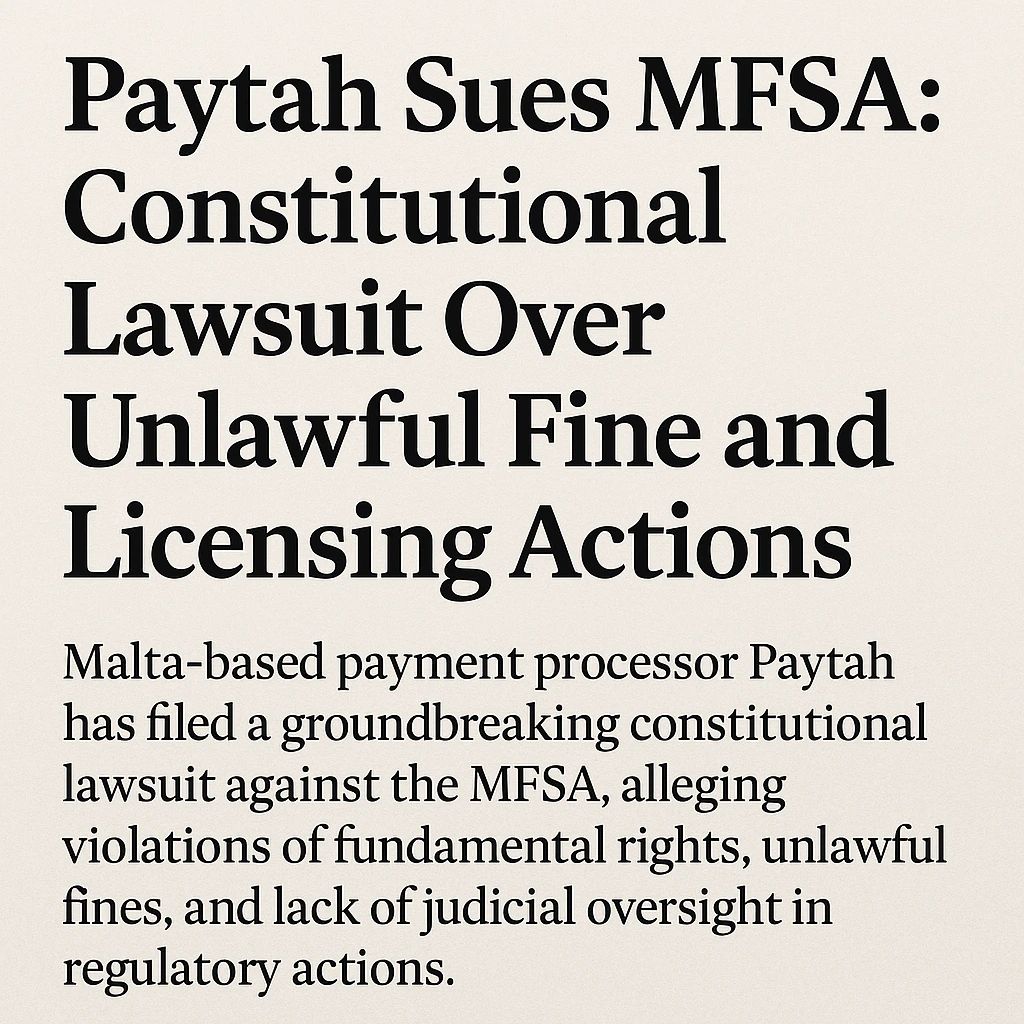
Malta continues to draw attention for its troubled regulatory environment, rivaling that of Cyprus. In a remarkable legal development, Phoenix Payments Ltd—operating under the Paytah brand—has filed a constitutional lawsuit against the Malta Financial Services Authority (MFSA), its own financial regulator. The complaint accuses MFSA of overstepping its legal boundaries by acting as “judge, jury, and executioner.”
The lawsuit was prompted by MFSA’s imposition of a €32,400 administrative penalty on Paytah, along with restrictions on the company’s operating license. Instead of pursuing the matter through conventional civil channels, Paytah escalated the case to Malta’s Constitutional Court—a move believed to be unprecedented in the jurisdiction. The payment processor is also seeking monetary damages from the authority.
Case Background: Paytah Under Scrutiny
The Scam-Or Project has previously highlighted Paytah’s involvement in facilitating fraudulent schemes. According to multiple reports, the payment provider served clients allegedly engaged in scams without carrying out sufficient KYC (Know Your Customer) or AML (Anti-Money Laundering) due diligence. As a result, numerous individuals reportedly lost significant amounts of money.
Adding weight to these allegations, former Chief Compliance Officer Daniela Pesci—a citizen of Italy—submitted formal complaints to the authorities, indicating serious concerns about potential money laundering. From an evidentiary standpoint, these disclosures appeared strong enough to warrant suspension of Paytah’s license. However, the MFSA’s handling of the situation raised questions about its adherence to due process and legality.
MFSA’s Senior Figures Implicated
Among those informed of the allegations are MFSA officials Edward Grech and Michelle Mizzi Buontempo. Despite their awareness of the situation, the regulator is accused of ignoring the plight of victims and failing to address the issues publicly. Instead of reinforcing trust, the authority finds itself repeatedly embroiled in controversy.
Constitutional and Human Rights Arguments
Violation of Article 39 – Constitution of Malta
The core of Paytah’s argument rests on Article 39 of the Maltese Constitution, which states that only a court led by a judge or magistrate has the authority to impose penalties of a criminal nature. A 2016 decision by Malta’s Constitutional Court reinforced this principle, ruling that criminal-like sanctions must be adjudicated by courts, not administrative bodies.
Article 6 – European Convention on Human Rights
Paytah has also invoked Article 6 of the European Convention on Human Rights. This provision guarantees individuals a fair and public hearing within a reasonable timeframe by an independent and impartial tribunal. Paytah argues that MFSA’s procedures fall short of these standards.
Key Legal Points Raised:
|
Legal Provision |
Alleged Violation |
|
Article 39 – Constitution of Malta |
Only courts can impose criminal penalties |
|
Article 6 – ECHR |
No independent and impartial tribunal at MFSA |
|
2016 Constitutional Court Ruling |
All criminal-like cases must go through full court process |
The first constitutional hearing in the Paytah vs. MFSA case was scheduled for May 26, 2021. Scam-Or Project has reportedly obtained related legal documents, extracts of which have been referenced in their coverage.
MFSA’s Structural Problems Exposed Again
Leadership Scandal: From Cuschieri to Buttigieg
The MFSA’s credibility was further shaken when former CEO Joseph Cuschieri resigned after it was revealed that he had accompanied Yorgen Fenech—the alleged mastermind behind the assassination of journalist Daphne Caruana Galizia—on a trip to Las Vegas. Following Cuschieri’s departure, Dr. Christopher Buttigieg assumed interim leadership. Notably, Buttigieg was a major proponent of Malta’s “Blockchain Island” initiative, which has since been shelved and criticized as a failure.
Opaque Processes and Conflicts of Interest
Critics argue that MFSA continues to operate without transparency:
-
Penalties are imposed in closed-door meetings
-
No oversight from actual judges or magistrates
-
Key figures with questionable track records remain in power
One such figure is Edwina Licari, the former general counsel who now sits on MFSA’s executive committee. She is viewed by many as emblematic of the regulator’s lack of independence and accountability.
This concentration of investigative, prosecutorial, and adjudicative power within a single authority has drawn parallels to a quasi-judicial system, where MFSA plays all roles—potentially violating both national and European legal standards.
Conclusion
Paytah’s legal offensive against the MFSA not only represents a significant pushback from a regulated entity but also exposes deeper issues within Malta’s regulatory architecture. Whether the courts will uphold Paytah’s constitutional and human rights claims remains to be seen. What’s certain, however, is that MFSA’s ongoing controversies continue to erode public trust in Malta’s financial oversight system.