
Bankera Founders Built Luxury Property Holdings While Investors Watched Their Tokens Collapse


How Millions Raised Through the Bankera ICO Were Allegedly Redirected Into Real Estate and Insider Lending
Key Findings
- The Bankera cryptocurrency project attracted significant investor interest during its Initial Coin Offering (ICO), raising more than €100 million, but the BNK token later lost almost all of its value.
- More than €45 million was transferred from a Lithuanian company connected to the project into accounts at Pacific Private Bank (PPB) in Vanuatu.
- PPB had been acquired by Bankera co-founders shortly before the ICO concluded.
- Internal banking records indicate that funds linked to the ICO were later used to support loans issued to companies owned by the founders.
- Those companies subsequently acquired luxury assets, including premium real estate in Lithuania and a villa on the French Riviera.
- Additional loans worth millions of euros were granted directly to the founders, often designated for personal purposes.
- Representatives of Bankera-related entities denied any fraudulent activity but declined to address many of the specific transactions examined during the investigation.
From Crypto Success Story to Investor Disappointment
At the peak of the cryptocurrency boom in early 2018, Lithuanian fintech startup Bankera appeared to be one of Europe’s most promising blockchain ventures.
The company announced that it had secured more than €100 million in just six months through the sale of its proprietary cryptocurrency token, BNK. The ambitious project promised to create what it described as a “bank for the blockchain era” — a financial institution capable of combining traditional banking services with cryptocurrency operations.
More than 100,000 investors participated in the token sale. Purchasers were attracted not only by the prospect of token appreciation but also by a revenue-sharing model that promised weekly payouts generated from platform transaction fees.
At the time, Bankera was frequently cited as one of the most successful ICO projects emerging from Lithuania’s rapidly growing fintech sector.
Seven years later, however, the outcome looks dramatically different.
The BNK token has lost nearly all of its market value, investor rewards have disappeared, and one of the project’s central promises — obtaining a European Union banking license — remains unfulfilled.
An investigation by Scam-Or Project uncovered evidence suggesting that substantial amounts of money linked to the ICO were ultimately used to finance loans benefiting the project’s founders and their affiliated companies.
Leaked banking documents, corporate records, and financial statements indicate that part of the money raised from investors may have been redirected into a growing portfolio of luxury real estate through a Vanuatu-based bank controlled by the same individuals behind the cryptocurrency venture.
More Than €45 Million Moved Through a Founder-Controlled Bank
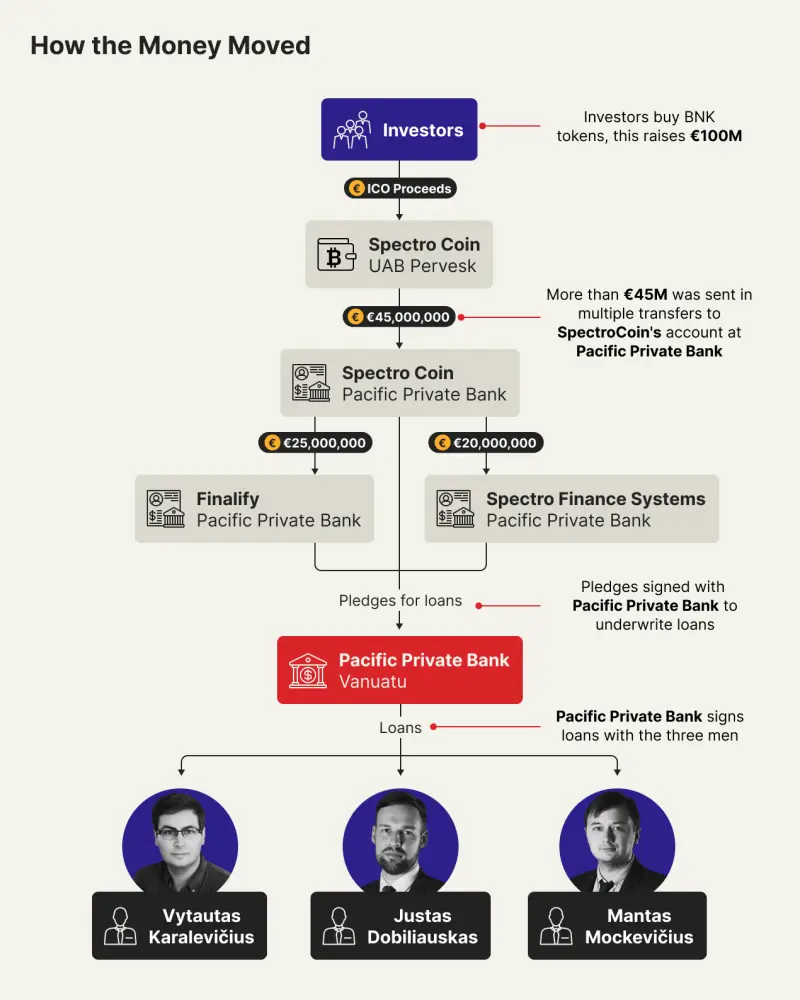
Records reviewed during the investigation show that during the four years following the ICO, over €45 million was transferred from a Lithuanian company associated with Bankera’s founders into accounts held at Pacific Private Bank (PPB) in Vanuatu.
The significance of these transfers lies in the ownership structure.
The bank receiving the funds had been acquired shortly before the ICO concluded by Bankera co-founders:
- Vytautas Karalevičius
- Justas Dobiliauskas
- Mantas Mockevičius
According to leaked banking materials, funds arriving at PPB were subsequently used as collateral or funding sources for loans granted to companies controlled by the same founders.
Those companies then proceeded to purchase high-value assets, including:
| Asset Type | Location |
|---|---|
| Luxury Villa | Èze, French Riviera |
| Residential Properties | Vilnius, Lithuania |
| Additional Real Estate Holdings | Lithuania and Vanuatu |
Investigators also identified numerous loans issued directly to the founders themselves. Many of these transactions were labeled for “personal use,” while others were described as investments.
The loans were frequently backed by entities that played central roles in the ICO process and controlled significant portions of the funds raised from investors.
Experts Raise Questions About Investor Funds
Financial crime specialists interviewed for the investigation expressed concern regarding the apparent use of ICO proceeds.
Kathryn Westmore, who leads financial crime policy work at the Royal United Services Institute (RUSI), said investor funds raised during a token offering are generally expected to be used exclusively for the purposes described in project documentation.
According to Westmore, using those funds in ways that appear to benefit project insiders could raise serious concerns.
She noted that if investors were led to believe funds would be dedicated to building a banking platform while substantial amounts were instead used to finance personal or affiliated business activities, questions naturally arise regarding whether investors received an accurate representation of how their money would be utilized.
The issue, she suggested, is fundamentally tied to whether the stated objectives of the ICO matched the actual deployment of the capital raised.
Attempts to Obtain Responses From the Founders
Scam-Or Project repeatedly sought comments from Bankera’s founders.
Requests were sent directly to:
- Vytautas Karalevičius
- Justas Dobiliauskas
- Mantas Mockevičius
Scam-Or Project contacted through affiliated companies and even traveled to industry events, including a conference in Malta, in an effort to obtain responses.
The only detailed reply came from lawyers representing Bankera UAB, one of several companies operating within what they described as the broader “Bankera ecosystem.”
The legal representatives declined to answer questions concerning specific transactions identified in the leaked banking documents.
However, they rejected allegations of fraud and maintained that the ICO funds were used to support the development of blockchain-based financial infrastructure.
Understanding the “Bankera Ecosystem”
During the course of the investigation, Scam-Or Project identified a network of interconnected entities involved in different aspects of the Bankera project.
These companies participated in:
- Issuing the BNK token
- Processing investor payments
- Operating cryptocurrency services
- Receiving and transferring ICO proceeds
- Managing banking and financial activities
The structure stretched across multiple jurisdictions, making it difficult to trace the movement of funds.
Among the key entities were:
| Company | Jurisdiction | Function |
|---|---|---|
| Bankera UAB | Lithuania | IT and support services |
| Pervesk UAB | Lithuania | Electronic money institution |
| Spectro Finance UAB | Lithuania | Cryptocurrency exchange operations |
| Finalify Ltd. | British Virgin Islands | BNK token issuer |
| Pacific Private Bank (PPB) | Vanuatu | Banking operations |
Lawyers representing Bankera UAB acknowledged that Karalevičius, Dobiliauskas, and Mockevičius were founders and majority owners of the wider Bankera ecosystem.
They emphasized, however, that ownership interests varied across different entities and that none of the founders necessarily held equal stakes in every company.
The lawyers further argued that the acquisition of Pacific Private Bank demonstrated that ICO funds were being deployed to build a blockchain-focused financial institution rather than being diverted for improper purposes.
They also stated that transferring money into PPB accounts had always formed part of the project’s broader strategic plans.
At the same time, they acknowledged that the BNK token had experienced a significant decline in value over time.
Despite this, they maintained that the Bankera brand remained successful and categorically denied that the ICO had been fraudulent.
The Men Behind Bankera
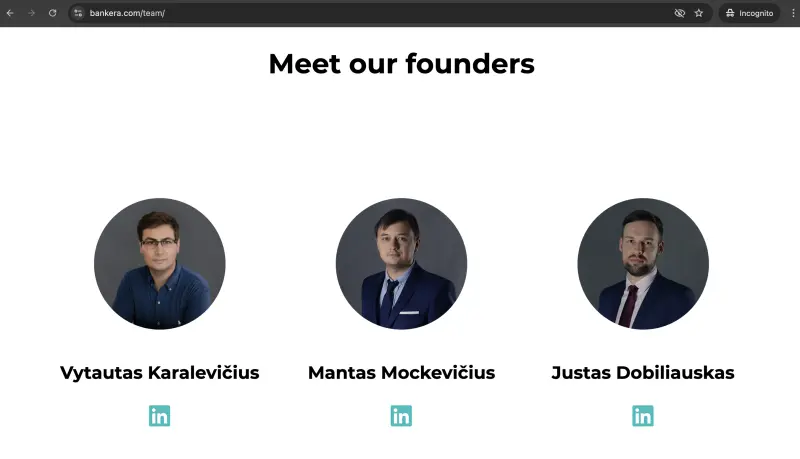
The three principal figures behind Bankera all originate from Šiauliai, a city in northern Lithuania with a population of approximately 120,000.
Vytautas Karalevičius
Karalevičius comes from a family involved in both healthcare and politics. His father worked in public health administration, while his mother was a plastic surgeon who later entered political life.
Justas Dobiliauskas
Dobiliauskas is the son of a public prosecutor and a senior banking executive.
Mantas Mockevičius
Mockevičius comes from a legal background. His father served as a civil court judge, while his mother worked within the education system.
All three were still in their twenties when they launched the BNK token sale in August 2017.
Another early participant, Ugnius Šimelionis, had initially co-founded several companies associated with the project. However, shortly before the ICO launched, he sold his ownership interests to the three remaining founders.
Šimelionis later stated that differences regarding the long-term strategic direction of the business led to his departure and that he played no role in the ICO itself.
Building the Bankera Narrative
The Companies Behind the ICO
By the time the BNK token sale launched, Bankera’s founders had already established several digital finance businesses serving a large international customer base.
According to Bankera’s 2017 white paper, three entities played particularly important roles in the ICO structure:
| Company | Jurisdiction | Role |
|---|---|---|
| Pervesk UAB | Lithuania | Payment processing and e-money services |
| Spectro Finance UAB | Lithuania | Cryptocurrency exchange operations |
| Finalify Ltd. | British Virgin Islands | BNK token issuer |
Finalify was responsible for issuing the BNK tokens, while Spectro Finance operated the exchange infrastructure through which investors could purchase them.
The ecosystem also included SpectroCoin, a cryptocurrency wallet service controlled by Spectro Finance.
Anyone wishing to participate in the ICO first had to create a SpectroCoin wallet. Investors then transferred funds to accounts operated by Pervesk, which handled payment processing for the offering.
Documents reviewed during the investigation show that investors were able to purchase BNK using either traditional currencies or cryptocurrencies.
Marketing the BNK Token
Bankera promoted BNK as more than a simple cryptocurrency.
As part of its promotional campaign, Bankera published video presentations explaining its vision of becoming a blockchain-focused financial institution and encouraging participation in the BNK token sale.
The project’s white paper compared ownership of the token to holding shares in a publicly traded company, emphasizing that tokens could later be bought and sold on the market.
Lawyers representing Bankera UAB later disputed this characterization and stated that the ICO should not be viewed as a form of equity fundraising.
Nevertheless, investors were offered several incentives.
Promised Benefits for Token Holders
Bankera stated that BNK holders would receive:
- Discounts on future Bankera products and services.
- Access to a growing blockchain banking ecosystem.
- Weekly revenue-sharing distributions.
The weekly payout mechanism became one of the project’s most heavily promoted features.
Under the model described by Bankera, transaction fees generated by the platform would be collected each week. After deducting operating expenses, 20 percent of the remaining revenue would be distributed among BNK holders in proportion to their holdings.
For many investors, this recurring income opportunity became a major selling point.
A Powerful Advisory Board
The project gained additional credibility through the involvement of prominent figures from politics, finance, taxation, and blockchain technology.
According to promotional materials, the ICO advisory board included former regulators, bankers, entrepreneurs, and politicians.
The presence of such well-known names helped create an image of legitimacy and professionalism during a period when many cryptocurrency projects lacked experienced leadership.
Promotional interviews and public appearances featuring project representatives and advisers were widely distributed through online video platforms to strengthen investor confidence.
At the time, several advisers publicly praised the venture.
Years later, however, some of those same individuals would distance themselves from the project.
The Bankera Advisory Board
The advisory panel reportedly consisted of ten high-profile figures.
Several advisers later told Scam-Or Project that their involvement had been minimal and that they had little influence over the project itself.
Antanas Guoga
Former Member of the European Parliament, businessman, and professional poker player.
Guoga served as an adviser until March 2018.
When contacted during the investigation, he stated that he departed after disagreements emerged between him and the founders regarding the project’s direction.
Audrius Žiugžda
Former CEO of SEB and former senior executive at Šiaulių Bankas.
Žiugžda said he was rarely consulted by the project.
According to him:
“They never really needed my advice. They simply used my name.”
Modestas Kaseliauskas
Former head of Lithuania’s State Tax Inspectorate.
Kaseliauskas left the advisory board after the ICO concluded.
He later joined the International Monetary Fund and stated that he had not participated in the project’s implementation phase.
Marc Kenigsberg
Founder of a cryptocurrency-focused media platform and advisor to several blockchain ventures.
Kenigsberg explained that he left after concluding that Bankera was moving in a more traditional financial direction than originally anticipated.
Lon Wong
Blockchain entrepreneur and technology developer.
Wong said he had virtually no ongoing involvement.
According to him, the founders rarely sought his advice and communication eventually ceased entirely.
Investor Demand Appeared Extraordinary
During the ICO, Bankera frequently highlighted strong demand for its token.
In August 2017, the company even encouraged potential investors to reduce the size of their purchases so that more participants could acquire BNK (Bitcointalk).
A month later, Bankera announced that it had reached its initial fundraising target of €25 million ahead of schedule.
By February 2018, the project claimed total fundraising of approximately €100 million.
At the height of cryptocurrency enthusiasm, such figures attracted significant international attention.
Why Investors Bought In
For many participants, the weekly revenue-sharing program proved more attractive than speculative gains.
Video presentations explaining the revenue-sharing mechanism and the broader Bankera ecosystem were frequently referenced by prospective investors evaluating the project during the ICO period.
German financial adviser Andreas Horb was among those convinced by the concept.
Horb invested approximately €2,000 in BNK and later told Scam-Or Project that the recurring distributions were one of the main reasons he purchased the token.
At the time, the model appeared to offer a blend of cryptocurrency exposure and passive income.
Thousands of investors shared a similar perspective.
The Collapse of BNK
The optimism did not last.
Years after the ICO, BNK’s market capitalization had fallen dramatically.
Data from the Ethereum blockchain shows that the total value of all issued BNK tokens eventually declined to roughly $1 million.
As the token’s value deteriorated, revenue-sharing payments also began shrinking.
By 2022, the weekly distribution program was discontinued entirely.
For many investors, the warning signs appeared much earlier.
According to Horb:
“Things started changing in 2018, only months after the ICO. The payouts became far lower than what investors had expected.”
Lawyers representing Bankera UAB argued that many purchasers were speculators hoping to profit from rapid price appreciation and that the departure of those investors contributed to the token’s decline.
Investors interviewed during the investigation disagreed with that assessment.
Several claimed that communication with the project’s leadership gradually deteriorated as complaints increased.
Growing Frustration Among Investors
Horb said that he and other investors initially maintained regular communication with Bankera representatives.
Over time, however, responses reportedly became increasingly infrequent.
Eventually, many investors felt they were no longer receiving meaningful answers to questions regarding falling payouts and declining token value.
Another investor, British telecommunications engineer Ryan Woodhouse, said he invested approximately £4,000 in BNK.
He recalled being impressed by the project’s vision and long-term ambitions.
However, according to Woodhouse, confidence quickly faded once weekly revenue distributions stopped and the token lost most of its value.
Experts Warn About the ICO Boom
Financial crime specialists interviewed during the investigation emphasized that the Bankera case unfolded during one of the most speculative periods in cryptocurrency history.
Ray Blake
A financial crime expert and researcher focused on illicit finance.
Blake described the ICO market of 2017–2018 as highly speculative and often driven by investor optimism rather than rigorous due diligence.
Kathryn Westmore
The RUSI specialist characterized the ICO frenzy as one of the least regulated periods in crypto finance.
According to her, investors who suffer losses frequently encounter significant obstacles when attempting to recover funds because many projects operated in jurisdictions with limited oversight.
Early Complaints Begin to Surface
The Bank of Lithuania later confirmed that it received several complaints regarding the Bankera ICO.
However, because Finalify — the company that issued the BNK tokens — was incorporated in the British Virgin Islands, complainants were directed toward supervisory authorities in that jurisdiction.
As investor dissatisfaction grew, another major development was unfolding behind the scenes.
While raising tens of millions from cryptocurrency buyers, Bankera’s founders were simultaneously pursuing the acquisition of a bank located more than 15,000 kilometers away in the Pacific Ocean.
That bank was Pacific Private Bank (PPB) in Vanuatu.
Half a World Away: The Purchase of Pacific Private Bank
In January 2018, while the ICO was still underway, Vytautas Karalevičius, Justas Dobiliauskas, and Mantas Mockevičius finalized the acquisition of Pacific Private Bank Ltd. (PPB), a small private bank based in Vanuatu.
The purchase would later become one of the most important elements of the entire investigation.
According to public statements made at the time, acquiring PPB was intended to accelerate Bankera’s ambition of becoming a global blockchain-focused financial institution.
The founders described the transaction as a major step toward creating a fully integrated banking ecosystem for cryptocurrency users.
However, leaked records suggest that PPB would soon play a very different role.
Half a World Away: Following the Money to Vanuatu
A Pacific Bank Becomes Part of the Bankera Story
While investors were still purchasing BNK tokens and Bankera was promoting its vision of becoming a next-generation financial institution, the company’s founders were simultaneously expanding into traditional banking.
In January 2018, during the final phase of the ICO, Vytautas Karalevičius, Justas Dobiliauskas, and Mantas Mockevičius acquired Pacific Private Bank Ltd. (PPB), a small private bank headquartered in Vanuatu.
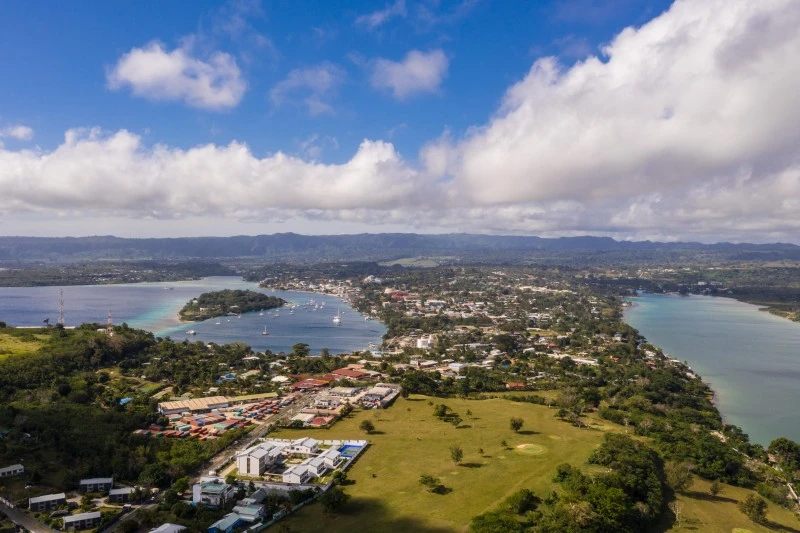
Vanuatu, an island nation in the Pacific Ocean with a population of roughly 300,000 people, has frequently attracted international scrutiny because of its offshore financial sector, tax advantages, and citizenship-by-investment programs.
PPB presented itself as an institution serving affluent international clients through private banking, wealth management, and tailored investment services.
The acquisition was publicly promoted as a strategic milestone.
Bankera’s founders claimed that owning a bank would accelerate their efforts to create what they called a “bank for the blockchain era” and help integrate traditional finance with cryptocurrency services.
The purchase price was never publicly disclosed.
Millions Begin Moving Into PPB
Only weeks after the acquisition was completed, substantial sums began flowing into accounts held at PPB.
Leaked banking records show that money started moving from Spectro Finance’s account at Pervesk—the same institution that had processed investor payments during the ICO—into accounts maintained by Spectro Finance at PPB.
The transfers occurred in multiple stages.
Major Transfers Identified
| Date | Amount |
|---|---|
| February 14, 2018 | €15 million |
| March–April 2018 | €2.8 million |
| Late 2018 | €12 million |
| August 2020 – September 2021 | Additional €15 million |
The total amount exceeded €45 million.
According to the bank records, the transfers were generally described simply as transfers between accounts controlled by the same entity.
No detailed explanations for the movements of funds appeared in the documentation reviewed during the investigation.
The Founders’ Explanation
Lawyers representing Bankera UAB acknowledged that money raised within the broader Bankera ecosystem had indeed been transferred into accounts at Pacific Private Bank.
However, they argued that no requirement existed to publicly disclose every use of funds generated during the ICO.
According to their position, the movement of money into PPB was consistent with the group’s long-term strategy of developing blockchain-based banking services.
The lawyers also maintained that grants and funding had been distributed among multiple companies within the Bankera ecosystem and that PPB played an important role in those plans.
Finalify Receives €25 Million
Another major transaction occurred in November 2019.
Banking records show that €25 million was transferred from Spectro Finance’s PPB account into a separate PPB account controlled by Finalify Ltd., the British Virgin Islands company responsible for issuing BNK tokens.
The transaction was particularly notable because it represented the first significant activity recorded in Finalify’s account.
Later, in April 2021, another major transfer followed.
This time, €20 million moved from Spectro Finance’s account into an account held by Spectro Finance Systems Ltd., a company established in the British Virgin Islands in 2019 by co-founder Mantas Mockevičius.
Three Accounts Become the Foundation for Lending
Investigators found that three entities ultimately became central to the lending structure:
| Entity | Jurisdiction |
|---|---|
| Spectro Finance | Lithuania |
| Finalify Ltd. | British Virgin Islands |
| Spectro Finance Systems Ltd. | British Virgin Islands |
Funds held in these accounts were repeatedly pledged as collateral supporting loans issued by PPB.
Those loans frequently benefited:
- Bankera’s founders personally;
- Companies owned by the founders;
- Real estate investment vehicles controlled by the founders.
As a result, money that had previously flowed through the ICO ecosystem became intertwined with an expanding network of loans and property acquisitions.
The French Riviera Villa
A Luxury Property Purchase Emerges
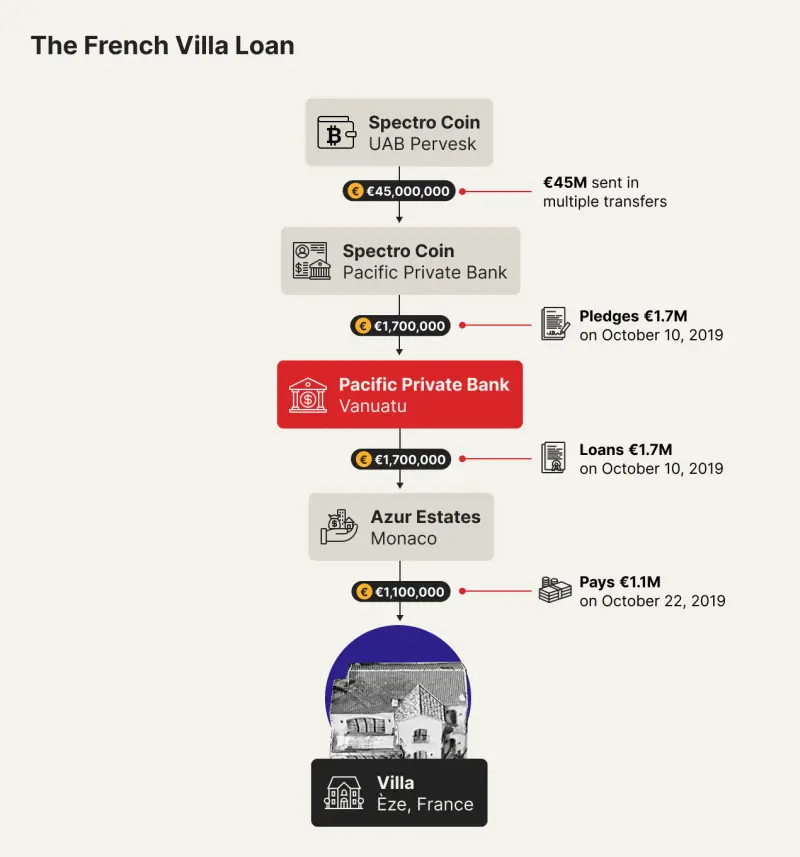
One of the clearest examples involved a company called Azur Estates (SCI).
The Monaco-based entity had been established by Vytautas Karalevičius and Mantas Mockevičius in August 2019.
On October 10, 2019, leaked bank records show that €1.7 million was withdrawn from Spectro Finance’s PPB account for what was described as business-related purposes.
On the very same day, PPB issued a loan for precisely €1.7 million to Azur Estates.
The funds were deposited into an account belonging to Azur at PPB.
At the time, that account reportedly had no prior activity.
The Route to France
The money moved quickly.
Timeline of the Transaction
| Date | Event |
|---|---|
| October 10, 2019 | PPB issues €1.7 million loan to Azur |
| October 22, 2019 | Azur transfers funds to Lithuania |
| October 28, 2019 | Property purchase completed in France |
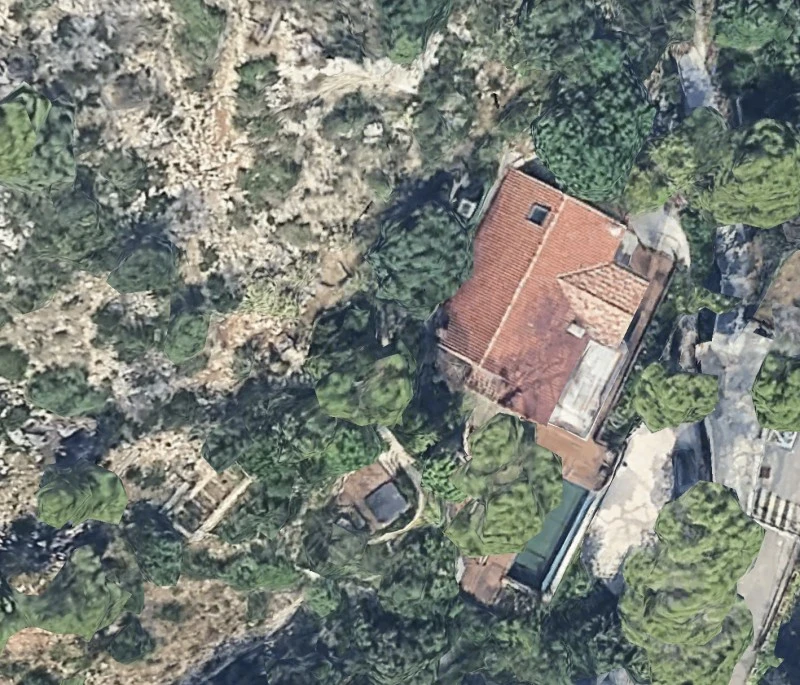
Only eighteen days after receiving the loan, Azur purchased a luxury villa in Èze, an exclusive coastal community located between Monaco and Nice on the French Riviera.
French property records reviewed during the investigation indicate that the company paid approximately €1.1 million for the property.
The acquisition was completed entirely using corporate funds.
What Is a Back-to-Back Loan?
The original loan matured roughly one year later.
Instead of repaying it with independent funds, Azur reportedly obtained a new loan from PPB and used those proceeds to settle the previous obligation.
Investigators found similar patterns elsewhere.
Several loans granted to founders and affiliated entities appeared to be refinanced through additional borrowing.
Financial crime experts noted that such arrangements are often described as back-to-back lending structures.
These structures can create extensive documentation showing that assets were purchased using formal bank loans rather than directly from company accounts.
Experts interviewed during the investigation explained that such documentation may help satisfy financial institutions that are required to verify the source of funds used in property transactions.
Experts Question the Structure
Alison Jimenez, President of Dynamic Securities Analytics, explained that banks receiving funds for major property purchases typically examine the source of the money.
A documented loan from a regulated institution can create an appearance that appropriate due diligence has already been performed.
Kathryn Westmore of RUSI also questioned the complexity of the arrangements.
According to her, the use of collateral provided by related entities can make transactions appear more independent than they actually are.
She suggested that opaque structures involving multiple interconnected companies naturally raise questions about transparency and the true source of funds.
Additional Loans for the Villa
Azur Estates did not stop at a single loan.
Bank statements indicate that between August 2021 and July 2022, PPB approved three additional loans totaling approximately €800,000.
These loans were reportedly backed by funds originating from the €25 million that Finalify had previously received from Spectro Finance.
Leaked pledge agreements show that Finalify agreed to deposit the full amount necessary to secure repayment of the loans.
In effect, money originating from companies connected to the ICO was being used as collateral to support financing for the French property structure.
No Detailed Responses From the Key Parties
Scam-Or Project submitted detailed questions to:
- Finalify Ltd.
- Spectro Finance
- Mantas Mockevičius
- Representatives of Azur Estates
No substantive responses were received before publication.
Lawyers representing Bankera UAB also declined to discuss the specific transactions connected to the French Riviera property.
However, they continued to reject allegations that the ICO or related activities involved fraud.
The Same Names Keep Appearing
As investigators continued reviewing documents, one individual repeatedly surfaced in transaction records, pledge agreements, and internal banking documents:
Eimantas Kazlauskas.
His role would become increasingly significant as the investigation moved beyond the French Riviera villa and deeper into the relationships linking PPB, Finalify, Rational Pacific Investments, and the founders themselves.
The next phase of the investigation would reveal how the same individuals appeared on multiple sides of major transactions—and how millions more euros were ultimately directed toward property acquisitions and personal lending.
One Man, Many Roles
The Recurring Presence of Eimantas Kazlauskas
As investigators analyzed the lending structures connected to Pacific Private Bank, one name appeared repeatedly across numerous transactions:
Eimantas Kazlauskas.
At various times, Kazlauskas acted in multiple capacities within organizations tied to the Bankera ecosystem, creating situations where he appeared on different sides of the same financial arrangements.
One example involved the loans issued to Azur Estates, the company that purchased the French Riviera villa.
For the first two loans granted to Azur, Kazlauskas signed pledge agreements on behalf of Pacific Private Bank in his capacity as managing director.
However, for a later loan, he signed documents on behalf of Finalify, acting through another entity called Rational Pacific Investments Ltd.
The ownership structure behind these companies further complicated the picture.
Rational Pacific Investments had acquired Finalify in March 2020, while Rational itself was owned by Pacific Private Bank.
As a result, multiple entities involved in the transactions were linked through overlapping ownership and management arrangements.
Signing Both Sides of the Deal
The overlap became even more striking in 2023.
Documents reviewed during the investigation showed a loan arrangement involving Mantas Mockevičius and Finalify.
To secure a €100,000 loan issued by PPB, a pledge agreement was executed involving Finalify.
According to the records, Kazlauskas signed the documentation in two different capacities:
- As Managing Director of Pacific Private Bank.
- As Director of Rational Pacific Investments, which represented Finalify.
This meant the same individual effectively appeared on both sides of the transaction.
While such arrangements are not automatically unlawful, experts note that they can raise governance concerns when transparency and independent oversight are limited.
Villa 25: A Luxury Property in Vanuatu
The investigation also uncovered transactions connected to another high-end asset.
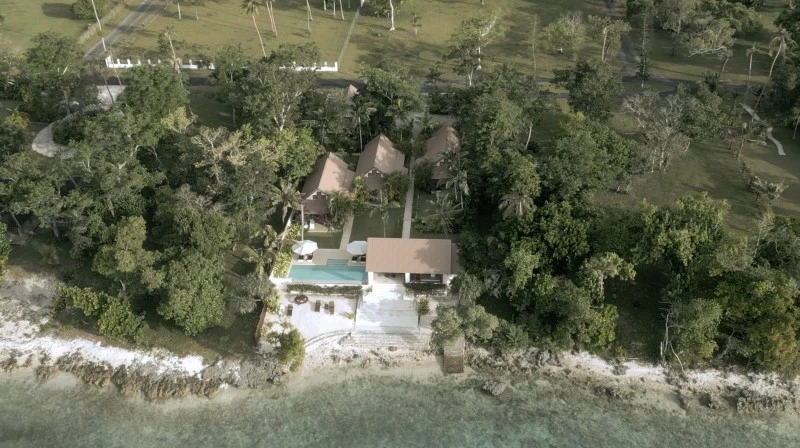
Shortly after the ICO concluded, Rational Pacific Investments Ltd., then owned by PPB, acquired a company known as Beachfront Properties.
That company owned Villa 25, an upscale waterfront property located near Port Vila, the capital of Vanuatu.
According to corporate records, Villa 25 featured:
- Private beachfront access.
- A swimming pool.
- Premium accommodation facilities.
- Luxury resort amenities.
The property marketed itself as offering exclusive seaside accommodation and could reportedly command nightly rates approaching $1,000 during peak seasons.
Payments for Property Maintenance
Leaked records showed that between 2018 and 2022, Rational Pacific Investments made several payments to Kazlauskas.
Descriptions attached to those payments referenced items such as:
- Kitchen equipment.
- Refrigeration components.
- Property maintenance supplies.
When contacted, Kazlauskas explained that he resided in one of the houses located within the Villa 25 complex and occasionally carried out maintenance work intended to preserve the property’s value.
He declined to discuss individual transactions in detail.
Direct Loans to the Founders
While some funds flowed into real estate companies, PPB also extended substantial loans directly to Bankera’s founders.
Investigators identified numerous transactions in which funds held by Finalify, Spectro Finance, or Spectro Finance Systems were pledged as collateral.
PPB then used those guarantees to issue loans directly to:
- Mantas Mockevičius
- Justas Dobiliauskas
- Vytautas Karalevičius
The pattern appeared repeatedly throughout the banking records.
The Eternity Ventures Foundation Connection
One notable example involved Mantas Mockevičius.
On December 15, 2020, bank records show that €360,000 from Finalify’s account was pledged as security.
On the same day, PPB issued a loan to Mockevičius for exactly the same amount.
Two days later, most of the money was transferred into an account belonging to Eternity Ventures Foundation, a Liechtenstein-based foundation.
Corporate records indicated that the foundation had been established by individuals connected to Bankera’s founders.
Internal documents also identified relatives of Karalevičius, Dobiliauskas, and Mockevičius among the beneficiaries.
Property Purchases in Vilnius
The transfer to Eternity was quickly followed by a real estate acquisition.
On December 18, 2020, the foundation used virtually the entire amount to purchase a parcel of land in the historic district of Vilnius, Lithuania’s capital.
A similar pattern emerged again less than a year later.
November 2021 Transaction
| Step | Amount |
|---|---|
| Finalify pledge | €300,000 |
| PPB loan to Mockevičius | €300,000 |
| Transfer to Eternity | €300,000 |
| Real estate acquisition | Approx. €290,000 |
Again, the money moved through multiple related entities before ultimately being used to acquire property.
A Growing Lithuanian Property Portfolio
Bank statements indicate that between mid-2019 and late 2021, Eternity Ventures Foundation received nearly €1.8 million from Mockevičius and Dobiliauskas.
During the same period, the foundation acquired multiple properties across Lithuania.
Eternity Property Activity
| Metric | Value |
|---|---|
| Funds received | Nearly €1.8 million |
| Properties acquired | 5 |
| Purchase value | More than €1.3 million |
The transactions added to a growing network of real estate holdings linked directly or indirectly to Bankera’s founders and affiliated entities.
Millions in Personal Loans
The most significant lending activity involved direct loans to the founders themselves.
Leaked banking statements indicate that between 2019 and 2023, PPB approved the following amounts:
| Founder | Loan Amount |
|---|---|
| Mantas Mockevičius | €5.4 million |
| Justas Dobiliauskas | €3 million |
| Vytautas Karalevičius | €5.2 million |
In total, the loans exceeded €13 million.
A large portion of these transactions carried descriptions explicitly indicating “personal use.”
According to the records:
- Approximately €4.2 million of the loans issued to Mockevičius and Dobiliauskas were classified as personal-use financing.
- Karalevičius’ loans were generally categorized as investment-related.
Most of these facilities were secured by funds held by:
- Finalify
- Spectro Finance
- Spectro Finance Systems
All three companies played central roles in the ICO ecosystem.
Questions About Investor Expectations
Financial crime experts interviewed during the investigation emphasized that the issue was not necessarily the existence of loans themselves.
Rather, the concern centered on the apparent relationship between:
- Funds raised from investors through the ICO.
- The entities holding those funds.
- The personal and corporate loans ultimately benefiting the founders.
The structure raised questions about whether investors fully understood how capital raised during the token offering would be deployed.
The transactions also highlighted the degree to which multiple companies within the Bankera ecosystem remained financially interconnected years after the ICO had concluded.
Tax Authorities Enter the Picture
While the property acquisitions and loan structures attracted attention, another issue would soon bring Bankera’s founders under scrutiny.
A dispute with Lithuanian tax authorities revealed that one of the founders had earned millions from activities connected to the ICO before the token sale had even officially begun.
Court records would later expose a series of transactions involving Bitcoin, marketing contracts, and multimillion-euro gains that ultimately led to tax penalties for all three founders.
Tax Authorities Challenge the Founders
Millions Earned Before the ICO Officially Began
While investigators were tracing loans and real estate acquisitions, another controversy emerged from court records in Lithuania.
In 2021, a tax dispute revealed that Mantas Mockevičius had received a substantial cryptocurrency payment connected to the Bankera project before the ICO officially launched.
According to a ruling by Lithuania’s Supreme Administrative Court, Mockevičius signed an agreement with Finalify Ltd. in August 2017.
Under the contract, he agreed to provide advertising and marketing services related to the upcoming Bankera token offering.
The unusual aspect of the arrangement was that Mockevičius signed the agreement on behalf of both parties.
At the time, he acted as a representative of Finalify while simultaneously serving as the individual receiving compensation.
The 750 Bitcoin Payment
Under the agreement, Mockevičius received 750 Bitcoin.
At the time of payment, the cryptocurrency was valued at more than €2.5 million.
However, the cryptocurrency market was experiencing explosive growth.
When Mockevičius later sold the Bitcoin, its value had increased dramatically.
According to court documents, the proceeds eventually reached approximately €6 million.
The case became one of the most significant tax disputes involving a Bankera founder.
A Monaco Apartment Purchase
Lithuanian tax authorities determined that part of the Bitcoin proceeds was used to acquire luxury real estate.
Court records indicate that Mockevičius purchased an apartment in Monaco valued at approximately €3 million.
The acquisition became one of the transactions examined during the tax proceedings.
Authorities concluded that income generated from the Bitcoin sale had been incorrectly classified for tax purposes.
As a result, Mockevičius was found to have underpaid personal income taxes.
Financial Penalties Imposed
The investigation eventually led to financial penalties against all three Bankera founders.
Tax Fines
| Founder | Fine |
|---|---|
| Mantas Mockevičius | More than €32,000 |
| Vytautas Karalevičius | Approx. €38,000 |
| Justas Dobiliauskas | Approx. €36,000 |
Although the court records primarily focused on Mockevičius’ Bitcoin transactions, the other founders also received tax penalties.
Lithuania’s State Tax Inspectorate later confirmed that all fines had been paid.
The founders did not respond to requests for comment regarding the tax proceedings.
Continued Prominence Despite Controversy
Despite years of criticism and investor complaints, the founders have remained visible figures within Lithuania’s fintech and cryptocurrency sectors.
Karalevičius, Dobiliauskas, and Mockevičius have continued appearing at industry conferences and technology events both domestically and internationally.
At the same time, many of the businesses associated with the Bankera ecosystem remain operational.
Bankera Remains Active
Although the BNK token has lost the vast majority of its value, the broader business structure surrounding Bankera continues to operate.
The Bankera website remains online and continues promoting financial services for individuals and businesses.
One of the original goals of the project—obtaining a full European Union banking license—has still not been achieved.
Lawyers representing Bankera UAB argued that funds raised through the ICO helped support the development of licensed financial operations within Europe.
They specifically pointed to regulatory authorizations obtained by companies within the Bankera ecosystem.
Pervesk Continues Operating
One of the most important companies connected to the ICO remains active today.
According to company disclosures, Pervesk UAB processed nearly €2.5 billion in transactions during 2023 and generated approximately €4.8 million in revenue.
The company continues to operate as an electronic money institution.
Meanwhile, Spectro Finance has also expanded its customer base.
The cryptocurrency platform that once claimed to serve around 300,000 users during the ICO now reports more than one million registered customers.
Regulatory Action by the Bank of Lithuania
Bankera-related entities have also faced regulatory scrutiny.
In 2018, the Bank of Lithuania imposed significant penalties on Pervesk for violations of Lithuanian banking regulations.
Initial Regulatory Penalties
| Entity | Penalty |
|---|---|
| Pervesk UAB | €700,000 |
| Vytautas Karalevičius | €500,000 |
In addition to the fines, restrictions were imposed on the company’s payment operations.
Pervesk was temporarily prohibited from conducting certain payment activities.
Restrictions Later Removed
The situation changed during the following year.
In January 2019, the Bank of Lithuania lifted the restrictions after concluding that Pervesk had taken corrective measures.
According to regulators, the company:
- Provided additional information requested by supervisors.
- Improved customer and business relationship monitoring.
- Addressed compliance deficiencies identified during inspections.
A later settlement further altered the outcome.
A Confidential Settlement
Two years after the original enforcement action, a settlement agreement was reached between Pervesk and the Bank of Lithuania.
Under the agreement:
| Measure | Outcome |
|---|---|
| Fine against Pervesk | Reduced from €700,000 to €244,000 |
| Fine against Karalevičius | Cancelled |
The specific details of the settlement remain confidential and have never been publicly disclosed.
As a result, questions remain regarding the circumstances that led to the reduction of the penalties.
Growing Scrutiny, Limited Consequences
The Bankera case highlights the challenges regulators face when dealing with cross-border cryptocurrency ventures operating through complex international corporate structures.
The investigation uncovered a network that stretched across:
- Lithuania
- British Virgin Islands
- Vanuatu
- Monaco
- France
- Liechtenstein
Within that structure, investigators identified:
- More than €45 million transferred through Pacific Private Bank.
- Millions of euros in loans backed by entities connected to ICO proceeds.
- Luxury real estate acquisitions in multiple jurisdictions.
- Significant personal lending to project founders.
- Tax penalties involving multimillion-euro cryptocurrency gains.
Yet despite years of investor complaints and regulatory attention, most companies within the Bankera ecosystem remain active.
Conclusion
What began as one of Lithuania’s most celebrated cryptocurrency projects ultimately left many investors disappointed.
The BNK token, once promoted as a cornerstone of a future blockchain banking empire, lost almost all of its market value. Revenue-sharing payments that attracted thousands of investors gradually declined before disappearing entirely.
Meanwhile, leaked banking records reviewed by Scam-Or Project revealed a parallel story involving offshore banking structures, interconnected companies, multimillion-euro loans, and luxury property acquisitions linked to the project’s founders.
Representatives of Bankera-related entities continue to reject allegations of fraud and maintain that funds raised during the ICO were used to support the development of innovative financial services.
However, the investigation leaves a number of unresolved questions regarding how investor money was ultimately deployed and whether the reality matched the expectations presented during one of Europe’s most successful cryptocurrency fundraising campaigns.
More than seven years after the ICO, those questions remain largely unanswered.