
Cyprus Payment Agents Under Scrutiny: How Norvelic and Nominee Directors Enable Offshore Anjouan Casinos to Access EU Banking Rails

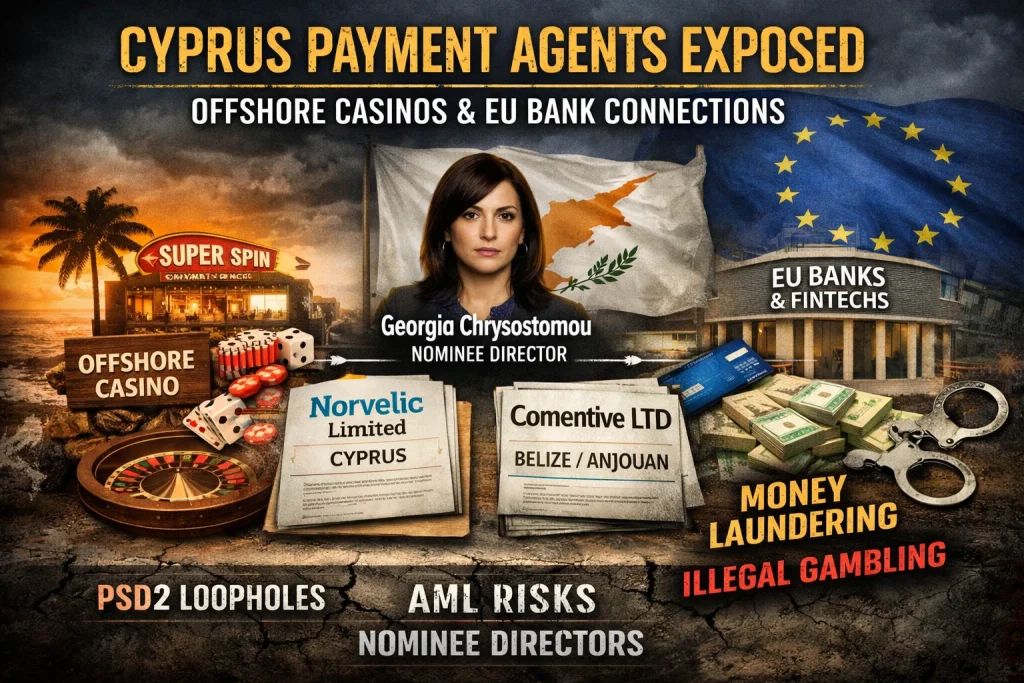
Unlicensed offshore casinos are increasingly operating through Cyprus-based “payment agents” that act as intermediaries between players, loosely regulated operators in jurisdictions such as Anjouan or Curaçao, and EU-regulated financial institutions.
In the case of Super Spin and Rolly Spin, allegedly operated by Comentive LTD in Belize under an Anjouan license, the Cyprus entity Norvelic Limited — formally represented by nominee director Georgia Chrysostomou — serves as the EU payment layer. This setup highlights a structurally high-risk model that challenges both PSD2 boundaries and EU AML enforcement.
Key Findings
- Offshore casinos such as Super Spin and Rolly Spin rely on Norvelic Limited (HE 475930, Nicosia) as a Cyprus-based payment intermediary for Comentive LTD.
- Cyprus corporate service providers actively promote Cyprus Payment Processing Agent Companies (CPPAC) as unlicensed bridges between offshore gambling operators and EU banks or PSPs.
- These agents are intentionally placed within the payment chain to ensure that EU institutions contract with an EU entity rather than directly with offshore casinos.
- When structured as wholly owned group entities, these payment agents may claim exemption from PSD2 licensing — but they remain fully subject to EU and Cypriot AML/CTF frameworks.
- If the underlying casino operates illegally in target jurisdictions, both the Cyprus entity and its nominee directors face exposure to facilitating illegal gambling and money laundering.
- Nominee directors such as Georgia Chrysostomou may incur personal liability if they knowingly (or negligently) support structures that misrepresent the true nature of the business to banks or EMIs.
Compliance Analysis
Why Offshore Operators Use Cyprus Payment Agents
Cyprus payment agent structures are marketed as a gateway for offshore casinos to gain access to EU financial infrastructure that would otherwise be unavailable to them.
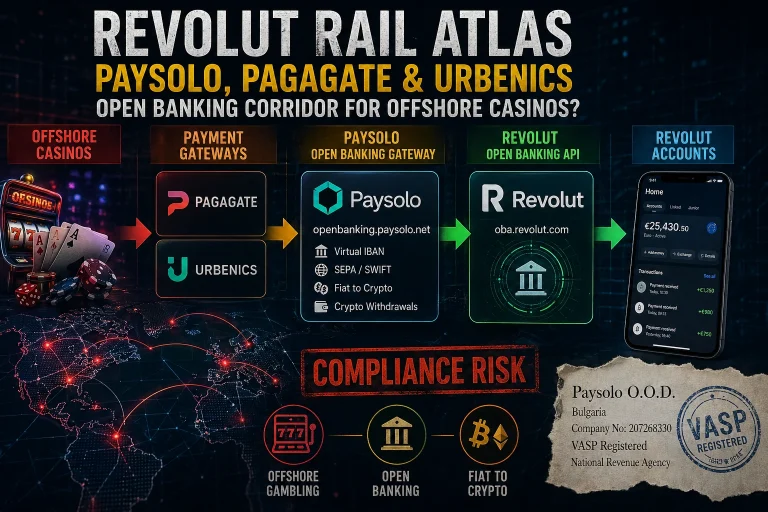
Banks and fintech companies — including card acquirers and platforms like Revolut — typically refuse to onboard entities registered in Belize or operating under weak licenses such as Anjouan. However, they may accept an EU-incorporated company with:
- A clean corporate registry profile
- A neutral business description (e.g. “IT services” or “payment processing”)
Law firms openly outline a standard architecture:
| Layer | Function |
|---|---|
| Offshore Operator (e.g. Comentive LTD) | Runs the casino and holds a low-cost license |
| Cyprus PPA / CPPAC (e.g. Norvelic Limited) | Handles player deposits and withdrawals within the EU |
| EU Banks / PSPs | Provide accounts and payment infrastructure to the Cyprus entity |
This structure effectively inserts a buffer layer into the payment flow, reducing perceived risk while exploiting regulatory grey zones within PSD2.
PSD2 Positioning: The “Intragroup” Argument
Cyprus advisors frequently refer to Article 3(3)(n) of PSD2, which exempts certain intragroup payment activities from licensing requirements.
Under this interpretation:
- A Cyprus payment agent processing funds exclusively for its parent or affiliated company may argue that it does not require authorization as a payment institution.
- This argument is commonly used to justify the operation of CPPAC structures without Central Bank of Cyprus licensing.
However, this does not eliminate regulatory obligations.
Key Reality Checks:
- AML/CTF compliance remains mandatory under both EU and Cypriot law.
- Banks and EMIs still impose strict KYC, transaction monitoring, and reporting requirements.
- Gambling-related businesses are categorized as high-risk and require enhanced due diligence.
When the Cyprus entity exists primarily to channel EU player funds to an offshore casino lacking proper authorization, the structure moves beyond efficiency and into potential facilitation of illegal activity.
EU-Wide Risks of Cyprus Payment Agents
Where Cyprus-based intermediaries such as Norvelic Limited support casinos that are unlicensed in EU jurisdictions, several risks arise:
-
Participation in illegal gambling payments
Similar to enforcement approaches like Germany’s payment-blocking regime under GlüStV 2021. -
Violation of AMLD obligations
Including enhanced due diligence for high-risk sectors and third countries. -
Cross-border enforcement exposure
Including civil recovery claims by players and criminal investigations by authorities.
The use of nominee directors and shared service-provider addresses does not mitigate these risks. On the contrary, such elements often serve as indicators of deliberate opacity within the payment structure.
The Role and Liability of Nominee Directors
Nominee directors — including Georgia Chrysostomou — are often positioned as formal representatives of Cyprus entities like Norvelic Limited. However, their legal responsibilities are substantive, not symbolic.
Under Cypriot law:
- Directors must exercise proper oversight and act in good faith.
- Signing off on structures that process funds for unlicensed or illegal casinos may constitute involvement in criminal activity or money laundering.
Potential Risks for Nominee Directors:
- Civil liability for misrepresentation or negligence
- Criminal exposure for aiding and abetting illegal gambling or fraud
- Regulatory violations tied to AML and financial misreporting
If directors are involved in onboarding processes or documentation that misrepresents the business (e.g. omitting gambling exposure), their personal risk increases significantly.
Repeated involvement in similar high-risk structures further weakens any claim of ignorance.
Summary Compliance Hypothesis
Cyprus-based payment agents such as Norvelic Limited appear to play a central role in a broader regulatory arbitrage strategy:
- Offshore operators obtain low-cost licenses in jurisdictions like Anjouan.
- A Cyprus entity is established as an intragroup payment processor.
- This entity secures access to EU banking and payment systems.
- The structure obscures the true nature and legality of the underlying gambling operations.
From a compliance standpoint, these arrangements should be classified as high-risk conduits with direct exposure to AML violations and illegal gambling enforcement across the EU.
Call to Whistleblowers and Players
Scam-Or Project continues to map the ecosystem of Cyprus payment agents, nominee directors, and offshore casino networks, including entities such as Comentive LTD, Norvelic Limited, Super Spin, and Rolly Spin.
Individuals with insider knowledge — including:
- Employees of Cyprus law firms and corporate service providers
- Banking and EMI professionals
- Payment agent staff
- Affected players
are encouraged to submit information via the Scam-Or Project website.
Relevant materials may include:
- Onboarding documentation
- Contracts and agreements
- Bank representations
- Internal compliance or risk assessments
All submissions are handled confidentially and may contribute to regulatory and legal action aimed at dismantling high-risk payment infrastructures affecting EU consumers.