
Landmark French Ruling Holds Payment Processors Liable for Broker Scams: A Blueprint for EU Victims?

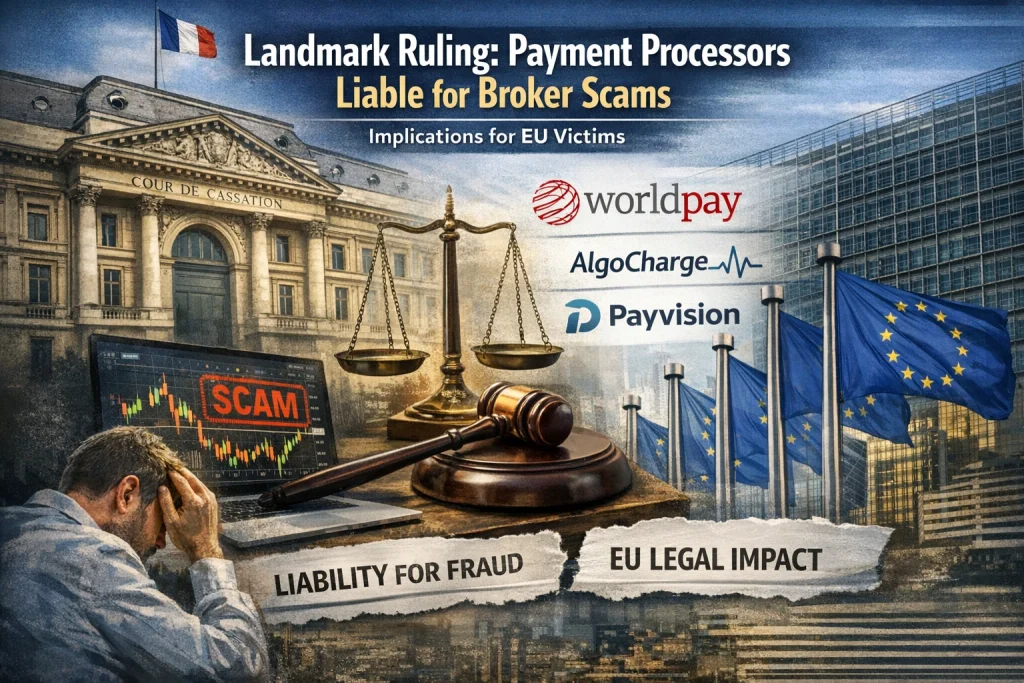
A recent decision by the French Supreme Court (Cour de Cassation) has set a powerful legal precedent by confirming the liability of payment processors such as WorldPay and Seroph Holding (AlgoCharge) in connection with unauthorized binary options schemes.
As restitution claims begin to take shape, this ruling introduces a strict due diligence benchmark that may influence courts across the European Union and strengthen recovery efforts against major institutions, including ING’s Payvision.
Key Findings
-
Joint and Several Liability
The Cour de Cassation ruled that primary payment service providers (WorldPay) and their intermediaries (Seroph Holding BV) can be held jointly liable for investor losses when they fail to meet their legal duty of vigilance. -
Ignorance Is Not a Valid Defense
Processing payments for entities listed on a regulator’s blacklist, such as the French AMF, constitutes a clear warning sign. Payment processors cannot rely on lack of awareness regarding the unlawful status of their clients. -
Jurisdiction in Cross-Border Fraud Cases
The Court clarified the interpretation of financial loss location under the Brussels I Regulation. Victims targeted in their home country may initiate legal action locally, even against foreign payment providers. -
Potential EU-Wide Impact
The ruling introduces a robust legal framework that could support cross-border claims and significantly strengthen cases against payment institutions across Europe.
Case Breakdown: WorldPay, AlgoCharge, and Seroph Holding
For years, unregulated binary options and Forex platforms—including 50 Option, Triompheoption, and Finch Markets—have caused substantial financial harm to retail investors across Europe. These operations relied heavily on licensed payment processors to move funds.
In the case examined by the Cour de Cassation, French victims transferred money to accounts formally held by WorldPay AP Ltd (UK). These accounts were made accessible to Seroph Holding BV (Netherlands) under a Payment Processing Agreement.
Seroph Holding BV acted as the operational entity behind AlgoCharge, a high-risk payment processor.
Court Findings
Both the Paris Court of Appeal (2022) and the Cour de Cassation identified serious compliance failures:
- Seroph Holding lacked proper authorization to operate as a payment institution
- Funds were routed to broker platforms blacklisted by the Autorité des Marchés Financiers (AMF)
- WorldPay failed to verify regulatory status and ignored clear red flags
As a result, the courts concluded that WorldPay breached its duty of vigilance by enabling transactions linked to unauthorized financial services.
Jurisdiction and the “Location of Financial Loss” (Quasi-Delicts)
One of the central legal disputes concerned jurisdiction. WorldPay argued that French courts lacked authority, as transactions were executed voluntarily by victims transferring funds abroad.
Court Interpretation
The Cour de Cassation examined Article 5(3) of the Brussels I Regulation and clarified:
| Legal Aspect | Court Position |
|---|---|
| Pure financial loss in a local account | Not sufficient on its own to establish jurisdiction |
| Voluntary bank transfer | Does not exclude liability |
| Fraudulent solicitation | Key factor in determining jurisdiction |
The Court ultimately determined that the relevant harmful event was not merely the transfer itself, but the broader fraudulent scheme. Since victims were actively targeted while residing in France, the courts confirmed jurisdiction under French law.
This interpretation allowed French consumer protection and civil liability rules to be applied to foreign payment processors involved in facilitating the fraud.
Hypothesis: Implications for EU Courts and Payvision Case
A New “Strict Vigilance” Standard
The ruling effectively establishes a stricter accountability threshold for payment processors. It narrows the gap between regulatory enforcement (AML/KYC violations) and direct civil liability toward victims.
This significantly challenges the long-standing argument that payment providers act only as neutral intermediaries.
Relevance to Payvision and ING
This precedent is particularly important for the ongoing legal actions involving Payvision and its parent company ING Bank.
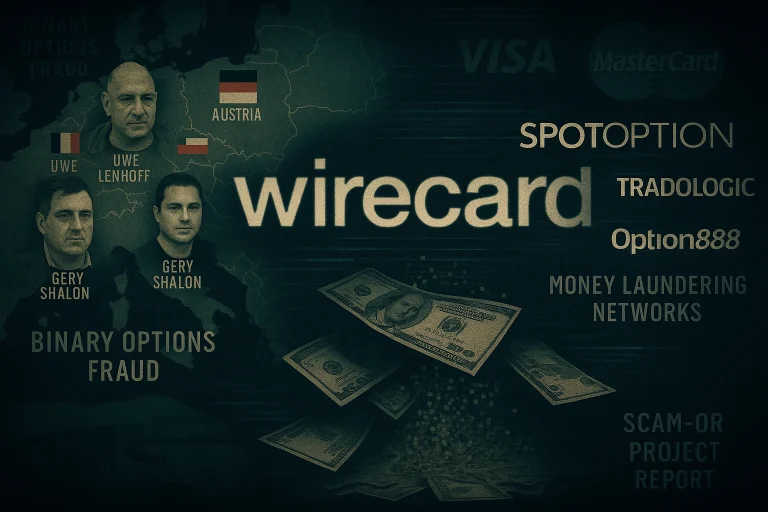
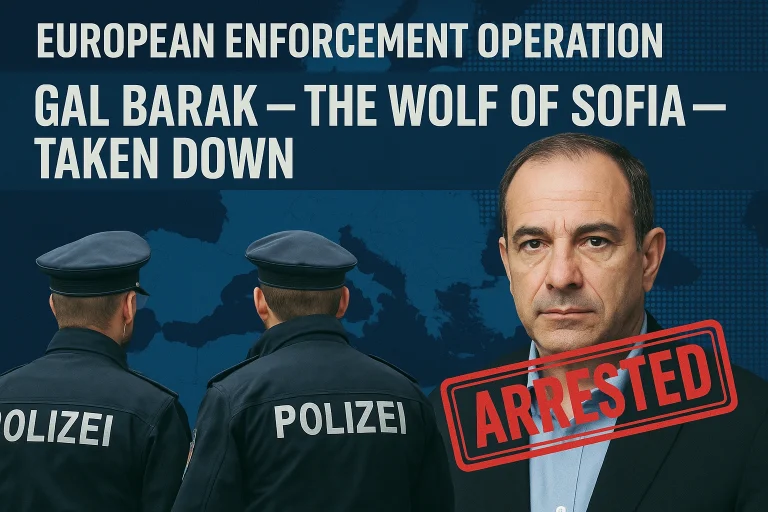
Evidence suggests that Payvision processed approximately €131 million for binary options operations linked to convicted individuals such as Uwe Lenhoff and Gal Barak (including brands like Option888 and XTraderFX).
Comparison: French Case vs. Payvision Scenario
| Element | WorldPay / Seroph Case | Payvision Case |
|---|---|---|
| Licensed processor involvement | Yes | Yes |
| Use of intermediaries / shell structures | Yes (Seroph Holding) | Yes (offshore entities) |
| Links to blacklisted brokers | Confirmed | Alleged |
| Due diligence failures | Proven | Under legal scrutiny |
| Potential liability | Confirmed | Likely if precedent applied |
If courts in the Netherlands or Germany adopt similar reasoning:
- Failure to verify licensing status of sub-merchants may qualify as a breach of duty
- Ignoring regulatory warnings could trigger civil liability
- Payment processors may be held jointly responsible for investor losses
Given the harmonized nature of EU financial regulations (including PSD2 and AMLD5), this French ruling may serve as a legal blueprint across jurisdictions.
Call to Action
Regulatory pressure is intensifying on payment processors that facilitated binary options and Forex fraud schemes.
If you have insider knowledge—whether as a former employee, compliance specialist, or industry professional—your information can play a crucial role in exposing how AML, KYC, and onboarding procedures were bypassed.
You can securely and anonymously share information through the Scam-Or Project whistleblower section.
Holding financial intermediaries accountable is becoming a reality—and informed insiders are key to accelerating that process.