
Scam-Or Project Flash Case: Hyperliquid’s EU Access (No KYC) to MiFID II-Scope Instruments

Summary:
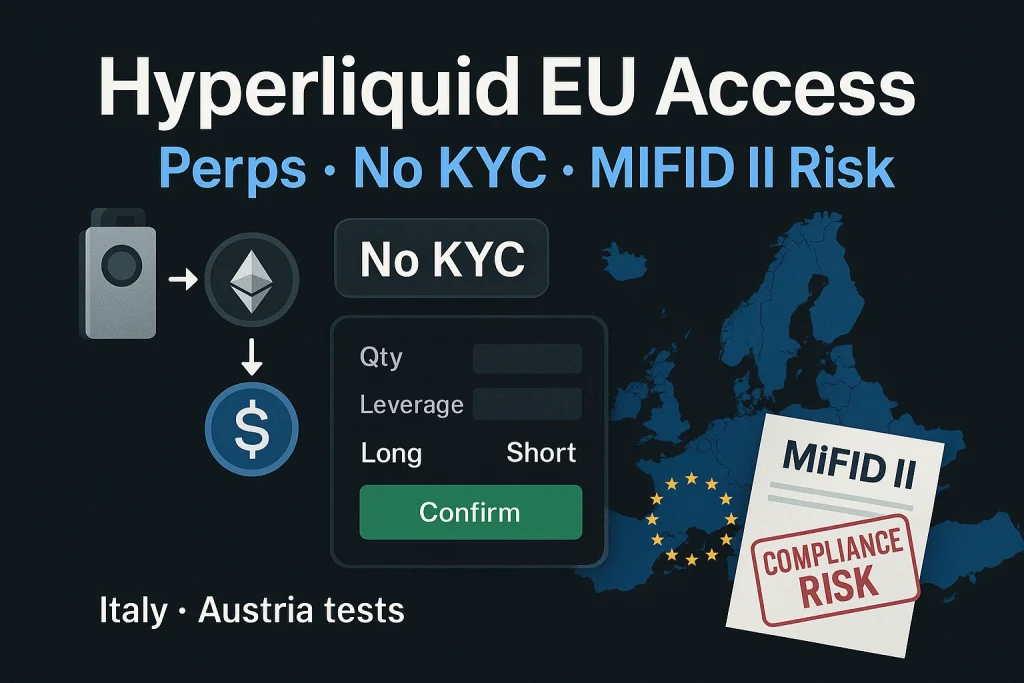
Independent checks conducted by Scam-Or Project across multiple EU locations indicate that EU residents can fund accounts, perform spot swaps, and open perpetual futures (Perps) on Hyperliquid without identity verification, geo-blocking, or explicit deposit ceilings. Testers deposited from Ledger cold wallets, converted ETH → USDC on the spot market, and opened Perps using USDC—all without KYC prompts.
Key Findings (New Evidence)
-
EU onboarding without KYC:
From several EU jurisdictions, wallets connected and the Hyperliquid UI remained fully usable with no identity checks, residency questions, or regional blocks. -
Cold-wallet funding works end-to-end:
ETH was transferred directly from Ledger to a Hyperliquid deposit address; no additional onboarding, relays, or soft caps appeared. -
Spot swap to USDC executed:
Deposited ETH was seamlessly converted to USDC on Hyperliquid’s Spot market, establishing a USDC balance. -
Perps opened with USDC:
With USDC as the trading currency, perpetual futures positions were opened and managed without KYC or gating procedures. -
No visible deposit ceilings:
Across repeated trials, no explicit deposit limits were displayed or enforced. -
Interface behavior unchanged for EU IPs:
The previously documented flow (wallet connect → ApproveAgent → accept terms) remained available from EU IP ranges.
Why This Matters (Compliance Lens)
-
Perps = derivatives:
Within the EU, perpetual futures fall under MiFID II when provided to EU clients. If a venue lets EU residents access and trade perps, investment-services authorization is ordinarily required (exchange/market-maker side). -
Anonymity heightens regulatory exposure:
Operating without KYC/appropriateness checks and without EU gating runs counter to typical MiFID II safeguards (client protection, market integrity, and AML/CFT expectations channelled through authorized firms). -
Spot ≠ clean room for perps:
Even if spot crypto-to-crypto can align with MiCA/CASP concepts, enabling EU access to perpetuals pushes the activity into the MiFID II perimeter for the provider. -
Replicated pattern across jurisdictions:
Identical results in Italy and Austria strengthen the factual basis beyond a single-country anomaly.
On-Platform Observations (Concise)
-
Deposit: ETH sent from Ledger into Hyperliquid’s deposit flow (no KYC).
-
Spot: ETH → USDC conversion completed on Hyperliquid Spot.
-
Perps: USDC used to open and manage perpetual futures positions.
-
Controls: No geo-blocking, residency selection, KYC, or deposit caps were encountered.
Quick Control Matrix (What Testers Saw)
| Control Area | Expected Under EU Norms (MiFID II context) | Observed on Hyperliquid (EU IPs) |
|---|---|---|
|
IP/Geo-fencing for Perps |
Regional gating or explicit exclusion |
Not observed |
|
KYC/Identity Verification |
Mandatory before derivatives access |
Not triggered |
|
Appropriateness/Suitability |
Assessment before enabling derivatives |
Not observed |
|
Deposit Limits |
Communicated thresholds or triggers |
None displayed |
|
Residency Attestation |
Required attestation for access |
Not requested |
Editorial Analysis (Strong View)
Hyperliquid appears to operate as a permissionless interface that, in practice, admits EU residents to derivatives trading without EU-perimeter controls. In a post-MiCA environment—where derivatives = MiFID II—this stance resembles the familiar “scale first, formalize later” approach seen in prior cycles. Jurisdictional boundaries eventually catch up with growth curves.
Updated Right-to-Reply (Questions for Hyperliquid)
-
Do you exclude EU/EEA/UK residents from Perps? If yes, where are the effective controls (IP gating, residency attestation, KYC)?
-
On what basis do you allow anonymous deposits and trading (including Ledger-funded flows) from EU IPs?
-
Why do your Terms list Restricted Persons (e.g., US/Ontario/sanctions) but omit EU/EEA/UK, while perps remain available in the UI?
-
Do you rely on reverse solicitation for EU users? If so, what evidence do you keep and how do you prevent indirect solicitation via affiliates/influencers?
-
Have you engaged any EU NCA regarding your EU access posture for perpetual futures?
Scam-Or Project will publish any response verbatim or note no comment.
Evidence Pack (On File, Timestamped)
-
How Hyperliquid addresses EU residents with crypto perps (Scam-Or Project explainer).
-
Multiple test runs: different EU jurisdictions, different IP ranges.
-
Flow artifacts: wallet-connect prompts, ApproveAgent signature, deposit confirmations, ETH→USDC spot fills, Perps order tickets/executions.
-
Hashing & timestamps: screenshots/recordings with SHA-256 hashes; environment details (IP geolocation, time, network).
-
Terms snapshot: current Terms of Use showing US/Ontario/sanctions restrictions; no EU exclusion observed.
Risk Signals for Readers
-
Regulatory: Potential unauthorized investment services risk if EU clients are admitted to perps.
-
Operational: Risk of sudden control changes (account restrictions, forced position closures, access blocks) if enforcement increases.
-
Consumer: Absence of the MiFID II investor-protection framework for these trades.
Next Steps (Scam-Or Project)
-
Transmit right-to-reply with a 72-hour response window; publish responses or note no comment.
-
Continue access monitoring via multiple EU ISPs; log any changes (geo-fencing/KYC prompts).
-
Prepare a comparative matrix (Hyperliquid vs. EU-authorized venues): KYC, onboarding, derivatives permissions, market surveillance.
-
Share information.