
Singapore Arrest of Ex-Wirecard Asia Director Brigitte Häuser-Axtner Tied to €300m ‘Operation Chargeback’ Subscription Fraud

1. Case Overview
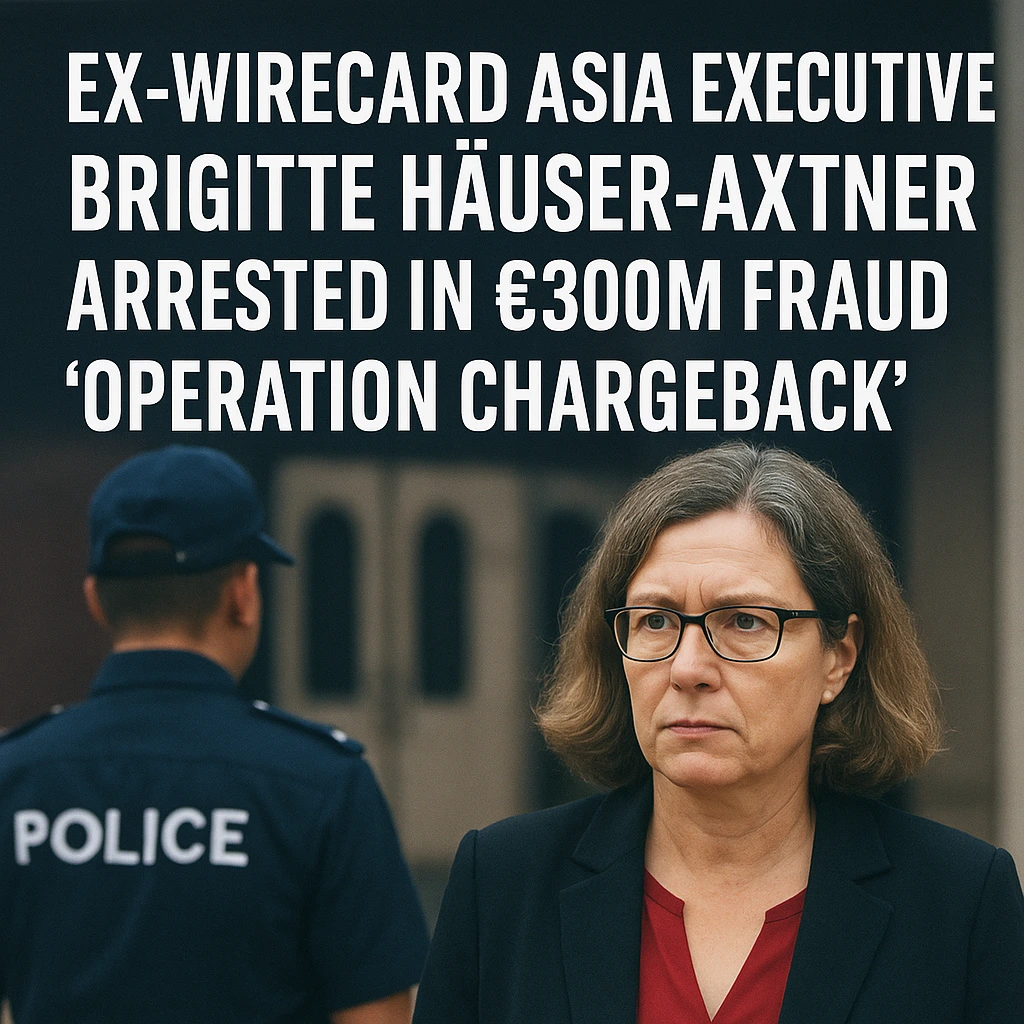
German national Brigitte Häuser-Axtner, a former senior executive in Wirecard’s Asian operations, has been arrested in Singapore on the basis of an extradition request from Germany. The detention is linked to “Operation Chargeback”, a Europol-supported investigation into three extensive fraud and money-laundering structures that allegedly exploited payment-card data from millions of individuals around the world.
According to investigators, these networks misused the infrastructure of four major German payment service providers (PSPs) and inflicted more than €300 million in losses. Media reports in Germany, including Der Spiegel, name Wirecard as one of the PSPs whose systems were used.
2. Key Developments and Allegations
2.1 Arrest in Singapore
-
Date of arrest: 4 November 2025
-
Authority involved: Singapore Police Force
-
Legal basis: Extradition request from Germany under the existing Germany–Singapore extradition treaty
-
Local status: Singaporean authorities have stated that, based on present information, Häuser-Axtner is not accused of committing offences on Singaporean soil and is held solely in relation to German proceedings (Source: The Straits Times).
2.2 Charges Sought by German Prosecutors
German authorities reportedly want Häuser-Axtner extradited to face accusations including:
-
participation in the creation of a criminal organisation abroad
-
computer fraud
-
offences committed as part of a gang
-
money-laundering under German criminal law
She is currently involved in extradition proceedings in Singapore, with additional hearings scheduled while German investigators continue their work.
2.3 Operation “Chargeback” – Scope and Reach
The investigation referred to as “Operation Chargeback” targets three interconnected fraud and laundering networks. According to Europol and German law-enforcement authorities:
-
Suspects identified: 44
-
Arrests so far: 18
-
Regions involved: Europe, North America and Asia
These networks allegedly relied on compromised or unlawfully obtained card details to run large-scale, small-amount billing schemes.
3. Anatomy of the Subscription-Fraud Scheme
Between 2016 and 2021, the networks are said to have orchestrated a global “subscription skimming” operation.
3.1 Operating Model
-
Victims: Over 4.3 million cardholders
-
Countries affected: 193
-
Billing pattern:
-
relatively small recurring charges (around €50 per transaction)
-
vague or obscure merchant descriptors
-
Sectors used as cover:
-
adult entertainment (pornography)
-
dating platforms
-
streaming/content sites
-
Corporate structure: More than 500 shell corporations, many located in the UK and Cyprus, acting as merchant fronts
The idea was simple: keep the amounts low and labels confusing so that many cardholders would either overlook the charges or not immediately identify them as fraudulent.
3.2 Role of German Payment Processors
Europol and German authorities have stated that the operation leveraged the acquiring and processing capacity of four major German PSPs. Official Europol communications have not named the companies, but Der Spiegel has reported that Wirecard was one of the providers whose systems supported these transactions.
Beyond simple abuse of infrastructure, the investigation suggests internal cooperation:
-
At least six individuals, including executives and compliance or risk officers, are suspected of:
-
intentionally enabling the networks’ access to payment systems
-
receiving compensation in return
This points to potential collusion inside the PSPs, rather than mere failure of automated monitoring tools.
4. Wirecard Context and Häuser-Axtner’s Track Record
4.1 Positions Held at Wirecard
Public company records and professional profiles show that Brigitte Häuser-Axtner held senior roles within the Wirecard group, including:
-
Vice President Digital Sales, Wirecard AG
-
Managing Director, Wirecard Asia Holding Pte Ltd (Source: Computerwoche)
Her position gave her visibility over both regional operations in Asia and strategic digital sales activities.
4.2 Parliamentary Scrutiny and OCAP Connection
Häuser-Axtner’s name had already surfaced during the German Bundestag’s inquiry into Wirecard. Evidence presented there indicated that:
-
Wirecard Asia Holding Pte Ltd granted a multi-million euro loan to OCAP, a company controlled by her husband Carlos Häuser.
This transaction raised early concerns over:
-
related-party dealings,
-
potential conflicts of interest, and
-
the broader governance culture within the Wirecard group (Source: ft.com).
These earlier governance issues now appear in a different light as investigators explore her possible role in the subscription-fraud networks uncovered by Operation Chargeback.
5. Broader Implications: Compliance, Governance and Regulatory Oversight
5.1 Wirecard’s Legacy Beyond 2020
The arrest of Häuser-Axtner underlines that the Wirecard affair did not end with the group’s insolvency in 2020. While former CEO Markus Braun is being tried in Munich and former COO Jan Marsalek remains a fugitive, attention is now clearly shifting to:
-
regional leaders,
-
risk and compliance staff,
-
individuals with influence over merchant onboarding and monitoring.
These layers of the organisation may have been critical in allowing high-risk or fraudulent activity to pass through payment systems (source).
5.2 Crime-as-a-Service and Internal Weaknesses
The pattern alleged in Operation Chargeback illustrates how card fraud, shell companies and payment processing can converge:
-
card details obtained via phishing or other cybercrime methods;
-
merchants set up through shell entities with limited real-world substance;
-
transactions routed through large, established PSPs whose controls were:
-
either too weak to detect the patterns, or
-
actively undermined by insiders (Source: Die Welt).
This is less a story about a single breach and more a case study in how criminals can industrialise online fraud when they gain reliable access to acquiring infrastructure.
5.3 Questions for Regulators and Card Schemes
For supervisors such as BaFin, the European Banking Authority (EBA), and the international card schemes, several issues emerge:
-
How did a scheme involving millions of cards and hundreds of merchants in inherently high-risk verticals persist for five years?
-
Were existing transaction-monitoring and merchant due-diligence requirements sufficient but poorly implemented, or fundamentally inadequate for this type of risk?
-
What improvements are now necessary to prevent PSPs – especially those specialising in high-risk industries – from becoming tools for organised fraud?
The fact that a collapsed and disgraced player like Wirecard can still be named in a 2025 enforcement operation shows that the fallout from its failure continues to impact the integrity of the payments ecosystem.
6. Recommended Actions for Market Participants
6.1 For Banks and Payment Institutions
-
Re-evaluate Hiring from High-Risk Legacy Firms
-
Conduct thorough background checks and risk-based reviews for senior hires with Wirecard or similar high-risk backgrounds, particularly in:
-
Asia-focused roles
-
risk management
-
compliance and merchant acquiring
-
Retroactive Transaction Analysis (2016–2021)
-
Re-run analytics on historical data to identify:
-
recurring card charges under €50,
-
merchants in adult entertainment, dating and streaming,
-
client structures tied to UK or Cyprus shell entities,
-
unusual descriptors suggesting attempts to camouflage the nature of services.
-
Strengthen Internal Controls Around Merchant Onboarding
-
Tighten due diligence for high-risk verticals.
-
Introduce escalation protocols where staff benefit directly or indirectly from merchant relationships.
-
Ensure independent oversight on approvals for complex or offshore corporate structures.
6.2 For Investors and Business Partners in Payments and Fintech
-
Require transparent disclosure of any past or present exposure to:
-
entities named in Operation Chargeback,
-
similar subscription-billing models in high-risk sectors.
-
Seek documented evidence of:
-
cooperation with law-enforcement agencies,
-
remedial steps taken to reinforce AML, risk and compliance frameworks.
A credible, detailed response should be a prerequisite for ongoing investment or partnership.
7. Call for Information – Tracing the Post-Wirecard Landscape
Scam-Or Project will continue to track developments in Operation Chargeback, the legal proceedings against Brigitte Häuser-Axtner, and related cases emerging in Germany and other jurisdictions.
We are particularly interested in:
-
Internal emails, risk assessments or compliance reports from Wirecard or other unnamed PSPs concerning subscription merchants in high-risk industries.
-
Documentation illustrating how shell companies in the UK, Cyprus or other jurisdictions were used to route online subscription payments.
-
Information on former Wirecard managers or compliance officers who later appeared in new fintech or payment ventures, especially in high-risk segments.
Current and former employees, business partners, merchants and affected cardholders can contact us confidentially at our website. Anonymous submissions are possible and will be handled with strict confidentiality and care.