

Extreme Fear in Crypto — A Near-Miss Crash Scenario for 2025

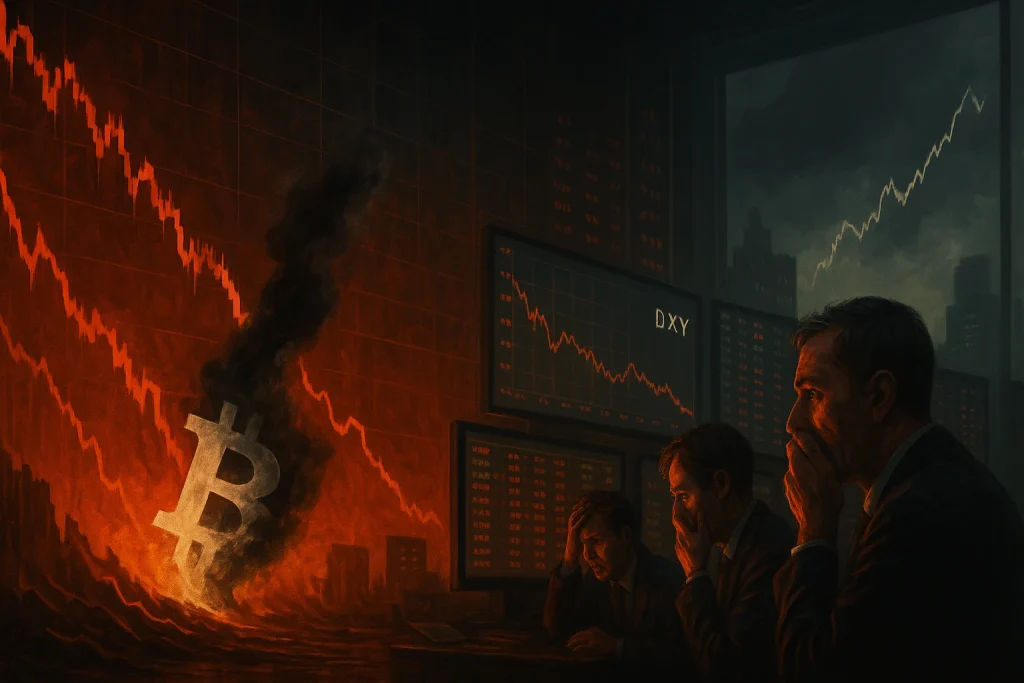
Market Overview: Post-Halving Hangover and “Extreme Fear”
Digital assets have entered a post-halving drawdown very similar to the patterns seen in 2016 and 2020. Since October, more than $1 trillion in total market capitalization has been wiped out. Bitcoin (BTC) has slid by roughly 30% from its peak as leverage is unwound, demand for ETFs turns negative, and the U.S. dollar strengthens.
In the short term, the backdrop is a high-volatility, data-sensitive trading range with clear risk of further downside before any durable bottom forms. The widely watched Fear and Greed Index is firmly in the “Extreme Fear” zone.
Layered Drivers of the Sell-Off
1. Forced Deleveraging Across the System
-
Multi-billion-dollar liquidations have hit perpetual futures markets.
-
Venue-specific “air pockets” have emerged, such as the Hyperliquid flash crash.
-
Reported by: coindesk, CryptoPotato.
2. ETF Flow Reversal
-
U.S. spot Bitcoin ETFs have recorded record daily outflows (including IBIT).
-
One of the worst months on record for U.S. spot BTC ETFs.
-
Reported by: Reuters.
3. Macro Risk-Off and a Stronger Dollar
-
The DXY index has rebounded to levels near 100.
-
The Federal Reserve maintains a hawkish tone.
-
Trade-policy uncertainty (tariffs, export controls) adds to risk-off sentiment.
-
Reported by: FXStreet.
4. Thin Liquidity and Profit-Taking
-
Liquidity remains shallow.
-
Long-term holders have engaged in profit-taking, which intensified downward moves.
-
Reported by: Business Insider.
Macro Context: Classic Mid-Cycle Halving Turbulence
Following a powerful rally into and immediately after the April 2024 halving, the market now faces well-known macro headwinds:
-
Tighter U.S. dollar liquidity
-
Higher real yields
-
Elevated policy noise (tariffs, export controls, geopolitical uncertainty)
Previous halving cycles also featured sharp mid-cycle pullbacks before the longer-term uptrend resumed. Historical halving analyses suggest that cycle lows tend to occur 512–542 days after a halving, which would point to Q1 2026 as a plausible window for a bottom, according to Bitcoin Suisse.
Scenario Framework to Year-End / January 2026
Updated Probability Distribution (to January 2026)
| Scenario | Previous Probability | Updated Probability | Summary Path |
|---|---|---|---|
|
Bear |
30% |
45% |
Deeper drawdown, slow grind recovery |
|
Base |
50% |
40% |
Volatile range, gradual stabilization |
|
Bull |
20% |
15% |
Faster recovery, constructive macro |
Path description (Downshifted Outlook):
A “crash-then-crawl” pattern is now more likely. After one or several capitulation waves (forced liquidations combined with ETF outflows), a reflexive rebound may materialize but is likely to fade into a lower, wider trading range. Altcoins are expected to underperform for longer as liquidity retreats and retail participation diminishes.
Why a Deeper and Slower Recovery Is Credible
-
Fear and Greed Is Not a Simple Buy Signal in Tightening Regimes
Extreme readings on the Fear and Greed Index are less reliably contrarian when: -
The macro regime is tightening
-
The USD is strong
-
Real yields are higher
-
Broader risk assets (equities, credit) are under stress
-
AI Bubble Risk and Systematic De-Risking
A potential unwind in crowded AI-related trades could trigger: -
Systematic de-risking by CTAs, volatility-control strategies, and risk-parity funds
-
A broad shrinkage in overall risk appetite
-
Higher cross-asset correlations, pulling crypto down with other risk assets
-
Flows Matter More Than Narratives
If: -
Spot ETF net flows stall or remain negative
-
Derivatives funding recovers while open interest rebuilds
then any rally is vulnerable to repeated “flushes”, as positioning becomes crowded again without a supportive flow backdrop.
Implications for Positioning
For Investors Already Allocated to Crypto
-
Re-focus on BTC/ETH core holdings; trim exposure to long-tail altcoins.
-
Cut leverage where possible.
-
Consider collars or protective puts if these instruments are available and liquid.
-
Maintain cash / dry powder to be deployed on days when forced sellers dominate.
-
Avoid aggressively “bottom-fishing” in high-beta altcoins during ongoing deleveraging.
For Investors Considering an Entry
Use time-staggered entries and wait for confirmation from three key conditions:
-
3–5 consecutive days of net positive ETF inflows in U.S. spot BTC products.
-
Signs of a cooling USD and softer yields (less macro pressure).
-
Funding rates near flat with open interest rebuilding gradually, not in a parabolic fashion.
Risk Management Principles
-
Anticipate large intraday gaps, failed breakouts, and whipsaws.
-
Use smaller position sizes and wider stops to account for volatility.
-
Diversify venue risk — do not rely on a single exchange or platform.
-
Favor spot exposure over perpetuals until volatility decisively compresses.
Bearish Signposts to Monitor
Investors should treat the following as warning indicators that the downside regime remains intact:
-
Persistent ETF outflows across multiple issuers, not just isolated products.
-
A rising DXY and widening credit spreads, both signaling broader risk aversion.
-
Altcoin breadth making fresh lows during rebounds (few coins participating in rallies).
Bottom line:
This part of the cycle should be regarded as a capital-preservation phase. The asymmetric upside of crypto will still be available once flows and macro conditions turn more favorable. Until then, patience, risk discipline, and sizing control are more important than chasing “hero trades.”
What Can Investors Practically Do Right Now?
If You Are Already Invested
-
Rebalance toward higher-quality assets: tilt portfolios more heavily toward BTC and ETH.
-
Reduce or eliminate leverage where possible.
-
Use staged add-backs only after ETF flows turn positive for several consecutive days and prices reclaim key breakdown zones.
-
Define and respect hard invalidation levels for each position.
If You Are Still on the Sidelines
-
Prefer staggered entries, either by:
-
Time (e.g., fixed allocations over weeks/months), or
-
Price levels (pre-defined buy zones).
-
Start with small sizing, especially in a still-volatile market.
-
Avoid high-beta altcoins until:
-
BTC price action stabilizes, and
-
Funding rates and open interest normalize.
Risk Controls for the Current Environment
-
Volatility remains elevated, so:
-
Use wider stop-loss levels.
-
Avoid excessive exposure to any single exchange or broker.
-
Continuously monitor:
-
Funding rates
-
Open interest (OI)
-
Daily ETF flow data
Core Watchlist Indicators
Investors should prioritize a compact, high-signal dashboard:
-
U.S. spot-BTC ETF net flows (daily)
-
DXY index trajectory
-
Liquidation and funding metrics across major derivatives venues
A sustained improvement across all three — consistent ETF inflows, a more benign USD path, and normalized derivatives metrics — will provide a credible confirmation signal that the worst of the deleveraging phase may be behind the market.