
Trustpilot’s Crypto Exchange Scorecard: A Sector-Wide Customer Experience Breakdown

Introduction: A Harsh Customer Verdict
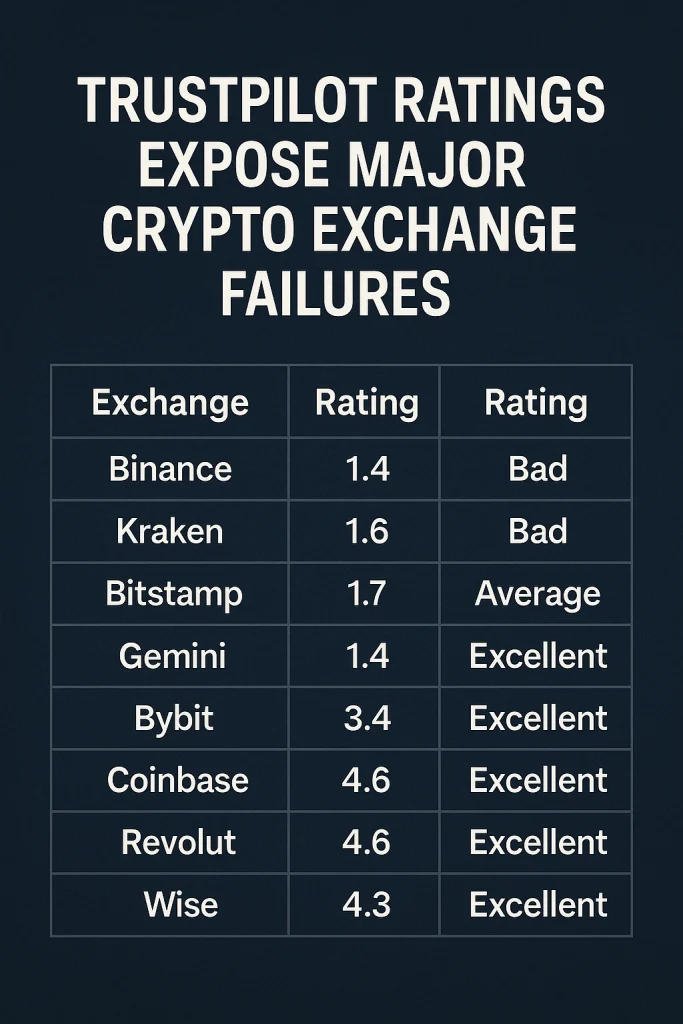
Trustpilot’s crowdsourced ratings paint a bleak picture for the crypto exchange industry. Major platforms such as Binance (1.4), Kraken (1.6), Bitstamp (1.7), Gemini (1.4), and Blockchain.com (2.1) sit deep in “Bad” or “Poor” territory, weighed down by horror stories about frozen accounts, blocked withdrawals, and dead-end customer support.
Only a handful of players—most notably Coinbase and Bitpanda (both at 3.9, “Great”) and Bybit (3.4, “Average”)—manage to stay above “scam-level” perception. By contrast, fintechs like Revolut (4.6, “Excellent”) and Wise (4.3, “Excellent”) show just how far crypto-native platforms lag in customer experience.
Trustpilot Snapshot: How Major Platforms Stack Up
Crypto Exchanges: Current Rating Landscape
The table below summarizes the Trustpilot ratings referenced in this analysis (approximate values and review counts):
| Platform | TrustScore (≈) | Rating Label | Approx. Review Count | Notes / Source Domain |
|---|---|---|---|---|
|
Binance |
1.4 / 5 |
Bad |
~6,000 |
Source: Trustpilot |
|
Kraken |
1.6 / 5 |
Bad |
~3,000 |
|
|
Gemini |
1.4 / 5 |
Bad |
1,000+ |
Source: uk.trustpilot.com |
|
Bitstamp.net |
1.6 / 5 |
Bad |
~990 |
Fragmented profile |
|
Bitstamp.com |
1.2 / 5 |
Bad |
~100 |
|
|
Blockchain.com |
2.1 / 5 |
Poor |
~7,000 |
Source: Trustpilot |
|
Coinbase |
3.9 / 5 |
Great |
~20,000 |
Source: Trustpilot |
|
Bitpanda |
3.9 / 5 |
Great |
~14,000 |
Source: Trustpilot |
|
Bybit |
3.4 / 5 |
Average |
~6,000–7,000 |
Source: Trustpilot |
Fintechs Offering Crypto: A Different CX League
Fintechs that also provide crypto trading or exposure display significantly better customer satisfaction:
| Platform | TrustScore (≈) | Rating Label | Approx. Review Count | Source Domain |
|---|---|---|---|---|
|
Revolut |
4.5–4.6 / 5 |
Excellent |
~300,000 |
|
|
N26 |
3.8 / 5 |
Great |
~38,000 |
|
|
Wise |
4.3 / 5 |
Excellent |
270,000+ |
Bottom line: With the partial exception of Coinbase, Bitpanda, and Bybit, the Trustpilot sentiment toward major crypto exchanges is effectively at “scam-level” territory.
Recurring Themes in the Worst Reviews
Across thousands of negative reviews, several patterns repeat almost word for word.
1. Frozen Accounts and Withheld Funds
-
Long-running “under review” flags on customer accounts
-
Blocked or delayed withdrawals for weeks or months
-
P2P escrow disputes where funds appear trapped
-
Support replies described as canned, repetitive, and unhelpful
These issues are particularly visible on the Binance and Blockchain.com Trustpilot pages.
2. Support That Feels Absent or Bot-Only
-
Users describe being stuck in automated chat loops
-
Tickets bounce between departments without resolution
-
Human escalation is slow or never materializes
Binance’s pages are frequently cited as examples where AI and scripted responses dominate the support journey.
3. Confusing Legal Entities and Jurisdictions
-
EU customers complain they do not know which Binance entity actually holds their funds
-
Ongoing restructuring, de-risking and entity migrations blur accountability
-
This complexity makes it harder for users to understand where to escalate disputes
4. Withdrawal Friction and Repeated KYC Checks
-
“Re-KYC after deposit” scenarios where users must re-verify despite prior approval
-
Requests for “old card proof” or additional documents mid-transaction
-
Compliance prompts that appear suddenly during withdrawal flows
These touchpoints often trigger accusations of “scam” when combined with slow responses.
5. P2P Marketplace Risk Exposure
-
Escrow release disputes in P2P trades
-
Alleged chargebacks after fiat has been sent
-
Confusion around how P2P protections actually work
On platforms like Binance, P2P-related complaints are a core part of the negative narrative.
6. Bitstamp’s Fragmented Review Footprint
-
Two separate Trustpilot profiles (bitstamp.net and bitstamp.com)
-
Both profiles sit firmly in “Bad” territory despite the split
-
Fragmentation makes the overall customer sentiment harder to read at a glance, but not more positive
Methodology Caveat: Review Gaming and Noise
Trustpilot itself has acknowledged issues around fake or manipulated reviews, including in the crypto space. The platform has:
-
Removed large numbers of suspicious reviews
-
Previously disabled Binance’s TrustScore at one point
This means the signal is not perfect. However, the scale and consistency of complaints—especially about frozen funds and non-responsive support—across thousands of reviews still point to a genuine, sector-wide CX issue rather than pure review bias. (Reference: reporting in The Guardian.)
Why Are Crypto Exchanges Rated So Poorly? A Working Hypothesis
A. Structural Compliance Friction That Looks Like Confiscation
Crypto exchanges operate under intense pressure from:
-
AML/CTF regulations
-
Sanctions regimes
-
Fraud and chargeback risk
Their default risk-control pattern is often:
-
Freeze funds or block withdrawals when a risk flag triggers
-
Investigate later, sometimes with limited human oversight
Without fast, human-led triage, retail users experience this as arbitrary confiscation rather than regulatory compliance. Review narratives suggest that time-to-resolution—not just the initial freeze—is the primary driver of anger.
B. Risky Product Models: P2P and High-Velocity Trading
-
P2P fiat on/off ramps generate escrow disputes and chargebacks
-
Leverage and derivatives products create more liquidations and conflicts
-
These dynamics trigger more compliance alerts and account holds than standard e-money or card transactions
As a consequence, crypto exchanges face structurally more friction than neobanks or EMIs.
C. Underinvestment in Human Support at Global Scale
-
Platforms expanded globally with relatively thin local licensing footprints
-
Support operations lean heavily on outsourcing and AI automation
-
That combination is problematic when decisions involve freezing or restricting access to a customer’s money
Numerous reviews across Binance and other exchanges describe bot loops, delayed human contact, and poor escalation paths.
D. Entity Sprawl and Governance Debt
-
Networks of legal entities across multiple jurisdictions
-
Migrations from one corporate shell to another
-
Ongoing compliance “clean-up” exercises
All of this leaves customers unclear about who is actually responsible for their funds or complaint handling. That lack of clarity amplifies frustration and reinforces “scam” narratives.
E. Review-Platform Dynamics
-
Angry customers post disproportionately more often than satisfied ones
-
Some companies actively try to manipulate or curate reviews
Even accounting for this skew, the sheer volume of negative experiences and the recurring themes across different platforms point to a structural customer-experience problem.
F. Why Fintechs Like Revolut, Wise, and N26 Score Better
Fintechs that combine payments, banking, and occasionally crypto exposure typically:
-
Use bank/EMI-style flows with more predictable risk models
-
Have clearer ex-ante risk scoring and fewer P2P dispute vectors
-
Offer in-app case management norms and more mature operational CX
They appear to have invested earlier in robust communications, ticket handling, and escalation processes—reflected in “Great” and “Excellent” TrustScores at scale.
Analyst View: What This Means for Key Stakeholders
1. For Regulators and Supervisors
Trustpilot data is not a legal finding, but it is a real-time barometer of:
-
Operational weaknesses
-
Consumer-protection gaps
-
Problems around access to funds and redress
Regulators should examine:
-
Service-level agreements (SLAs) for resolving frozen-account and restricted-funds cases
-
P2P dispute-handling processes and chargeback risk management
-
Transparency around which legal entity is responsible for a given customer relationship
-
Adequacy and availability of human support once funds are restricted or seized
The public review trail offers abundant, concrete case narratives for supervisory scrutiny.
2. For Crypto Exchanges
The reputational gap versus leading fintechs is substantial. The quickest wins are unlikely to come from new marketing campaigns, but from:
-
Clear SLAs and escalation ladders for frozen-funds and withdrawal tickets
-
Transparent, real-time case status tracking for customers
-
Simpler, better-communicated entity structures and responsibilities in the EU, UK, and US
Unless exchanges fix these fundamentals, “scam-level” Trustpilot scores will continue to undermine licensing, partnerships, and institutional trust.
3. For Consumers
Trustpilot ratings do not prove fraud. They do highlight where users repeatedly encounter predictable pain points. Practical takeaways include:
-
Prefer providers with “Great” or “Excellent” TrustScores when large balances are involved
-
At minimum, test small deposits and withdrawals before committing material funds
-
Be especially cautious with P2P ramps and leveraged products, where disputes and freezes are more frequent
In short: customer experience data can be treated as a risk signal, not a verdict.
Data Notes and Limitations
- Trustpilot ratings are dynamic and can be influenced by review campaigns, both organic and artificial
- Where possible, this analysis references live company pages, acknowledging that some ratings differ by domain or region
- For Revolut and Wise, company disclosures and third-party references align with the Trustpilot score bands cited
Treat these figures as directional indicators rather than precise, immutable metrics. As of 29 October 2025, the overarching pattern remains robust across sources: major crypto exchanges cluster in the “Bad/Poor” range, while leading fintechs sit comfortably in “Great/Excellent” territory.