
How the Trump Administration Disabled the U.S. Financial Crime Early-Warning System at the Worst Possible Moment

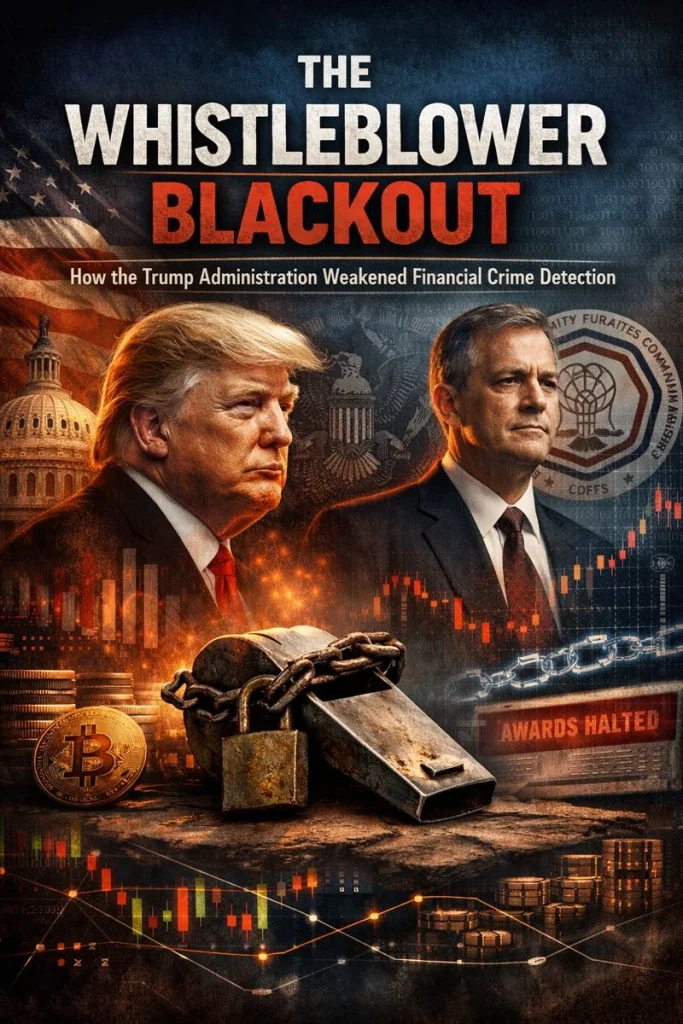
Public disclosures make one trend impossible to ignore: by 2025, official communication around U.S. whistleblower awards has nearly vanished. The newsroom tag used by the U.S. Securities and Exchange Commission shows seven award-related posts in 2023, five in 2024, and only one in 2025. The Commodity Futures Trading Commission whistleblower feed tells a similar story, with a single award announcement in 2025.
This is not a random lull. It represents a systematic rollback of one of the most effective financial-crime detection tools—occurring precisely as markets become more digital, fragmented, and vulnerable to abuse.
Key Facts at a Glance
| Item | Data |
|---|---|
| SEC award posts (newsroom tag) | 2023: 7 · 2024: 5 · 2025: 1 |
| SEC FY2024 outcomes | $255M+ paid to 47 whistleblowers; ~24,980 tips received |
| SEC 2025 award release | “SEC Awards $6M to Joint Whistleblowers” (Apr 21, 2025) |
| Leadership shift | Paul Atkins nominated Jan 20, 2025; sworn in Apr 21, 2025 |
| CFTC 2025 award | ~$700,000 announced May 29, 2025 |
A Crisis Hidden in Plain Sight
What no Wall Street lobby fully achieved, the current administration has quietly delivered: the hollowing-out of the most effective anti-fraud mechanism in U.S. securities oversight—exactly as financial crime has gone fully digital.
Under Gary Gensler, the SEC Whistleblower Program reached historic highs. In FY2024 alone, it distributed $255 million to 47 whistleblowers—the third-largest annual total ever—and contributed to more than $2.2 billion in cumulative awards since 2011.
By contrast, FY2025—under Donald Trump and newly installed SEC Chair Paul Atkins—saw awards fall to roughly $59.7 million, a collapse of about 77% and the weakest year in recent history.
Why Did the Pipeline Freeze?
Three interlocking factors explain the sudden chill:
-
Higher Friction and Denials
Legal and compliance observers report more rejections and tighter eligibility standards, slowing payouts even where cases proceed. -
Enforcement and Staffing Disruption
Media reporting describes a post-January 2025 pivot toward “traditional” enforcement and internal restructuring amid staff departures—conditions that delay complex cyber-finance cases, which typically generate the largest awards years later. -
A Messaging Pullback
Some program watchers argue that awards continue quietly, but without the prior level of public promotion—creating the perception of shutdown even as determinations occur behind the scenes.
The CFTC tracks the same pattern. After a record 12 awards totaling $42 million in FY2024, it issued only two in FY2025—about $700,000 in May and $1.8 million in December. Both agencies still sit on vast backlogs of tips in crypto and derivatives markets yet appear unwilling to pay at scale.
This is not a funding problem. It is a policy choice.
Paul Atkins and the Ideological Reversal
Paul Atkins has long opposed the whistleblower model. In Senate testimony in 2011, he criticized the Dodd-Frank program for creating “perverse incentives” and encouraging employees to bypass internal compliance. Subsequent evidence disproved those claims—yet the program now operates under his authority.
Concerns deepen when examining conflicts:
- Approximately $6 million in personal crypto holdings disclosed prior to taking office
- A consulting firm that advised and lobbied for FTX before its collapse
- Roles on digital-asset advisory bodies promoting “best practices” for token issuers and platforms
Since the leadership change, the SEC has paused or dropped a large share of crypto-related cases, sharply reduced actions against public companies, and initiated no new crypto enforcement matters. At the same time, whistleblower awards—the primary incentive for insiders to expose crypto and DeFi fraud—have been throttled.
This is not a routine reprioritization. It is regulatory capture in real time.
Cyberfinance Without Whistleblowers: Regulators in the Dark
The timing could not be worse. Financial crime has migrated from physical offices to blockchains, APIs, and instant payment rails:
- Cross-chain laundering pushed more than $20 billion in illicit crypto across multiple blockchains in 2025, often spanning 5–10 chains
- Stablecoins such as USDT have become favored laundering instruments due to speed and liquidity
- Open banking and embedded finance fragment payment flows across multiple intermediaries
- Instant payments carry dramatically higher fraud risk than legacy transfers
- Offshore casinos and high-risk PSPs deploy “fake instant banking” and crypto on-ramps to obscure flows—patterns documented by Scam-Or Project in investigations around Winning.io and its processors
Legacy AML systems were never designed for DeFi, privacy mixers, synthetic identities, nested correspondent banking, or white-label payment cascades. These structures cannot be decoded from the outside. They require insiders—developers, compliance officers, risk teams, PSP staff—who can map wallets to real operators and explain where beneficial ownership is concealed.
Academic research confirms that the SEC Whistleblower Program materially reduced financial reporting fraud and deterred insider trading, particularly at firms with weak controls. SEC officials themselves have repeatedly acknowledged that insider intelligence is indispensable for uncovering complex schemes and that the system only works when informants expect fair compensation.
In crypto and DeFi, experts are even clearer: without insiders, exposing fraud is extraordinarily difficult. As complexity grows, whistleblowers become more—not less—essential.
The signal sent in 2025 is unmistakable: stay silent.
Hypothesis: A Deliberate Shutdown of a Critical Safety System
Modern financial misconduct is rail-based and multi-layered—open-banking “pay-by-bank” flows, nested PSPs, stablecoin bridges, OTC brokers, DeFi derivatives, affiliate-driven offshore casinos. Accountability is deliberately fragmented.
Regulators cannot “audit the internet” from Washington. They rely on human sensors embedded in the stack: compliance teams, payment operations, KYC vendors, chain-analysis contractors. SEC data from FY2024 already shows crypto-related allegations forming a significant share of tips.
If 2025 becomes the year authorities stop visibly rewarding insiders, the message to the market is stark. Those who thrive in opacity will hear it clearly—and act accordingly.