
ChainValley as the Named Payee in Offshore Casino Open Banking Transactions

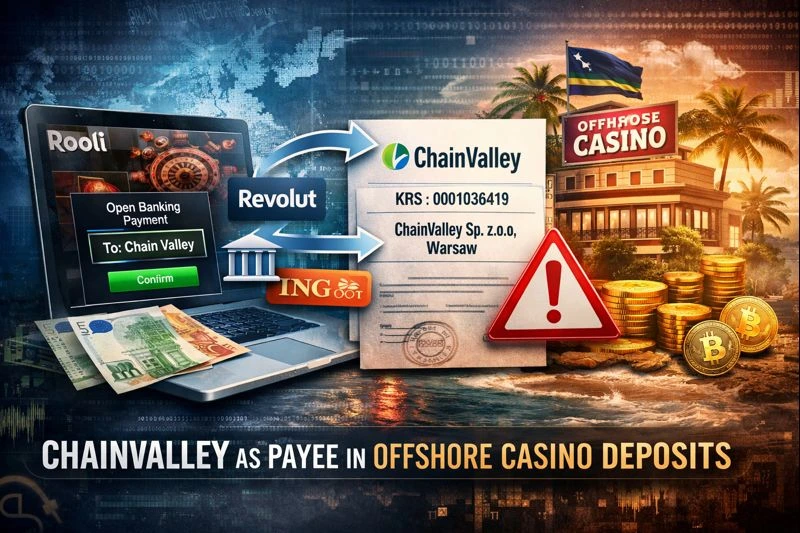
An investigation by Scam-Or Project into the offshore casino Rooli (rooli.com), operated by Curaçao-based Dama N.V., reveals a recurring Open Banking deposit configuration in which player bank transfers are directed to “Chain Valley” as the recipient. Across multiple observed payment flows, the confirmation screens identify Chain Valley as the payee, while the payer is a retail bank customer using institutions such as Revolut or ING.
This is not a benign technical detail. The designation of the payee represents a critical compliance pressure point within the payment chain.
Key Findings
-
Unlicensed gambling activity
Rooli operates as an offshore casino without authorisation to provide gambling services in the United Kingdom, the European Union, or North America. -
Observed payment rail
User selects Open Banking in the Rooli cashier → payment initiation screen → transfer marked “To: Chain Valley” → funds debited from the player’s bank account (e.g., Revolut, ING) and credited to Chain Valley.
This flow is supported by transaction screenshots. -
Corporate entity
Chain Valley Sp. z o.o., based in Warsaw, operates the domain chainvalley.pro. The company disclosures reference KRS 0001036419 and a Warsaw address. -
Polish registration status
Chain Valley appears in Poland’s virtual-currency activity register (RDWW-765, entry dated 25.05.2023). The listed activities include exchanges between virtual currencies and fiat means of payment, as well as intermediary services. -
Regulatory clarification
The Polish Ministry of Finance has publicly stated that inclusion in this register does not constitute a financial licence or prudential supervision. Oversight is limited primarily to AML/CFT compliance obligations. -
Operator positioning
Rooli indicates that payments are processed via Dama N.V. (Curaçao) and places responsibility on players to determine the legality of participation in their respective jurisdictions. -
Recurring pattern indicator
ChainValley previously appeared in Scam-Or Project reporting related to the Legiano payment rail, including FIAT-to-USDC “conversion” narratives that raise similar regulatory risks.
Illegal Gambling Exposure
It must be stated clearly: the underlying activity being funded is illegal across significant portions of the market. Rooli, like other Dama-branded casinos, appears to accept EU-based players and deposits without holding the necessary national gambling licences.
During the review, account registration and funding from EU banks occurred with minimal resistance. At the same time, the cashier interface dynamically presented EU languages and local banking options aligned with the user’s jurisdiction.
This combination strongly suggests intentional cross-border targeting rather than incidental accessibility. When a gambling service lacks legal authorisation in a player’s location, the payment infrastructure ceases to be neutral and instead functions as an enabler of unlawful activity.
Payment facilitators, Open Banking intermediaries, and associated service providers should therefore treat exposure to Dama-operated casinos as a high-risk or non-permissible use case, triggering rejection and off-boarding controls.
The observed reality, however, indicates that Open Banking, instant bank transfers, and crypto on-ramps are increasingly used to bypass local licensing requirements, card-based gambling blocks, and merchant monitoring frameworks.
Compliance Analysis
The Payee Problem
Within the Open Banking flow, the recipient of funds is Chain Valley. The transfer is not sent directly to the casino, nor to a licensed EU acquiring institution, nor to an e-money wallet with regulated safeguarding disclosures.
Functionally, this places Chain Valley in the role of a collection account or payment agent for casino deposits, or alternatively as a de facto merchant of record via a “crypto purchase” wrapper. In either scenario, this represents a high-risk typology commonly associated with gambling block circumvention: bank statements show “Chain Valley” rather than a casino name.
VASP Registration Is Not a Payment Licence
Registration as a virtual asset service provider does not confer the right to operate fiat payment rails. Under PSD2, payment services in the EU must be provided by authorised or registered payment service providers within the directive’s scope.
ChainValley’s public positioning emphasises crypto-related services, including KYC/AML policies, crypto purchases, and alternative payment methods such as instant bank transfers. If casino deposits are being processed as “crypto buys,” this should be viewed as regulatory arbitrage—gambling funding masked as virtual-asset onboarding.
Critical Questions for Stakeholders
Chain Valley
- Who is the ultimate beneficiary of transfers linked to offshore casino activity?
- Is Chain Valley acting as the merchant of record?
- Are incoming payments booked as casino deposits or as cryptocurrency purchases?
- How are funds settled onward to Dama N.V. or its payment service provider stack?
Open Banking providers
- Why is a casino cashier initiating transfers where the payee is a crypto-registered entity?
- What enhanced due diligence is applied to unlicensed or offshore gambling exposure?
Banks
- Why are repeated transfers to “Chain Valley” not flagged as potential gambling funding or third-party collection activity requiring investigation?
Call for Information
If you work at ChainValley, an Open Banking provider, a bank compliance or risk team, or within an offshore casino payment operation—and you have documentation explaining how these “To: Chain Valley” transactions are classified, settled, and screened—please share evidence securely.
Submissions (screenshots, transaction references, merchant agreements, settlement files, risk rules) can be sent via the Scam-Or Project whistleblower section.