
Skrill “Deposits” That Aren’t Deposits: German Player Says Bassbet Shifted from utPay to ChainValley — A MiCA-Era Payment Rail Transition?


A German offshore-casino player has shared a detailed report with Scam-Or Project that appears to support a developing hypothesis: ChainValley may be replacing the Lithuanian utPay/UTRG infrastructure in casino cashier systems, particularly in payment flows presented to users as Skrill deposits.
According to the player, the transaction that appeared as a “Skrill payment” was in fact structured as a cryptocurrency purchase followed by a transfer to a wallet address. In addition, during a refund attempt the player encountered a KYC verification process where the verification link was allegedly sent by ChainValley support, suggesting possible backend operational continuity between the systems.
Key Findings
Based on the player’s report and additional context reviewed by Scam-Or Project, several observations stand out.
Alleged Payment Rail Switch
The player reports that Bassbet casino changed its internal payment rail:
- Previous infrastructure: Utorg / utPay
- Current infrastructure: ChainValley
- User interface: still presented as a “Skrill transfer”
This suggests that the consumer-facing payment method remained unchanged, while the backend infrastructure may have been replaced.
Minimal Disclosure Inside Skrill Flow
The player described a small disclosure notice in the Skrill interface stating that the user agrees to purchase cryptocurrency and send it to a stored wallet address.
This structure mirrors patterns previously documented by Scam-Or Project in “fake-fiat” deposit flows, where:
- the user believes they are making a normal e-wallet deposit
- the legal transaction becomes a crypto purchase
- the purchased crypto is immediately forwarded to a casino wallet
Such disclosures may appear in low-visibility interface elements and sometimes with pre-selected consent boxes.
Unusual Refund and KYC Process
During a refund attempt, the player described the following sequence:
- Utorg support requested identity verification
- The verification link was sent by ChainValley support
If technically confirmed, this detail could indicate:
- shared operational infrastructure
- a migration from utPay to ChainValley
- white-label operational continuity between systems
Regulatory Context: utPay Suspension Under MiCA
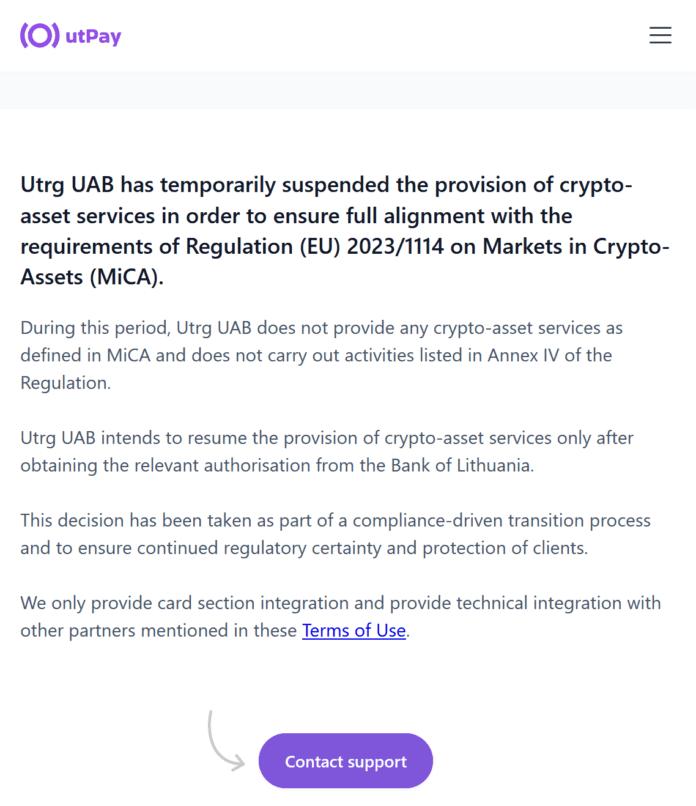
Scam-Or Project previously reported that UTRG UAB, operating under the utPay brand in Lithuania, suspended all crypto-asset services effective 1 January 2026.
The company cited the need to comply with the EU’s MiCA (Markets in Crypto-Assets Regulation) and stated that operations remain suspended pending authorization from the Bank of Lithuania.
This regulatory pressure provides an important background for the possible transition described by the player.
UTORG and ChainValley Technical Link
Public product navigation from UTORG shows a direct routing between the platforms.
According to the UTORG Terms of Use, the service operates as a cryptocurrency purchase and exchange interface.
At the same time, the “Buy Crypto” section on the UTORG website redirects users directly to app.chainvalley.pro, indicating a technical integration between the platforms.
This routing appears to be part of the platform’s own product flow rather than an indirect or third-party integration.
Terms vs Observed Reality
According to ChainValley’s published Terms and Conditions, users are prohibited from using the service for:
- illegal gambling operations
- illegal gambling services
However, investigative observations repeatedly show ChainValley appearing in casino cashier environments, including cases where the gambling operator may not be licensed in the player’s jurisdiction.
Analysis
1. The “Skrill Disguise”
The payment process described by the player follows a structure frequently observed in high-risk gambling environments:
- A casino cashier displays a trusted payment brand such as Skrill.
- The user proceeds through what appears to be a standard deposit interface.
- The transaction is actually processed as:
- a cryptocurrency purchase, and
- a transfer of that crypto to a casino wallet.
This distinction is important.
If the payment is legally categorized as a crypto purchase, consumer redress options may be significantly reduced. Operators may argue that the user received the purchased cryptocurrency, limiting refund or chargeback options.
A similar mechanism was previously documented in the Legiano case, where deposits presented as wallet payments were ultimately converted into crypto transfers to casino wallets.
Compliance Implications
Such payment structures raise several potential regulatory concerns:
- consumer protection risks
- AML and KYB transparency issues
- payment-rail integrity
- misleading payment interface design
These issues become especially relevant in jurisdictions where the underlying gambling offer may be unauthorized.
2. The ChainValley Verification Link
The most technically significant detail in the player’s report concerns the KYC verification link allegedly sent by ChainValley support.
If verified, this could indicate:
- shared operational infrastructure
- a service migration from utPay to ChainValley
- white-label backend operations
Notably, ChainValley’s Terms explicitly allow third parties to deploy the platform as a white-label solution, which could technically enable such arrangements.
Evidence Needed
To verify this claim, investigators would require:
- the original verification email
- full email headers
- the complete verification URL
- support ticket identifiers
- screenshots of the verification interface and branding
Updated Working Hypothesis
Based on available indicators, a possible interpretation is emerging:
ChainValley may be functioning as the operational successor rail to utPay following MiCA-related regulatory pressure.
Supporting signals include:
- utPay service suspension in January 2026
- direct UTORG → ChainValley product routing
- reported cashier changes in casino payment systems
- similar transaction structures observed in casino deposits
If confirmed, this would represent an evolution of existing payment infrastructure under regulatory pressure, rather than the entry of a completely new provider.
Summary Table
| Node | Brands in Casino Cashier | Key Domains | Legal Entity / Jurisdiction | Regulatory Situation | Role in Payment Flow |
|---|---|---|---|---|---|
| utPay / UTORG (legacy rail) | utPay / Utorg appearing behind deposit methods | utpay.io, app.utpay.io, utorg.com, utorg.pro | UTRG UAB (Lithuania) | Services reported suspended from 1 Jan 2026 pending MiCA authorization | Crypto on-ramp used for casino deposits |
| ChainValley (replacement rail) | Skrill / Neteller flows leading to crypto purchase | chainvalley.pro, app.chainvalley.pro | Chain Valley Sp. z o.o. (Poland) | Terms prohibit illegal gambling but casino integrations repeatedly observed | Crypto purchase and wallet forwarding layer |
| UTORG → ChainValley routing | “Buy Crypto” navigation | utorg.com | UTORG platform | Direct routing to app.chainvalley.pro visible in product flow | Evidence of technical integration |
| Casino example | Bassbet cashier | player-provided | Offshore operator (unverified) | Player claims casino licensing status unclear | Reported switch from Utorg to ChainValley |
Evidence Request From Players and Insiders
Scam-Or Project invites players and industry insiders to submit evidence if they have encountered Skrill or Neteller deposits at offshore casinos that redirect into utPay, UTORG, or ChainValley transaction flows.
Relevant materials include:
- screenshots of deposit screens showing Skrill branding and disclosure text
- exchange order pages from utPay / Utorg / ChainValley
- bank or Skrill statements showing transaction descriptors and reference IDs
- blockchain evidence such as USDT or USDC transaction hashes
- support emails, especially KYC verification links sent by ChainValley support
Evidence can be submitted securely through the Scam-Or Project website.
Such documentation helps investigators reconstruct the merchant-of-record chain and determine which regulated payment entities or upstream partners may be facilitating deposits into unauthorized gambling operations.