
Plunging Whistleblower Awards: Do the 2025 SEC and CFTC Reports Indicate a Shift in Enforcement Policy?

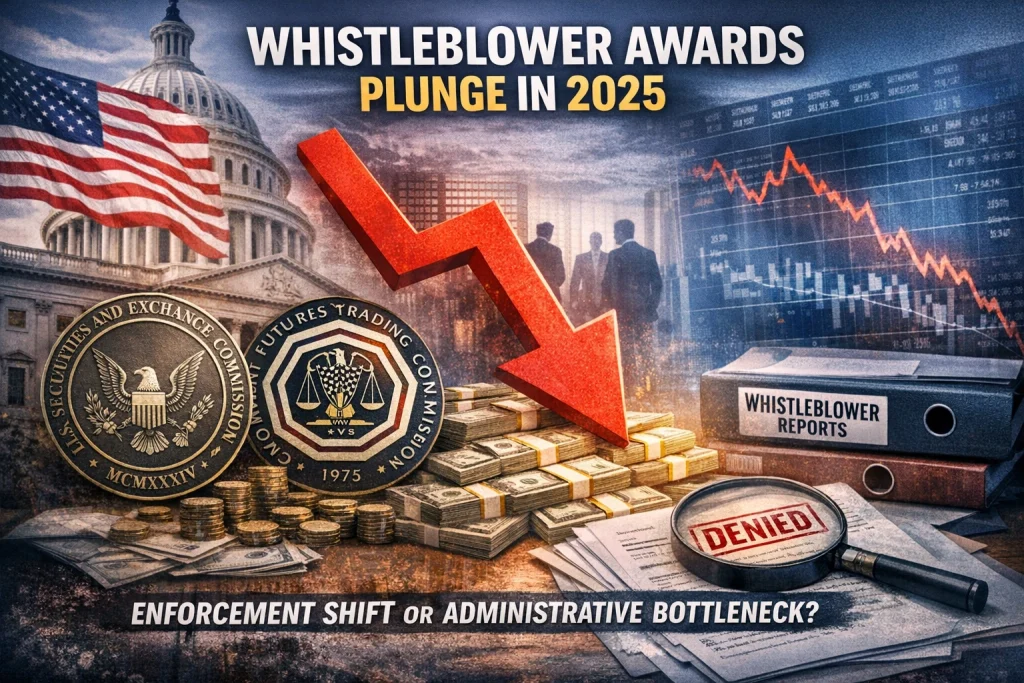
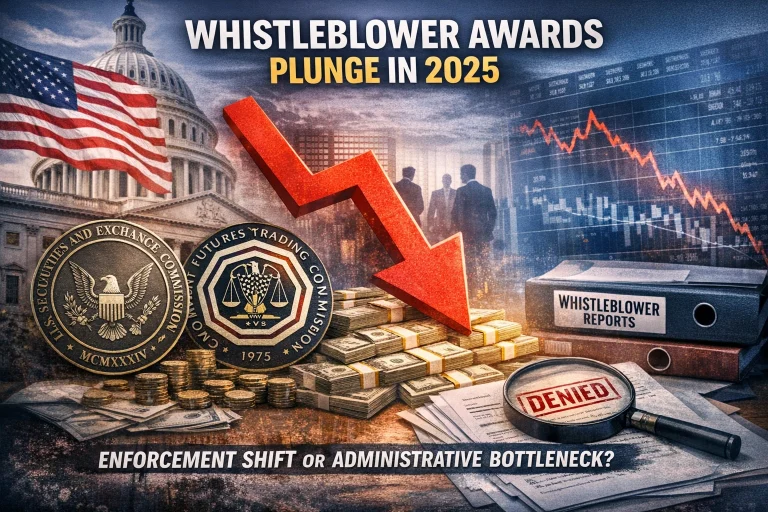
The whistleblower reports released by the SEC and CFTC for fiscal year 2025 reveal a sharp reduction in both the number and total value of awards granted. With payouts falling to levels not seen in years, questions arise about whether this downturn reflects temporary administrative constraints or a deeper shift in regulatory priorities under the Trump administration.
Below we examine the latest data and what it may signal for whistleblower programs and enforcement policy in the United States.
Key Findings: FY 2025 Whistleblower Data Overview
The fiscal year (FY) 2025 reports delivered to U.S. Congress in February 2026 outline several notable developments in the whistleblower ecosystem.
Major Highlights
-
SEC Awards Decline Sharply
The SEC granted approximately $60 million to 48 whistleblowers during FY 2025. - FY 2024: $255 million awarded
- FY 2023: $600 million awarded (record high)
-
CFTC Awards Drop Significantly
The CFTC approved only two whistleblower awards totaling $4.6 million in FY 2025. - FY 2024: $42 million distributed to 12 whistleblowers
-
Tip Volume Continues to Grow
Despite lower payouts, the SEC received roughly 27,000 tips, representing an 8% increase year-over-year. -
High Denial Rates
The SEC rejected over 120 award claims, with denial rates exceeding 80% at certain points during the fiscal year. -
Enforcement Staffing Cuts
The SEC enforcement division reportedly lost around 17% of its personnel, resulting in: - consolidation of field offices
- dissolution of certain enforcement units
-
Deferred Financial Obligations
According to the SEC 2025 Agency Financial Report, the agency has reserved $218 million to $655 million for probable future whistleblower awards. This suggests that although payouts slowed, potential liabilities remain substantial.
Comparative Perspective: Pressure on the Whistleblower System
A comparison between FY 2025 and the preceding years illustrates a striking disconnect between incoming tips and awarded payouts.
Between 2020 and 2024, the SEC whistleblower program distributed approximately $1.8 billion in total awards and was widely regarded as a powerful mechanism for uncovering complex financial fraud schemes.
In contrast, FY 2025 saw the conversion rate from tip to award collapse, raising concerns among whistleblower advocates.
Industry Reactions
Stephen M. Kohn, Chairman of the U.S. National Whistleblower Center, described the situation bluntly, stating that the CFTC whistleblower program is “in crisis.” According to Kohn, delays in case processing and award payments undermine the fundamental intent of the Dodd-Frank Act, which established these whistleblower incentives.
Other experts see a different explanation.
Dave Jochnowitz, attorney at Outten & Golden, argues that the large contingent liabilities listed in the SEC’s financial statements demonstrate that the program remains financially active. In his view, enforcement agencies are being forced to operate with reduced resources, creating severe processing backlogs rather than dismantling the whistleblower framework.
Interpreting the Decline
Working Hypothesis
Hypothesis:
The significant drop in whistleblower awards during FY 2025 indicates that whistleblower programs and compliance enforcement have become less of a priority under the Trump administration.
To evaluate this claim, it is necessary to distinguish between administrative constraints and policy-driven changes.
Evidence Supporting the Hypothesis
Several indicators suggest a structural shift in enforcement policy:
- SEC award payouts fell by nearly 75%
- CFTC awards declined by roughly 90%
- SEC enforcement staffing decreased by about 17%
- Certain enforcement units were disbanded
- Record numbers of award denials were issued
Taken together, these factors point toward a leaner and more conservative regulatory approach, where enforcement resources are more limited and award eligibility is evaluated under stricter criteria.
Evidence Challenging the Hypothesis
However, several elements indicate that whistleblower programs remain operational and financially supported:
- The SEC reserved up to $655 million for future whistleblower payouts.
- The growing backlog may stem from staff shortages rather than policy abandonment.
-
Regulators have reported a surge of low-quality or frivolous submissions.
For example, in FY 2024 more than 14,000 tips were submitted by just two individuals, overwhelming screening processes and increasing denial rates.
These factors suggest that operational bottlenecks, rather than strategic dismantling, could explain much of the decline in payouts.
Conclusion
The evidence indicates that the hypothesis is partially valid.
The current regulatory environment emphasizes smaller enforcement teams and tighter resource allocation, which has significantly slowed the processing and awarding of whistleblower claims. This has directly reduced the visible output of the SEC and CFTC whistleblower programs.
However, the programs themselves do not appear to be intentionally dismantled. Instead, the data points to a severe administrative backlog, where regulators are applying stricter scrutiny while operating with fewer personnel.
In practical terms, the whistleblower system remains intact—but its operational efficiency has clearly deteriorated.
Call to Action: Report Misconduct Through the Scam-Or Project Whistleblower Channel
If bureaucratic delays and rising denial rates discourage reporting through federal programs, alternative reporting channels remain available.
Whistleblowers, insiders, compliance officers, and industry professionals can submit evidence of financial misconduct, crypto fraud, regulatory violations, or payment-processing abuse through the Scam-Or Project whistleblower section.
Secure and anonymous submissions help expose bad actors and maintain market integrity—even when official enforcement pipelines move slowly.