
Gambling’s Hidden Influencer Network: How Social Media Personalities Direct European Players to Illegal Casinos

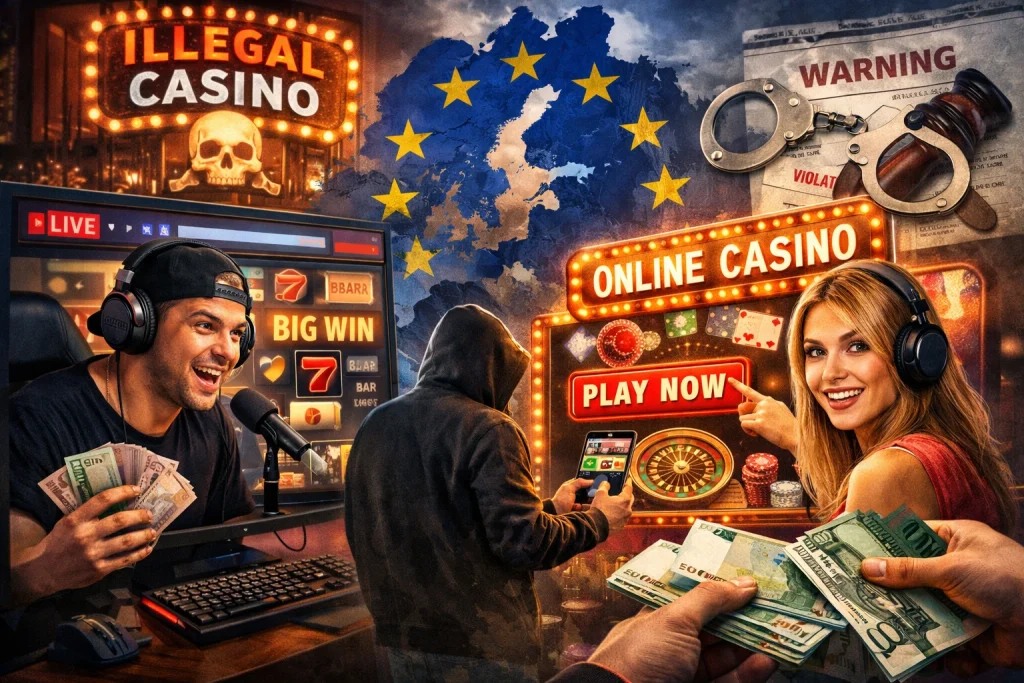
A recent cross-border investigation by Investigative Europe highlights a large-scale ecosystem in which well-known YouTube and Twitch influencers guide millions of European users toward blacklisted and unlicensed online casinos. Some influencers reportedly receive commissions reaching up to 60% of their audience’s gambling losses, operating within a significant regulatory gray zone.
This model raises serious concerns related to compliance oversight, anti-money laundering (AML), and consumer protection. Scam-Or Project analyzes the potential legal exposure of these digital promoters and encourages whistleblowers to reveal the affiliate networks that financially sustain these activities.
Key Findings of the Investigation
The investigation outlines several structural elements of the influencer-driven gambling ecosystem.
Affiliate Revenue Models
Investigative Europe describes a system built on revenue-share and CPA (Cost Per Acquisition) models, where streamers receive payments for each player they refer.
According to whistleblower materials:
- Influencers may earn direct commissions tied to player losses.
- Some agreements combine CPA payments and ongoing revenue share.
- The model incentivizes affiliates to promote high-risk gambling behavior.
This structure creates a financial motive for influencers to continuously drive traffic toward these platforms.
Cross-Border Promotion Across Europe
The investigation identified prominent influencers operating across multiple European markets who promote casinos without valid European licenses.
Countries mentioned include:
- Italy
- Portugal
- Greece
- Poland
- Germany
- Spain
- Sweden
Promotion methods often include:
- Direct links embedded during livestreams
- URLs placed in video descriptions
- Affiliate links in comments or pinned posts
These tactics enable illegal operators to bypass national advertising restrictions.
The Soft2bet Ecosystem
Investigative Europe reports that a significant portion of the promoted casino platforms eventually connect back to Soft2bet, a European gambling technology firm.
The investigation links this ecosystem to more than 100 casinos previously placed on regulatory blacklists, suggesting a centralized technology infrastructure behind many of these operations.
“House Money” Streaming Practices
Whistleblower accounts also describe a controversial practice commonly known as “house money streaming.”
In these setups:
- Influencers receive pre-funded gambling accounts.
- The balances may be non-withdrawable promotional funds.
- Streamers gamble with minimal personal financial risk.
For viewers, however, the financial risk is real. The livestream creates the illusion of authentic play, while the influencer may not actually lose personal funds.
Uneven Regulatory Enforcement
Authorities across Europe have begun responding to influencer-driven gambling promotion, though enforcement varies significantly.
Examples include:
- Italy’s AGCOM has issued sanctions against major platforms for hosting illegal gambling advertising.
- Dutch regulators have pursued enforcement actions against influencers promoting unlicensed operators.
Despite these efforts, enforcement remains inconsistent across jurisdictions.
Platform Responsibility Under the Digital Services Act (DSA)
Within the European Union, the Digital Services Act (DSA) places new responsibilities on large online platforms.
Key obligations include:
- Establishing mechanisms to report illegal content
- Removing illegal services promotion when identified
- Mitigating systemic risks linked to scalable harms
When promotion of illegal gambling becomes widespread and persistent, platforms may face scrutiny regarding their response once they are notified.
Compliance and Legal Analysis: Why This Is More Than Marketing
Although influencer promotion may appear to be ordinary advertising, the operational structure suggests a more complex compliance issue.
1. Influencers as High-Risk Affiliate Intermediaries
In regulated gambling markets, affiliate marketing is already recognized as a potential compliance risk.
The evidence presented by Investigative Europe indicates that illegal casino operators — or their marketing intermediaries — rely on influencers as a front-end distribution layer.
The structure typically works as follows:
| Role | Function |
|---|---|
| Influencer | Provides audience trust, community engagement, and visibility |
| Casino operator | Supplies the gambling platform |
| Affiliate network | Tracks referrals and distributes commissions |
This creates a structured acquisition pipeline rather than casual promotion.
Compliance Implications
From a compliance perspective, influencers resemble traffic brokers or introducers in other financial-crime typologies.
Risk-mitigation measures that would normally apply include:
- Affiliate identity verification (KYC)
- Marketing audit rights
- Geographic restrictions for advertising
- Transparent affiliate tracking systems
- Traceable payment flows
2. Legal Exposure for Advertising Unlawful Gambling
Many jurisdictions treat advertising illegal gambling services as a criminal or administrative offense.
For example:
- Under the UK Gambling Act 2005, Section 330 makes advertising unlawful gambling an offense.
While liability varies depending on jurisdiction and specific facts, creators targeting audiences in regulated markets while promoting unlicensed casinos may face legal exposure — particularly when promotions involve:
- Paid advertising
- Affiliate tracking links
- Direct user acquisition campaigns
Potential Enforcement Targets
Regulators increasingly pursue multiple layers within the distribution chain:
- The casino operator
- Affiliate networks or marketing intermediaries
- Influencers distributing the promotion
- Platforms hosting the content
The enforcement strategy often depends on national law and regulatory priorities.
3. Consumer Protection and AML Concerns
Investigative Europe emphasizes that unlicensed casinos frequently lack the protections provided by regulated operators.
Key risks include:
- Weak or absent Know-Your-Customer (KYC) procedures
- Limited affordability checks
- Poor dispute resolution mechanisms
- Reduced financial oversight
From an AML perspective, funneling users into these environments creates a compliance blind spot, where oversight mechanisms are significantly weaker.
4. Platform Responsibility Under the DSA
The Digital Services Act focuses heavily on harms that scale across large platforms.
Key questions regulators may ask include:
- Were illegal services promoted at scale?
- Did platforms receive reports about the content?
- What mitigation actions were taken afterward?
The AGCOM sanctions in Italy demonstrate that authorities are willing to take action against platforms hosting illegal gambling advertising targeted at domestic audiences.
Working Hypothesis: Influencers as the Conversion Layer of Illegal Casino Markets
A plausible interpretation of the current ecosystem is that illegal casino operators have professionalized their marketing infrastructure between 2024 and 2026.
Under this model, influencers function not simply as promoters but as performance-based acquisition partners.
They contribute to the ecosystem by:
- Transferring credibility through personal relationships with followers.
- Demonstrating gambling in real time via livestreams and recorded content.
- Monetizing audiences through affiliate programs, sometimes linked to player losses.
This dynamic effectively places influencers in a risk-bearing position within the compliance chain, comparable to unregulated brokers in financial markets:
- High audience reach
- Minimal regulatory oversight
- Strong incentives to maximize conversions.
Expected Regulatory Trend
Future enforcement may increasingly follow a two-track strategy:
- Targeting illegal casino operators
- Disrupting the surrounding marketing infrastructure
This includes affiliate networks, payment processors, influencers, and hosting platforms.
Call for Information
Do you have information about influencers, marketing agencies, affiliate programs, referral links, or payment flows connected to unlicensed casinos targeting EU or UK users?
Relevant evidence may include:
- Affiliate agreements (CPA or revenue share)
- Screenshots of promotional content
- Referral URLs or tracking links
- Payment confirmations or invoices
- Outreach via Telegram or Discord
- Platform takedown patterns
You can submit tips anonymously through the Scam-Or Project whistleblower section.
Such information may help expose the networks that enable illegal casino promotion across Europe.