
Volt in the Payment Rail Map: KNF-Licensed PISP Surfaces in Offshore Casino Deposit Flows

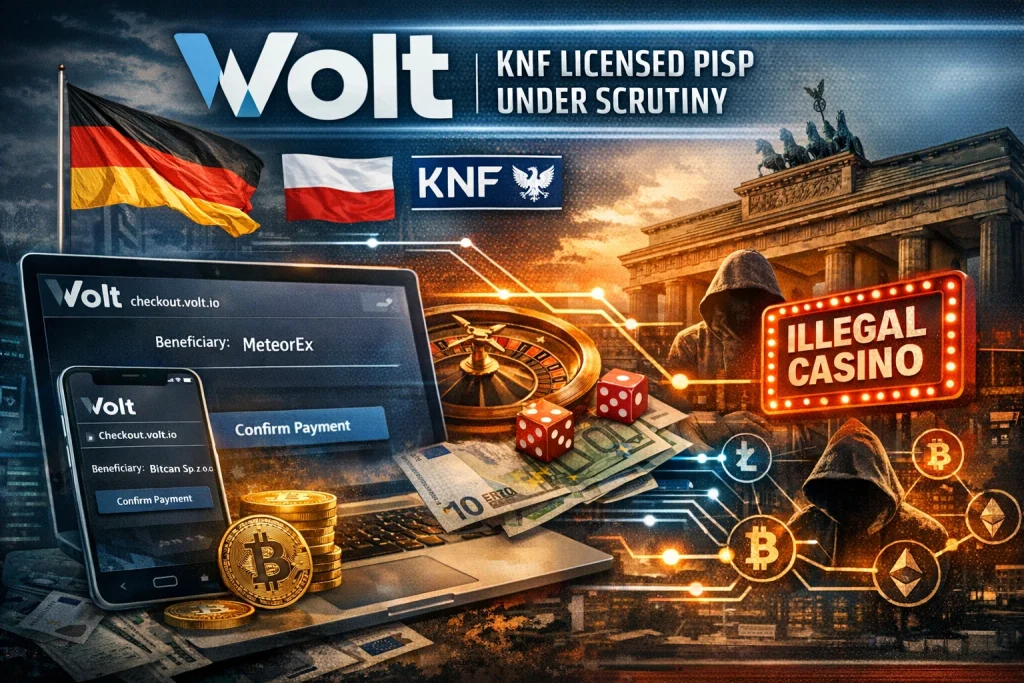
Volt, an open-banking provider licensed by the Polish Financial Supervision Authority (KNF), has been identified in documented payment flows linked to offshore casinos targeting users in Germany. A review conducted by Scam-Or Project shows that Volt’s checkout interface appears within deposit journeys routed through crypto-related intermediaries. This raises critical questions regarding merchant due diligence, compliance with German gambling restrictions, and the regulatory exposure of licensed Payment Initiation Service Providers (PISPs).
Key Findings
- Volt Technologies sp. z o.o. is authorised by the KNF as a National Payment Institution (entity ID 635816).
- Corporate disclosures identify Steffen Vollert as CEO, with funding rounds including:
- In analyzed deposit flows, checkout.volt.io appears in casino payment paths targeting Germany, with MeteorEx and Bitcan listed as beneficiaries instead of the casino operator.
- Volt’s user terms explicitly state that payments may be routed to a merchant provider rather than directly to the end merchant.
- German law prohibits payment participation in unauthorised gambling activities, and courts have upheld enforcement actions, including against payment initiation services.
The Core Compliance Question
How does a payment to an illegal offshore casino result in an open-banking transaction initiated by a KNF-licensed institution?
This question arises from two deposit flows reviewed by Scam-Or Project. In both cases:
- The user begins on a casino interface accessible from Germany
- The transaction passes through multiple gateway layers
- The final payment initiation occurs via Volt’s checkout
- The beneficiary is a crypto-linked intermediary rather than the casino itself
Why Volt’s Role Is Significant
Volt is not a peripheral service provider. Public records confirm:
- Volt Technologies sp. z o.o. operates as a regulated National Payment Institution in Poland
- The group structure includes:
- Volt Technologies Holdings Limited (UK) (Companies House)
- Volt Technologies Limited (UK, EMI authorised by FCA) (Companies House)
- Registered address: 42 Berners Street, London
Volt markets itself as infrastructure for real-time account-to-account payments across Europe. Its regulated status is clear — the issue lies in how its infrastructure is being used.
Regulatory Context in Germany
Germany’s Interstate Treaty on Gambling prohibits participation in payment processing for unauthorised gambling operators once illegality is established.
- 2023:
- 1,864 websites reviewed
- 133 prohibition proceedings initiated
- 2024:
- Over 1,700 websites reviewed
- 231 prohibition proceedings initiated
Court decisions have reinforced this approach:
- October 2023: OVG Sachsen-Anhalt confirmed legality of payment service prohibitions
- December 2024: Payment-blocking order upheld against a Swiss Zahlungsauslösedienst
This places payment providers directly within the enforcement perimeter.
Observed Deposit Flows
Flow A: PalmSlots
- User selects open-banking payment option
- Redirect chain:
- cashier.smartpayz.com
- tollgate.smartpayz.com
- gate.wltpay.pro
- checkout.volt.io
- Beneficiary: MeteorEx
- Country: Germany
Flow B: PureBets
- User selects “Bank Transfer”
- Redirect chain:
- Smartpayz layers
- gatewaycpay.com
- Consent screen:
- User agrees to purchase crypto and send to a designated address
- Entity identified: Bitcan Sp. z o.o.
- Final step:
- Redirect to Volt checkout
- Beneficiary: Bitcan
These flows show Volt acting as the visible payment initiation layer, not merely a background API.
Key Intermediaries in the Payment Chain
MeteorEx s.r.o.
- Czech-registered crypto service provider
- ICO: 21270244
- Platform: meteorex.net
- Functions as fiat-to-crypto on-ramp
Bitcan Sp. z o.o.
- Registered in Poznań, Poland
- Operates crypto exchange (bitcan.pl)
- Owned by ARI10 Sp. z o.o.
- Provides crypto gateway and POS infrastructure
Smartpayz
- Payment orchestration layer
- Identified as “Ghost Entity” in prior investigations
- No confirmed legal registration
wltpay.pro
- White-label payment gateway layer
- No verifiable corporate attribution
gatewaycpay.com
- Displays crypto purchase consent step
- Explicitly links fiat deposits to crypto transactions
Merchant Due Diligence Concerns
Volt’s Merchant Services Agreement allows suspension if usage is unlawful or exposes the company to risk.
However, Volt’s own terms confirm:
- Payments may be directed to merchant providers rather than the final merchant
The European Banking Authority (EBA) guidance indicates that PISPs are not always required to conduct full due diligence on both payer and payee simultaneously.
This leads to a critical question:
- Who exactly was onboarded as Volt’s merchant in these flows?
- What use case was declared during onboarding and monitoring?
If intermediaries such as MeteorEx or Bitcan were onboarded instead of the casino operator, the compliance implications become more complex.
Why Flow B Is Particularly Important
Flow B presents the strongest evidence:
- User selects a fiat deposit method
- Is shown a consent screen to purchase crypto
- Funds are routed via Bitcan
- Volt initiates the payment
This suggests a structured pattern:
- Casino deposit appears as bank transfer
- Transaction is converted into crypto mid-flow
- Funds are routed via intermediary
- Volt executes payment initiation
Such layered structures are typically subject to heightened regulatory scrutiny.
Operator Perspective
From a German legal standpoint, the key issue is not licensing in Curaçao or elsewhere — it is whether the operator is authorised in Germany.
German law:
- Prohibits payments linked to unauthorised gambling
- Treats payment infrastructure as an enforcement point
Thus, the structure of the payment flow is more relevant than the casino’s marketing claims.
Why This Matters for Volt
Volt operates as a regulated, venture-backed payment institution. Its infrastructure is designed for compliant financial transactions.
However, its presence in these flows raises three core concerns:
1. Merchant Onboarding and Monitoring
- Were intermediaries properly assessed?
- Was the actual end-use of payments understood?
2. German Regulatory Exposure
- Payment providers are now directly targeted
- Enforcement includes cross-border entities
3. Supervisory Oversight
- Volt’s Polish entity is regulated by KNF
- Compliance failures fall within supervisory scope
Entities and Domains Observed
| Layer | Entity / Domain | Role |
|---|---|---|
| Casino | PalmSlots / PureBets | Deposit interfaces |
| Gateway | Smartpayz | Payment orchestration |
| Gateway | wltpay.pro | Redirect layer |
| Gateway | gatewaycpay.com | Consent & crypto step |
| PISP | checkout.volt.io | Payment initiation |
| Intermediary | MeteorEx | Crypto on-ramp |
| Intermediary | Bitcan | Crypto exchange |
| Regulated entity | Volt Technologies sp. z o.o. | KNF-licensed institution |
Summary: Volt.io Structure
| Category | Details |
|---|---|
| Holding | Volt Technologies Holdings Limited |
| UK Entity | Volt Technologies Limited (FCA EMI) |
| Polish Entity | Volt Technologies sp. z o.o. |
| Licence | KNF National Payment Institution |
| CEO | Steffen Vollert |
| Funding | $23.5M (Series A), $60M (Series B) |
| Model | Open-banking payment infrastructure |
| Observed role | Payment initiation in casino flows |
Conclusion
The issue is not whether Volt is licensed — it is.
The issue is whether a licensed payment institution can distance itself when its checkout layer is embedded in deposit flows that:
- Originate from offshore casino front-ends
- Pass through opaque gateway systems
- End with crypto-linked intermediaries rather than the gambling operator
In the reviewed materials, this exact structure is present. In one case, the user explicitly agrees to purchase crypto after selecting a casino deposit option.
This is not a minor compliance nuance. It is a structural issue within the payment rail — one that carries clear regulatory implications.
Call for Information
If you possess relevant materials — including payment screenshots, gateway logs, onboarding documentation, compliance communications, or insider knowledge regarding Volt, Smartpayz, gatewaycpay, wltpay, MeteorEx, Bitcan, or related infrastructure — you can securely share them via the Scam-Or Project whistleblower section.
Scam-Or Project welcomes verifiable evidence related to payment processing, illegal gambling infrastructure, and compliance gaps.
Sources
- KNF register (Volt Technologies sp. z o.o., entity ID 635816)
- Volt regulatory disclosures
- Companies House (UK entities)
- FCA register and Volt legal documentation
- German Interstate Treaty on Gambling (2021)
- GGL enforcement reports (2023–2024)
- OVG Sachsen-Anhalt rulings (2023–2024)
- EBA Q&A 2021_6048
- Volt Merchant Agreement and User Terms
- MeteorEx and Bitcan public data
- ARI10 corporate information