

DeFi Bingo: Hyperliquid’s Billion-Dollar Engine

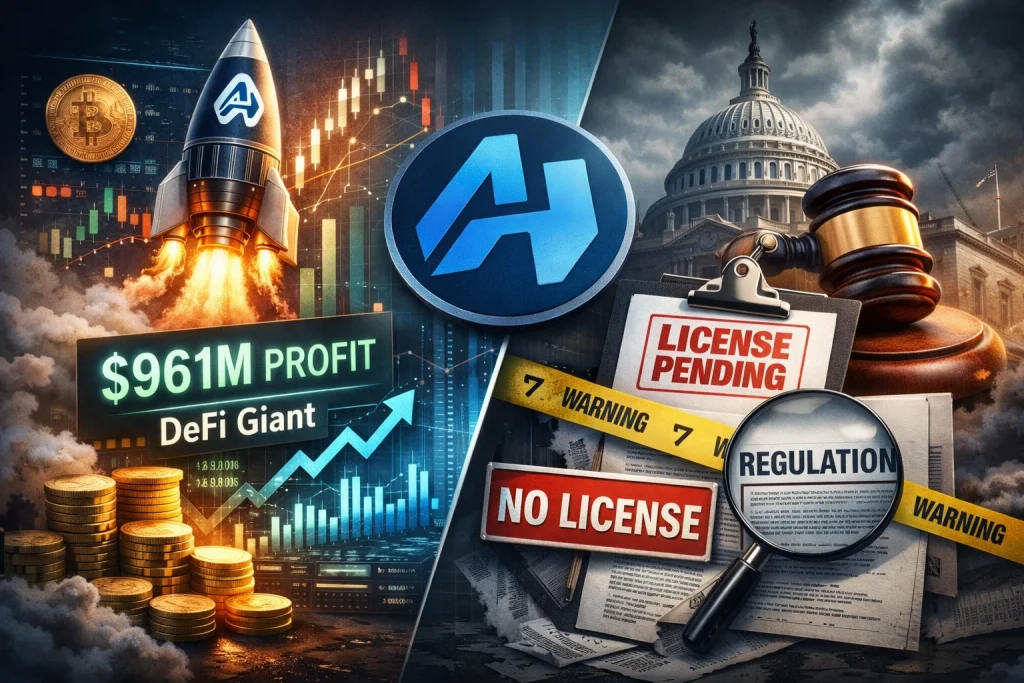
A High-Performance DeFi Trading Giant Confronts the Licensing Dilemma
Hyperliquid has emerged as one of the most powerful revenue-generating mechanisms in the crypto space. According to publicly available analytics, the protocol produced approximately $961.5 million in gross protocol revenue in 2025, alongside an estimated $873.7 million in gross profit. Even today, its annualized revenue remains close to $675 million.
Operationally, the platform handles around $193.9 billion in 30-day perpetual trading volume, maintains roughly $8.2 billion in open interest, and supports a token market capitalization of approximately $10.6 billion. However, beneath this rapid expansion lies a critical compliance issue: while Hyperliquid emphasizes self-custody, jurisdictional restrictions, and sanctions compliance in its official materials, Scam-Or Project could not identify any publicly disclosed exchange, broker-dealer, or derivatives license tied to the reviewed interface or protocol infrastructure.
Key Findings
-
Exchange-Level Economics
Hyperliquid operates at a scale comparable to centralized exchanges. Data from DeFiLlama indicates approximately $674.6 million in annualized revenue, $758.8 million in annualized fees, $193.9 billion in 30-day perpetual volume, and $8.21 billion in open interest. -
Outstanding 2025 Financial Results
Based on quarterly protocol data, Hyperliquid achieved around $961.49 million in gross protocol revenue in 2025 and approximately $873.68 million in gross profit after costs. -
Extreme Efficiency Model
The project is widely described as operating with a team of roughly 11 people, yet generating over $900 million in profit—making it one of the most profitable crypto startups per employee. -
Direct Value Capture Mechanism
Fees are allocated to community participants, deployers, HLP, and the Assistance Fund, which converts fees into HYPE tokens and burns them, reinforcing token scarcity. -
Expansion Toward Traditional Finance
In March 2026, S&P Dow Jones Indices licensed the S&P 500 to Trade[XYZ] for perpetual contracts on Hyperliquid—highlighting growing institutional relevance. -
Regulatory Weakness
While access is restricted for users in certain jurisdictions (e.g., the United States), no publicly disclosed licensing framework for the trading interface or protocol was identified. -
Increasing Regulatory Pressure
Hyperliquid has funded a Washington-based policy center focused on enabling legal pathways for DeFi perpetuals in the U.S., signaling awareness of regulatory risks.
Why This Matters
Hyperliquid has moved beyond the category of niche DeFi protocols. It now resembles a full-scale financial infrastructure player, combining:
- High throughput and deep liquidity
- Significant fee generation
- A native Layer-1 blockchain
- EVM compatibility
- A token increasingly behaving like a growth equity proxy
For Scam-Or Project, the central issue is not its success but its scale versus regulatory positioning. As Hyperliquid grows, the traditional DeFi approach—self-custody combined with geofencing and legal ambiguity—becomes harder to justify.
Financial Performance
A DeFi Platform Generating Exchange-Level Cash Flow
Current metrics from DeFiLlama highlight the platform’s scale:
| Metric | Value |
|---|---|
| Total Value Locked (TVL) | ~$4.99 billion |
| 30-Day Revenue | ~$62.2 million |
| 30-Day Protocol Revenue | ~$55.29 million |
| 30-Day Perpetual Volume | ~$193.9 billion |
| 24h Perpetual Volume | ~$7.41 billion |
| Open Interest | ~$8.21 billion |
| Market Cap (HYPE) | ~$10.63 billion |
| Fully Diluted Valuation | ~$42.9 billion |
2025 Revenue Breakdown
| Quarter | Gross Protocol Revenue |
|---|---|
| Q1 2025 | $139.67 million |
| Q2 2025 | $180.35 million |
| Q3 2025 | $354.94 million |
| Q4 2025 | $286.53 million |
| Total 2025 | $961.49 million |
Total cost of revenue across 2025 was approximately $87.81 million, resulting in an estimated $873.68 million gross profit.
These numbers reinforce the narrative: Hyperliquid delivers exchange-level profitability with minimal organizational overhead.
Why Hyperliquid Outperformed Expectations
Hyperliquid’s architecture is central to its success. Its documentation describes:
- A purpose-built Layer-1 blockchain
- Fully on-chain order books (spot and perpetuals)
- One-block finality
- Throughput of ~200,000 orders per second
- Integration with HyperEVM for developer access
This design enables a compelling value proposition:
centralized exchange performance without centralized infrastructure.
Revenue Model
Unlike many protocols, Hyperliquid routes fees toward ecosystem participants:
- Community
- HLP participants
- Deployers
- Assistance Fund (token buyback and burn)
This aligns trading activity directly with token value appreciation.
Expansion Beyond Crypto
The licensing of the S&P 500 benchmark for perpetuals demonstrates that external institutional players now recognize Hyperliquid as a viable liquidity infrastructure—not merely a DeFi experiment.
Regulatory Status
Large-Scale Platform, Limited Licensing Visibility
The regulatory picture presents a stark contrast to its commercial success.
- The platform restricts access for “Restricted Persons,” including users from the U.S. and Ontario, as outlined in its official terms
- Users interact through self-custodial wallets rather than traditional onboarding
- Documentation emphasizes technical access, not regulatory licensing
After reviewing official materials, Scam-Or Project did not identify:
- Broker-dealer licenses
- Exchange licenses
- Derivatives licenses
- CASP or MTF registrations
This does not necessarily prove absence of regulation within the broader ecosystem. However, it indicates that public-facing regulatory transparency is significantly weaker than the commercial narrative.
Cayman Foundation ≠ Trading License
An SEC-related filing references the Hyper Foundation, a Cayman Islands entity established in October 2024 to oversee governance and ecosystem growth.
However, this structure:
- Supports governance and development
- Does not constitute a trading license
- Does not address regulatory obligations for leveraged derivatives markets
This distinction is critical and often misunderstood within crypto ecosystems.
Regulation as the Next Strategic Frontier
In February 2026, Hyperliquid funded the Hyperliquid Policy Center in Washington, D.C., with an estimated $28 million contribution aimed at shaping regulatory frameworks for decentralized derivatives.
This move reflects a strategic reality:
future valuation may depend not only on trading volume but on regulatory legitimacy.
Scam-Or Project Compliance Perspective
Hyperliquid’s performance is undeniably strong:
- High profitability
- Deep liquidity
- Efficient capital structure
- Strong token economics
However, as the platform scales, regulatory scrutiny becomes inevitable.
A system processing hundreds of billions in monthly derivatives volume, offering leveraged exposure, and interacting with institutional benchmarks cannot indefinitely rely on regulatory ambiguity.
Core Issue
Hyperliquid has achieved:
Exchange-level economics without exchange-level licensing disclosure
This imbalance represents a key concern for regulators, institutional investors, and compliance professionals.
Conclusion
Hyperliquid may currently be one of the most efficient and profitable financial startups in crypto. Its growth metrics are exceptional.
However, the next phase of its evolution will depend on whether it can transition from:
- high-performing DeFi infrastructure
to
- a legally sustainable financial system
before regulators impose their own definitions.
At present, Hyperliquid stands as a billion-dollar DeFi engine with an unresolved licensing question—both its competitive advantage and its primary risk.
Whistleblower Call to Action
Scam-Or Project invites whistleblowers, current and former employees, developers, compliance professionals, market participants, and affected users to share relevant information regarding:
- Hyperliquid operations
- Offshore derivatives access
- Geofencing circumvention
- Sanctions compliance gaps
- Market structure risks
- Hidden control mechanisms
If you possess relevant evidence, you can submit it securely through the Scam-Or Project website.