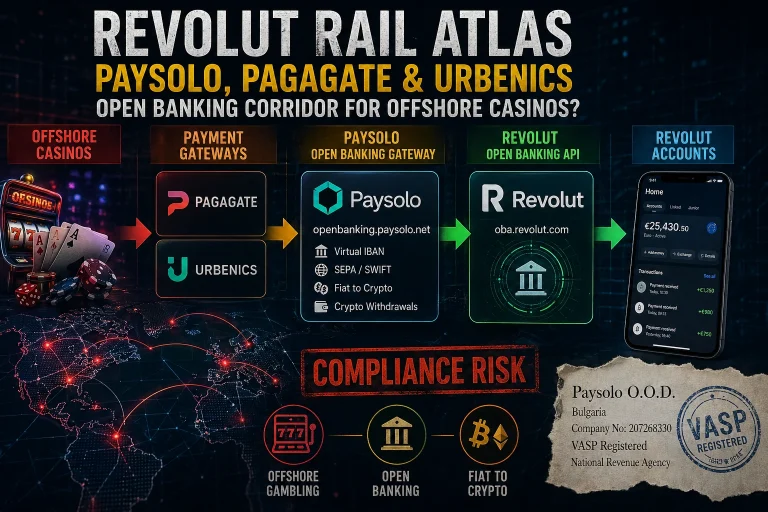

The Casino You Access Is Not Always the Casino You Think You’re Using: How Offshore Gambling Networks Build Hidden Routing Systems

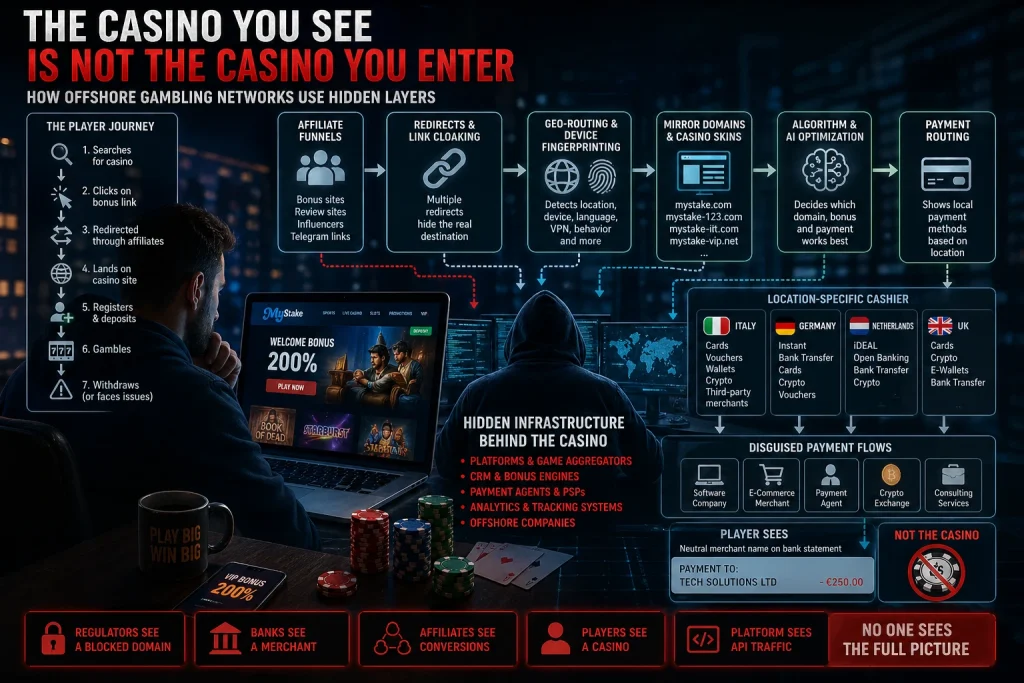
Illegal online gambling platforms are increasingly operating as highly adaptive digital ecosystems rather than traditional casino websites. A player may believe they are simply accessing a brand such as MyStake, Donbet, or GoldenBet. In reality, that journey may pass through affiliate funnels, mirror domains, device-fingerprinting systems, geo-routing infrastructure, bonus attribution engines, and localized payment gateways before the user even reaches the deposit page.
This creates a hidden compliance labyrinth where the casino brand visible to the player, the domain used for access, the payment method displayed, and the merchant ultimately receiving funds may all vary depending on factors such as location, device type, browser language, banking provider, referral source, and prior activity.
Key Findings
- Illegal casino brands often function only as the visible front-end layer.
- Behind many brands sits a broader infrastructure of affiliates, mirrors, tracking systems, payment agents, and platform providers.
- Geo-routing plays a central role in this model.
- Mirror domains allow operators to bypass regulatory website blocks (brand123.com, brand-italia.com, brand-vip.com).
- Payment methods are frequently customized based on a player’s jurisdiction.
- AI-powered optimization may increasingly be used to improve routing decisions.
- Players often do not know who actually processes their payments.
- Regulatory oversight becomes fragmented because no single participant sees the full infrastructure.
Why The Player Journey Is Often Misleading
From a consumer perspective, the process appears straightforward:
- Search for a casino
- Click a link
- Register
- Deposit funds
- Gamble
However, that apparent simplicity can be deceptive.
In many offshore casino operations, players may not move directly from Google, Telegram, TikTok, affiliate websites, or promotional pages to the gambling operator. Instead, they may pass through multiple invisible routing layers before the final casino page appears.
The GAMRS / Deal Me Out report involving Santeda International B.V. and Ryker B.V. described this structure in connection with MyStake and affiliated brands. According to the report, traffic may move through multiple intermediary domains before reaching the final operator, including:
- Affiliate redirect domains
- Link-cloaking services
- Device fingerprinting systems
- Bonus attribution tools
- Geo-routing engines
These systems may determine whether a player is sent to:
- A mirror domain
- A replacement site
- A different operator
- A version of the platform not yet blocked by regulators
According to Scam-Or Project’s Rail Atlas methodology, this distinction is critical: the casino is no longer just a website — it functions as a routed infrastructure.
Layer 1: The Visible Casino Brand
Players typically recognize brands such as:
- MyStake
- Donbet
- GoldenBet
- Rolletto
- CosmoBet
- Velobet
These brands often appear to be standalone gambling businesses with:
- Logos
- Promotions
- Customer support
- Terms and conditions
- Offshore license references (such as Curaçao or Anjouan)
However, the visible brand may represent only one layer of a much larger ecosystem.
The GAMRS report noted that MyStake should not be viewed as an isolated operator, citing:
- Shared analytics identifiers
- Coordinated hosting behavior
- Domain turnover
- Links to aggregation systems
This creates significant risks for consumers. Self-exclusion from one brand may provide little protection if multiple brands operate on shared infrastructure.
Layer 2: Mirror Domain Infrastructure
Illegal casino operators frequently rely on multiple domains for the same gambling operation.
| Domain Type | Example Pattern | Purpose |
|---|---|---|
| Main domain | goldenbet.com | Primary brand site |
| Mirror domain | goldenbet-1234.com | Backup access |
| Country domain | goldenbet-it.com | Local targeting |
| Affiliate page | best-bonus-goldenbet.com | Traffic acquisition |
| Falling-back domain | goldenbet-vip.net | Post-block replacement |
| Temporary shell | unfinished clone | SEO preservation |
This model is particularly relevant in countries such as Italy, where the regulator Agenzia delle Dogane e dei Monopoli actively blocks unauthorized gambling domains (source).
The challenge is obvious:
Regulators block one website, while operators maintain dozens of replacements.
The GAMRS report referred to this structure as a “Hydra model”.
Layer 3: Affiliate Funnels and Link Cloaking
Affiliate systems often serve as the first acquisition layer.
A player may click on:
- “Non-GamStop casino” articles
- Telegram links
- Influencer promotions
- Casino comparison websites
- “Best crypto casino” pages
- Fake review platforms
- Localized bonus pages
That click may trigger multiple redirects before the player reaches a final destination.
These systems can collect:
| Data Collected | Purpose |
|---|---|
| IP address | Identify jurisdiction |
| Device type | Optimize conversions |
| Browser | Platform targeting |
| Language | Localization |
| Referral source | Affiliate attribution |
| Previous activity | Returning player tracking |
The GAMRS report identified Affision, operated via Legitnine OÜ, as part of a larger network involving:
- Santeda International B.V.
- Ryker B.V.
- Onyxion
The report stated that these systems promoted brands including:
- MyStake
- GoldenBet
- JackBit
- FreshBet
- 31Bet
Layer 4: Device Fingerprinting and Geo-Routing
Modern routing systems often evaluate far more than simple IP location.
| Technical Signal | Why It Matters |
|---|---|
| IP address | Country detection |
| Browser language | Regional targeting |
| Device type | Mobile/desktop behavior |
| Operating system | Fraud scoring |
| Referral source | Campaign attribution |
| Cookies | Returning user tracking |
| Payment preferences | Deposit optimization |
| Time zone | Location verification |
| SIM/network data | Mobile location detection |
| Behavioral patterns | Risk profiling |
These technologies can serve legitimate compliance purposes.
However, the same systems may also be abused to route restricted users toward channels that are harder to block.
Layer 5: The Algorithmic Workaround
Traditional illegal casino models often rely on fixed routing logic:
- Italy → mirror domain A
- Germany → bank transfer option
- Netherlands → open banking route
- UK → crypto fallback
- Blocked users → alternative domain
An AI-enhanced model may go further by continuously optimizing:
- Which landing page converts best
- Which payment methods succeed most often
- Which bonuses maximize deposits
- Which domains survive longest before shutdowns
| Compliance Tool | Legitimate Use | Potential Abuse |
|---|---|---|
| Geo-location | Restrict access | Route restricted players |
| Device fingerprinting | Prevent fraud | Retarget vulnerable users |
| Payment orchestration | Improve transactions | Rotate payment providers |
| Bonus personalization | Improve UX | Encourage repeat deposits |
| Affiliate attribution | Marketing tracking | Hide acquisition networks |
This creates what can be described as an algorithmic workaround system.
Layer 6: Localized Casino Cashiers
Payment pages may differ significantly depending on where a user is located.
A player in Netherlands may see:
- iDEAL-style payments
- Open banking options
A player in Germany may see:
- Instant bank transfers
- Cards
- Crypto
A player in Italy may see:
- Card processors
- Wallets
- Crypto routes
- Voucher systems
A player in the United Kingdom may see:
- Cards
- Crypto
- Bank transfers
- E-wallets
The GAMRS report described infrastructure involving:
- PayOp
- PayDo
- Clear Junction
- Mobilum Pay
It also referenced mainstream fintech providers such as:
- Revolut
- Monzo
- Wise
- Starling Bank
The report explicitly stated that it does not accuse these regulated institutions of wrongdoing.
Layer 7: Merchant Descriptor Masking
One of the most concerning issues involves disguised payment descriptors.
A player may believe they paid a casino, while their bank statement displays:
- A software company
- A consulting firm
- An e-commerce business
- A crypto exchange
- A payment intermediary
- A completely unfamiliar merchant name
This creates serious problems:
- Banks may fail to identify gambling transactions
- Chargebacks become harder
- Players may not know who received their money
Layer 8: Platform Providers and Aggregators
The front-end casino brand often represents only one component.
Additional infrastructure may include:
- Sportsbook platforms
- Game aggregators
- Bonus engines
- CRM systems
- Payment integrations
- Affiliate tracking systems
The GAMRS report stated that the Santeda/MyStake ecosystem showed shared infrastructure across:
- MyStake
- CosmoBet
- VeloBet
- GoldenBet
- Rolletto
It also identified continued use of legacy InPlayNet systems under the Upgaming brand.
How The Entire System Functions
| Step | What Player Sees | What May Happen Behind The Scenes |
|---|---|---|
| 1 | Casino review | Affiliate tracking |
| 2 | Casino link | Redirect routing |
| 3 | Casino homepage | Mirror selection |
| 4 | Registration | Device profiling |
| 5 | Bonus offer | Retention targeting |
| 6 | Payment page | Payment routing |
| 7 | Deposit | PSP/intermediary routing |
| 8 | Balance credited | Funds distributed |
| 9 | Withdrawal request | Delays or verification |
| 10 | Domain blocked | Redirect to replacement site |
Regulatory Challenges
Regulators increasingly face infrastructure that evolves faster than traditional enforcement.
UK Gambling Commission has acknowledged the growing complexity of illegal online gambling networks.
Agenzia delle Dogane e dei Monopoli continues blocking unauthorized domains, but domain takedowns alone may no longer be sufficient.
Future enforcement efforts may require:
- Mapping redirect chains
- Identifying mirror clusters
- Monitoring payment disguises
- Reviewing open-banking routes
- Investigating payment intermediaries
- Strengthening cross-border intelligence sharing
Scam-Or Project Conclusion
The illegal casino market in 2026 increasingly resembles a location-aware, payment-aware, and device-aware routing ecosystem.
Players in Italy, Germany, Netherlands, and the United Kingdom may all be shown entirely different domains, payment methods, bonuses, and casino interfaces while interacting with the same backend infrastructure.
The real risk often sits behind the visible casino interface:
- Which domain survives enforcement actions
- Which payment route is used
- Which merchant receives funds
- Which bonus keeps players depositing
- Which sister brand receives redirected users
The visible casino may simply be the front-end layer of a far more complex black-market network.
Scam-Or Project Whistleblower Call
Scam-Or Project invites:
- Players
- Former employees
- Affiliates
- Payment insiders
- Compliance officers
- Investigators
to share evidence related to:
- Mirror domains
- Casino cashier flows
- Merchant descriptors
- Open banking routes
- Crypto payment channels
- Withdrawal disputes
- Redirect systems
Particularly valuable evidence includes:
- Bank statements
- Payment screenshots
- Redirect logs
- Withdrawal emails
- Internal affiliate records
- Payment processor documentation
Information can be submitted securely through the Scam-Or Project whistleblower section.