
Cologne Court Convicts Rainer Treuer in B2G Case — But Europe’s Binary Options Payment Network Questions Remain Unanswered

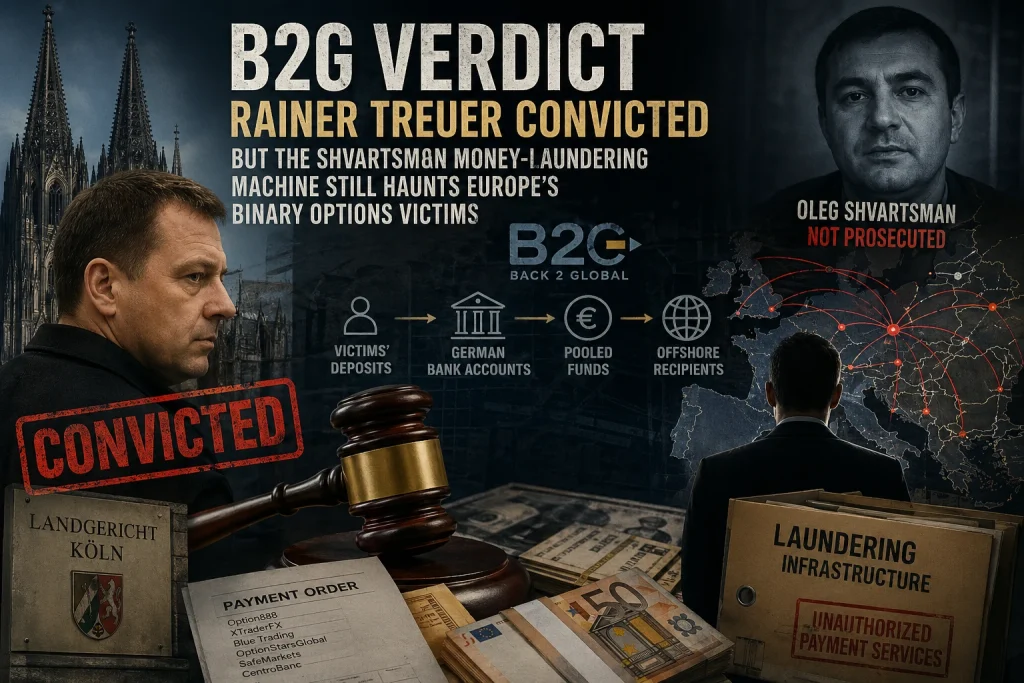
The Regional Court of Cologne has issued a long-awaited ruling against German businessman Rainer Treuer, sentencing him to two years and four months in prison for unauthorized payment-services activity connected to the notorious B2G payment network.
The ruling reinforces concerns that Scam-Or Project raised years ago: B2G was far more than a consulting business. It operated as a payment-processing structure that collected victim deposits through German bank accounts and transferred funds to foreign recipients tied to fraudulent broker operations.
However, one major figure remains absent from the verdict: Oleg Shvartsman, widely viewed as a central architect of the operation, was not adjudicated because he failed to appear in court. That leaves broader questions unresolved about why German authorities treated what many describe as a large-scale laundering infrastructure primarily as a licensing violation.
Key Findings
- Rainer Treuer convicted: The Regional Court of Cologne sentenced him to two years and four months, with three months credited due to excessive delays in proceedings.
- Asset confiscation ordered: The court ordered confiscation from B2G GmbH totaling €671,549.52.
- Illegal payment activity confirmed: The court found that B2G accepted third-party funds through company bank accounts and transferred those funds onward without regulatory authorization.
- Massive transaction volume: Court-related analysis indicates approximately €33.57 million flowed through B2G GmbH in roughly one year.
- Oleg Shvartsman absent: His role was not examined because he did not appear during proceedings.
- Scam-Or Project findings: Based on prior communications with both men, Scam-Or Project previously concluded that Shvartsman acted as the strategic force behind the structure while Treuer managed the German operational side.
- Victim complaints: Multiple victims previously submitted complaints connected to B2G-linked payment flows.
- Larger issue remains: While the verdict confirms unauthorized payment services, it does not fully address the broader laundering infrastructure behind binary options fraud.
The Verdict: Conviction Without Full Accountability
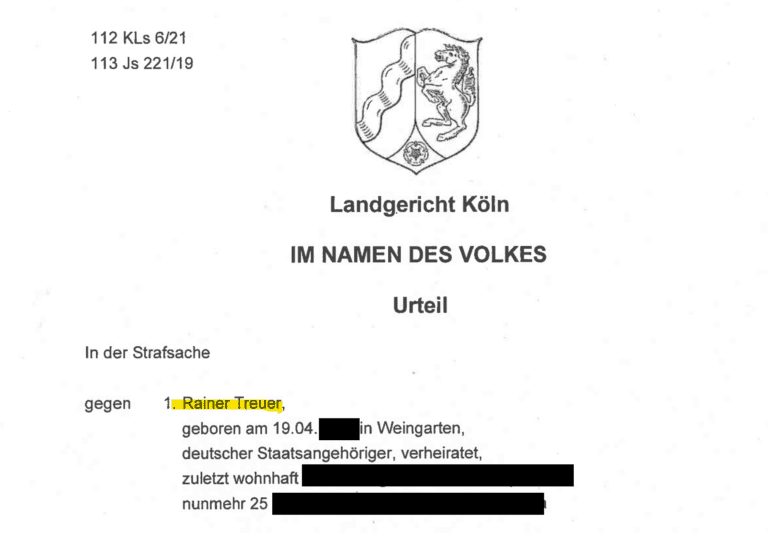
After years of legal proceedings, the Regional Court of Cologne delivered its judgment on 27 January 2026.
Treuer was found guilty of:
- intentional unauthorized payment services activity
- incitement related to unauthorized payment operations
The court imposed a prison sentence of two years and four months, while acknowledging delays in proceedings by crediting three months as already served.
Additionally, authorities ordered the confiscation of €671,549.52 from B2G GmbH.
The ruling confirms that B2G operated illegally as a payment intermediary. However, many observers argue that the actual scale of financial misconduct was far greater than what was ultimately prosecuted.
Who Are Rainer Treuer and Oleg Shvartsman?
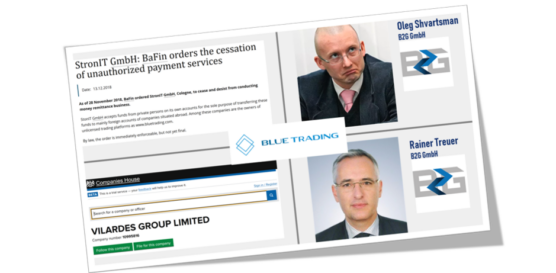
Rainer Treuer
Treuer served as one of the official directors of B2G GmbH, a Cologne-based entity used to receive and distribute client funds.
Court records show that he co-founded the company in September 2016 alongside Shvartsman, with both holding equal ownership stakes.
Oleg Shvartsman
Shvartsman, a Russian national, has long been viewed as the strategic operator behind the broader structure.
Although the court did not rule on his involvement due to his absence, historical communications reviewed by Scam-Or Project suggest he played a central role in designing and expanding the payment network.
Earlier investigations also linked both individuals to broker scams such as:
- Option888
- Blue Trading
- XTraderFX
- OptionStarsGlobal
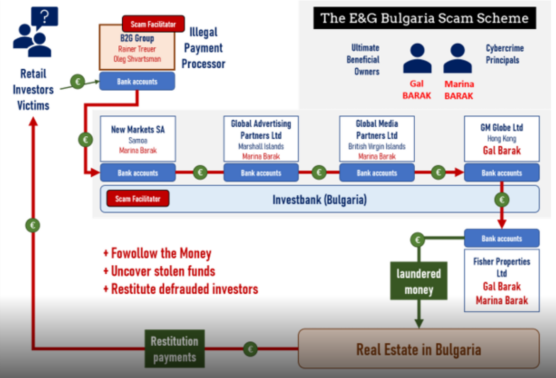
How the B2G Payment Model Worked
According to court findings, Treuer and Shvartsman created a straightforward but highly effective payment funnel.
Step 1: Open company bank accounts
Accounts were opened under B2G GmbH.
Step 2: Receive victim deposits
Funds from retail investors were deposited into these accounts.
Step 3: Pool transactions
Rather than forwarding funds individually, deposits were grouped together.
Step 4: Transfer abroad
Large sums were then sent to foreign recipients.
Step 5: Collect fees
B2G earned compensation for facilitating these transactions.
This structure reportedly used accounts at:
| Bank | Role |
|---|---|
| Kölner Bank / Volksbank Köln-Bonn | Payment intake |
| Sparkasse Koblenz | Transaction processing |
| Deutsche Bank | Payment routing |
| Südwestbank | Account infrastructure |
| UniCredit / HypoVereinsbank | Payment processing |
Court-related documentation suggests approximately €33,577,475.80 passed through this infrastructure.
That volume reflects far more than ordinary consulting work—it resembles industrial-scale payment routing.
Why Binary Options Scams Needed Structures Like B2G
Fraudulent broker schemes required far more than fake websites.
They typically relied on multiple operational layers:
- fraudulent trading platforms
- boiler rooms
- shell companies
- payment processors
- offshore entities
- laundering channels
B2G reportedly played a critical role in the payment layer.
Without entities like B2G:
- scammers could not easily collect deposits
- banks might have detected suspicious patterns faster
- cross-border fraud operations would have scaled far more slowly
Previous investigations connected B2G-related payment rails to schemes including:
- Option888
- Blue Trading
- XTraderFX
- OptionStarsGlobal
- SafeMarkets
- CentroBanc
- StoxMarket
The Legal Problem: Too Narrow a Charge?
German prosecutors focused primarily on unauthorized payment-services violations.
That legal framework matters—but critics argue it fails to reflect the broader financial crime implications.
The court described:
- pooled victim deposits
- layered transfers
- foreign recipients
- repeated cross-border movement of funds
These are patterns frequently associated with large-scale financial crime infrastructure.
Many victims argue the case should have gone much further.
The Missing Defendant: Oleg Shvartsman
The most glaring gap in the case remains Oleg Shvartsman.
Because he did not appear in court:
- no verdict was issued regarding his role
- no direct accountability was imposed
- major questions remain unanswered
According to historical reporting by Scam-Or Project, Shvartsman was not a peripheral figure.
He allegedly helped build the system that allowed fraudulent brokers to move millions.
His absence remains one of the most significant unresolved aspects of the case.
Regulatory and Banking Questions
The case also raises uncomfortable questions for banks and regulators.
Several institutions allegedly continued processing transactions despite growing warning signs.
Reported concerns included:
- customer complaints
- refund requests
- suspicious payment patterns
- repeated fraud allegations
Critics continue asking whether earlier intervention could have prevented additional victim losses.
Key Entities and Their Roles
| Name / Entity | Role | Relevance |
|---|---|---|
| Rainer Treuer | German B2G executive | Convicted in Cologne |
| Oleg Shvartsman | Alleged architect | Not prosecuted in this ruling |
| B2G GmbH | Payment vehicle | Processed victim funds |
| B2G s.r.o. | Related entity | Part of broader infrastructure |
| P2P GmbH | Additional payment structure | Linked to fund routing |
| Option888 | Broker scam | Linked to payment flows |
| Blue Trading | Broker scam | Linked to payment flows |
| XTraderFX | Broker scam | Linked to payment flows |
| OptionStarsGlobal | Broker scam | Linked to payment flows |
Scam-Or Project Analysis
The Cologne ruling confirms a core issue long highlighted by Scam-Or Project: fraudulent investment operations rely heavily on payment facilitators.
Fake brokers alone do not move millions.
They require:
- bank accounts
- payment processors
- routing networks
- laundering infrastructure
B2G allegedly provided exactly that.
Treuer has now been convicted.
Shvartsman remains absent.
Many victims are still waiting for restitution.
Conclusion
The B2G verdict sends a clear signal that unauthorized payment operators face legal consequences.
But the broader lesson remains highly relevant.
Today’s high-risk sectors—including crypto schemes, offshore casinos, and unregulated investment platforms—continue relying on similar payment infrastructure.
Follow the payment rails, and the real enablers often emerge.
Scam-Or Project Whistleblower Request
Scam-Or Project invites former employees, victims, banking insiders, compliance officers, and law enforcement sources with relevant information about:
- B2G GmbH
- B2G s.r.o.
- P2P GmbH
- Rainer Treuer
- Oleg Shvartsman
Please submit information securely through the Scam-Or Project whistleblower section.
We are particularly interested in:
- bank account opening documents
- compliance correspondence
- internal communications
- payment instructions
- offshore transfer records
- regulatory documentation related to B2G investigations