
Prince Group Associates Build Property Portfolio in Japan Amid Global Sanctions Campaign

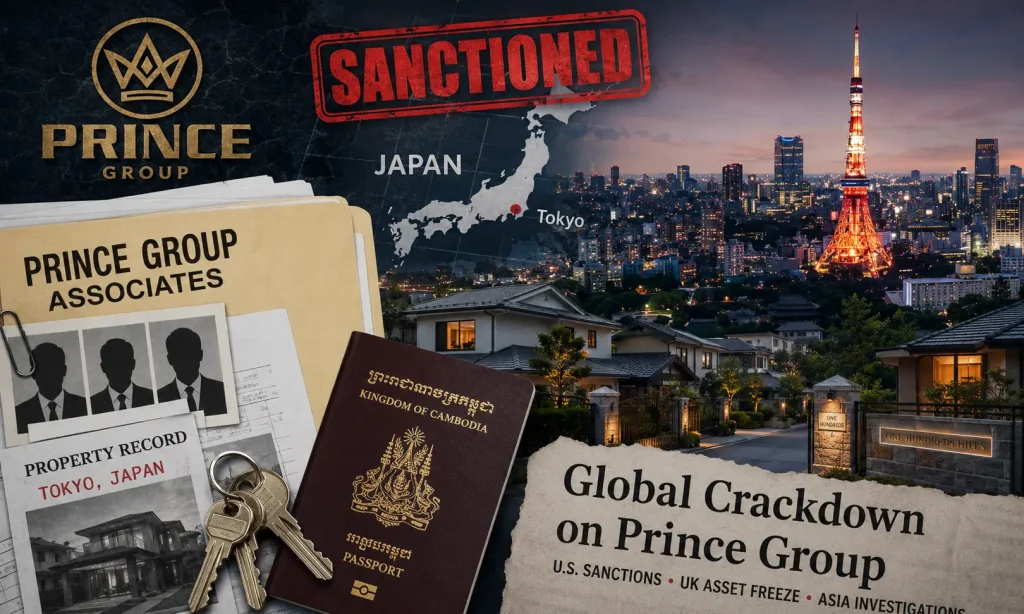
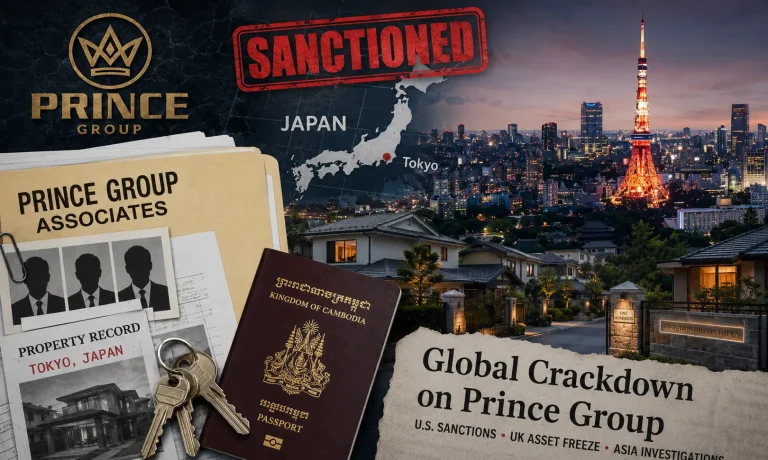
Executives connected to Cambodia’s Prince Group have quietly acquired luxury real estate in Japan, even as the conglomerate faces mounting pressure from regulators and law enforcement agencies worldwide. Property ownership records, corporate filings, and aviation data reviewed by Scam-Or Project reveal that several individuals linked to the sanctioned network established significant assets in and around Tokyo. The findings add Japan to the growing list of jurisdictions where Prince Group-affiliated figures appear to have developed financial and personal interests.
International Pressure Mounts on Prince Group
The Prince Group has faced increasing scrutiny since October 2025, when U.S. authorities designated the organization a “transnational criminal organization.” According to the U.S. government, companies within the group allegedly participated in large-scale cyberfraud operations conducted from compounds in Cambodia that relied on human trafficking and forced labor.
Prince Group and its chairman, Chen Zhi, have consistently denied all accusations. Through a company spokesperson, the conglomerate maintained that it represents a collection of legitimate businesses operating internationally and employing tens of thousands of people. The spokesperson further argued that allegations made by U.S. authorities and repeated elsewhere lack factual support.
The sanctions campaign expanded beyond the United States. British authorities froze more than $200 million in assets connected to companies and individuals associated with the conglomerate, while dozens of corporate entities became subject to restrictions. U.S. Treasury documents also identified an extensive network of offshore companies and operational hubs spanning Hong Kong, Laos, and the British Virgin Islands.
Notably absent from those disclosures was Japan, where authorities have made no public announcement regarding investigations into Prince Group-linked individuals.
Property Acquisitions on the Outskirts of Tokyo
Property records reviewed by Scam-Or Project show that Chen Bo, a Chinese-born businessman who later obtained Cambodian citizenship, controls significant real estate assets in Japan.
One of the properties is located in Chiba Prefecture, east of Tokyo, inside the exclusive gated residential development known as “One Hundreds Hills.” Chen Bo purchased the property in 2019. The estate occupies a large parcel of land measuring approximately 2,365 square meters and includes a luxury residence.
Although Chen Bo has not personally been sanctioned, Cambodian corporate records connect him to numerous companies that later became targets of international restrictions. Among them are Byex Exchange Co. Limited and Tian Xu International Technology Plc, both sanctioned by the United Kingdom for allegedly providing services that benefited the Prince Group network.
Additional Tokyo Residence
The Chiba estate is not Chen Bo’s only Japanese asset. Records show that he also acquired a residence near Tokyo’s Zenpukuji Park shortly before the United States and United Kingdom announced sanctions against Prince Group.
Ownership of that property was subsequently transferred to his wife shortly after sanctions were imposed.
Japanese media have estimated that the combined value of both residences is approximately $7 million. However, the financial origins of the funds used to purchase the properties have not been publicly established.
Attempts to obtain comment from Chen Bo were unsuccessful. Representatives at companies where he serves as chairman either denied knowledge of him or stated that he was currently located in China.
Su Chang’s Real Estate Investment in Central Tokyo
Corporate documentation also links Billion Wisdom Investment Co Ltd. to another Chinese-born Cambodian citizen, Su Chang.
Land registry records indicate that Su Chang purchased an apartment in Wellith One Aoyama, a high-end residential development situated in Tokyo’s prestigious Minato ward, in 2021.
While Su Chang has not been sanctioned or accused of criminal conduct, his corporate associations place him within a broader network of individuals connected to Prince Group-related businesses.
Requests for comment sent to companies associated with Su Chang received no response.
Brendon Luo Acquires Luxury Apartment in Shibuya
Another Prince Group-linked executive with Japanese property holdings is Brendon Luo, also known as Luo Pinghua.
Government records show that Luo, who holds Cambodian citizenship and was born in China, purchased a luxury apartment in Tokyo’s Shibuya district in May 2025.
Corporate filings identify him as a director of Prince Plaza Investment Co. Ltd., a company chaired by Chen Zhi. While Luo himself has not been sanctioned, Prince Plaza Investment was included in the extensive sanctions package announced by the U.S. Treasury Department.
American authorities listed the company among more than one hundred entities allegedly owned, controlled, or operated on behalf of members of the Prince Group transnational criminal organization.
Representatives of companies linked to Luo declined to provide contact details or facilitate communication.
Private Jet Travel Raises Additional Questions
Aviation records reviewed by Scam-Or Project uncovered links between Prince Group associates and private flights to Japan.
Flight data examined by Scam-Or Project show that Su Chang traveled aboard a private aircraft together with Hu Xiaowei, a businessman sanctioned by both U.S. and U.K. authorities in relation to Prince Group activities.
Su Chang himself has not been accused of misconduct and remains free from sanctions.
However, Hu Xiaowei has attracted increasing attention from investigators. Previous reporting by Scam-Or Project revealed that he operated under multiple identities and maintained previously undisclosed connections to both Prince Group and Chen Zhi.
Following those revelations, British authorities froze several London properties linked to Hu Xiaowei, with a reported value exceeding $44 million.
Aircraft Ownership Structure
The aircraft used for multiple journeys between Cambodia and Japan is reportedly owned by CN Breeze Limited.
Corporate records indicate that CN Breeze is controlled through Future King Inc., a British Virgin Islands company linked to Hu Xiaowei. Hong Kong stock exchange filings identify ownership through the alias Wu An Ming.
Flight records reveal repeated visits to Japan beginning in March 2023, including several trips that occurred after the United States announced sanctions against 146 individuals and entities connected to Prince Group in October 2025.
More recently, Hong Kong’s Department of Justice sought a freezing order against Future King Inc. and additional assets allegedly connected to Hu Xiaowei.
Global Enforcement Actions Continue to Expand
The sanctions announced by the United States and United Kingdom in October 2025 marked only the beginning of a broader international response.
Over the following months, authorities in South Korea, Hong Kong, Singapore, Taiwan, and Thailand introduced various measures targeting individuals and entities allegedly associated with Prince Group.
These actions included:
- Asset freezes;
- Property seizures;
- Criminal investigations;
- Arrests of suspected associates;
- Formal charges against individuals connected to the network.
In January 2026, Cambodian authorities arrested Prince Group chairman Chen Zhi before extraditing him to China. Chinese state media later reported that investigators suspected him and his associates of operating fraud schemes and concealing illicit proceeds.
Prince Group again rejected those allegations, arguing that authorities had failed to produce credible evidence supporting their claims.
Additional restrictions, indictments, and asset freezes were subsequently announced by authorities in the United Kingdom, Hong Kong, and Taiwan.
Why Japan May Be Different
At present, no public evidence directly demonstrates that the Japanese properties acquired by Chen Bo, Su Chang, Brendon Luo, or other associated individuals were purchased using criminal proceeds.
However, experts note that even if concerns existed, Japanese authorities possess fewer legal mechanisms for asset recovery than their counterparts in some Western countries.
The Financial Action Task Force (FATF) highlighted these weaknesses in its latest Mutual Evaluation Report on Japan, noting that the country’s approach to confiscation and restraint of criminal assets does not fully reflect its money-laundering risk profile.
Absence of Civil Forfeiture
One significant distinction is the lack of a civil forfeiture framework.
In jurisdictions such as the United Kingdom, authorities may freeze assets and subsequently seek confiscation if owners cannot demonstrate a lawful source of wealth. Japanese law offers far fewer options in comparable circumstances.
A retired senior police official interviewed by Scam-Or Project summarized the issue succinctly, stating that there is “no civil forfeiture in Japan.”
As international investigations surrounding Prince Group continue to expand, the luxury properties connected to its associates in Japan are likely to attract increasing attention from regulators and enforcement agencies monitoring the conglomerate’s global footprint.