
2025: The Breakout Year for Stablecoins — $33 Trillion On-Chain and a Rapidly Forming TradeFi Link

Overview
In 2025, stablecoins transitioned from a supporting role within crypto markets to a recognized component of global payment and settlement infrastructure. On-chain transaction volumes reached historic levels, while banks and fintech firms initiated real-world pilots for stablecoin-based settlements. At the same time, regulators advanced comprehensive frameworks: the EU implemented its first full year of MiCA enforcement, and the United States introduced a federal regime through the GENIUS Act.
Key Metrics and Market Data
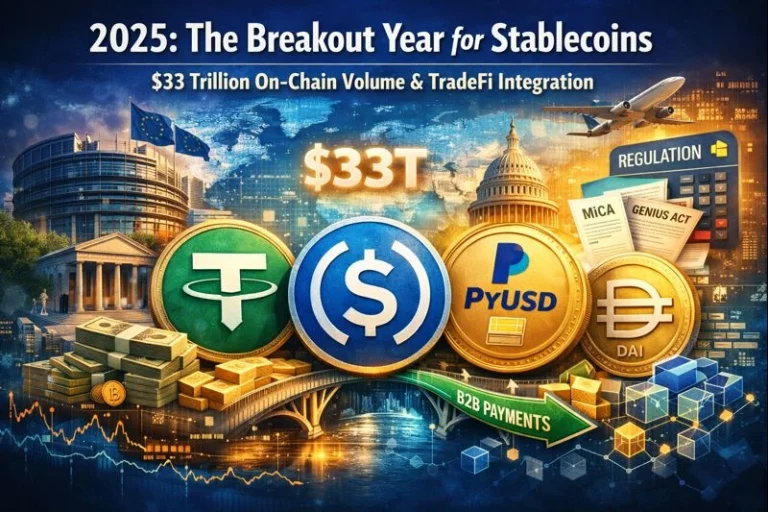
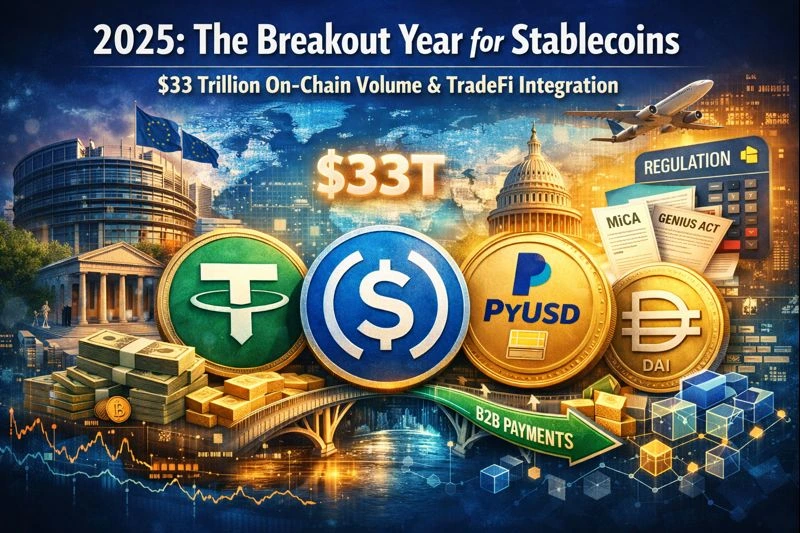
- Aggregate stablecoin transaction volume increased by approximately 72%, reaching an estimated $33 trillion in 2025.
- USDC accounted for roughly $18.3 trillion, while USDT processed about $13.3 trillion in transactions.
- The fourth quarter of 2025 alone saw nearly $11 trillion in stablecoin transfers.
- Total stablecoin supply hovered around $300 billion, with B2B payment flows exceeding $3 billion per month.
- Visa disclosed an annualized stablecoin settlement volume of around $3.5 billion and enabled USDC settlement for U.S. institutional clients in December 2025.
Market Interpretation
Stablecoins increasingly function as an operational bridge between traditional finance and blockchain networks, offering fiat-linked stability with continuous, programmable settlement. Throughout 2025, adoption expanded beyond trading and DeFi into areas such as international B2B payments, corporate payouts, and settlement experiments conducted by established financial institutions.
Regulatory developments simultaneously supported and limited growth. Under MiCA, the EU introduced harmonized rules for stablecoins categorized as e-money tokens (EMTs) or asset-referenced tokens (ARTs), including authorization, transparency, and risk-management obligations. Usage thresholds—commonly summarized as around 1 million transactions or €200 million in daily volume within a currency area—may activate corrective measures for widely used instruments.
In the United States, the GENIUS Act, enacted on July 18, 2025, established the concept of “payment stablecoins.” The law allows issuance by banks and approved non-bank entities while imposing requirements related to reserves, attestations, and supervisory oversight.
Major Stablecoins and Issuers
- USDT (Tether) remained the largest stablecoin by circulation, reaching approximately $187 billion, and processed $13.3 trillion in 2025 transactions. Its Treasury-backed reserves generated an estimated $15 billion in profits.
- USDC (Circle) expanded its market capitalization by about 75% to $77 billion, with $18.3 trillion in transaction volume, supported by institutional adoption and regulatory alignment.
- PYUSD, issued by PayPal, achieved roughly $910 million in circulation, positioning itself as a payment-oriented, commerce-focused stablecoin.
- DAI, the largest decentralized stablecoin, maintained circulation exceeding $5 billion, backed by a mix of crypto collateral and real-world assets.
Forward Outlook: 2026–2027
Stablecoins are expected to further entrench themselves as core payment infrastructure. Conservative projections suggest total market capitalization could expand to $500–750 billion by 2027. Growth is driven by cross-border payment use cases—where settlement times can drop from days to minutes—and by adoption in regions affected by high inflation. In Africa, for example, stablecoins now represent over 40% of cryptocurrency transaction volume.
Banks are likely to respond by issuing tokenized deposits, aiming to match the efficiency of private stablecoins while retaining regulatory safeguards. As traditional finance and decentralized finance increasingly intersect, stablecoins may become the default settlement layer for programmable financial services. Although adoption may slow as infrastructure matures and risk-averse investors proceed cautiously, the structural shift appears permanent: stablecoins have moved beyond experimentation into essential financial rails linking dollar-denominated markets with blockchain-based efficiency.
Request for Information
Are stablecoins being used for settlement, payroll, or remittances—or alternatively as informal rails for illegal gambling operations, high-risk brokerage activity, or sanctions circumvention?
Relevant documents and credible leads can be submitted confidentially via the Scam-Or Project whistleblower section.