
Gemini IPO: A Defining Test for “Compliant Crypto” in the Post-Coinbase Era

Executive Overview
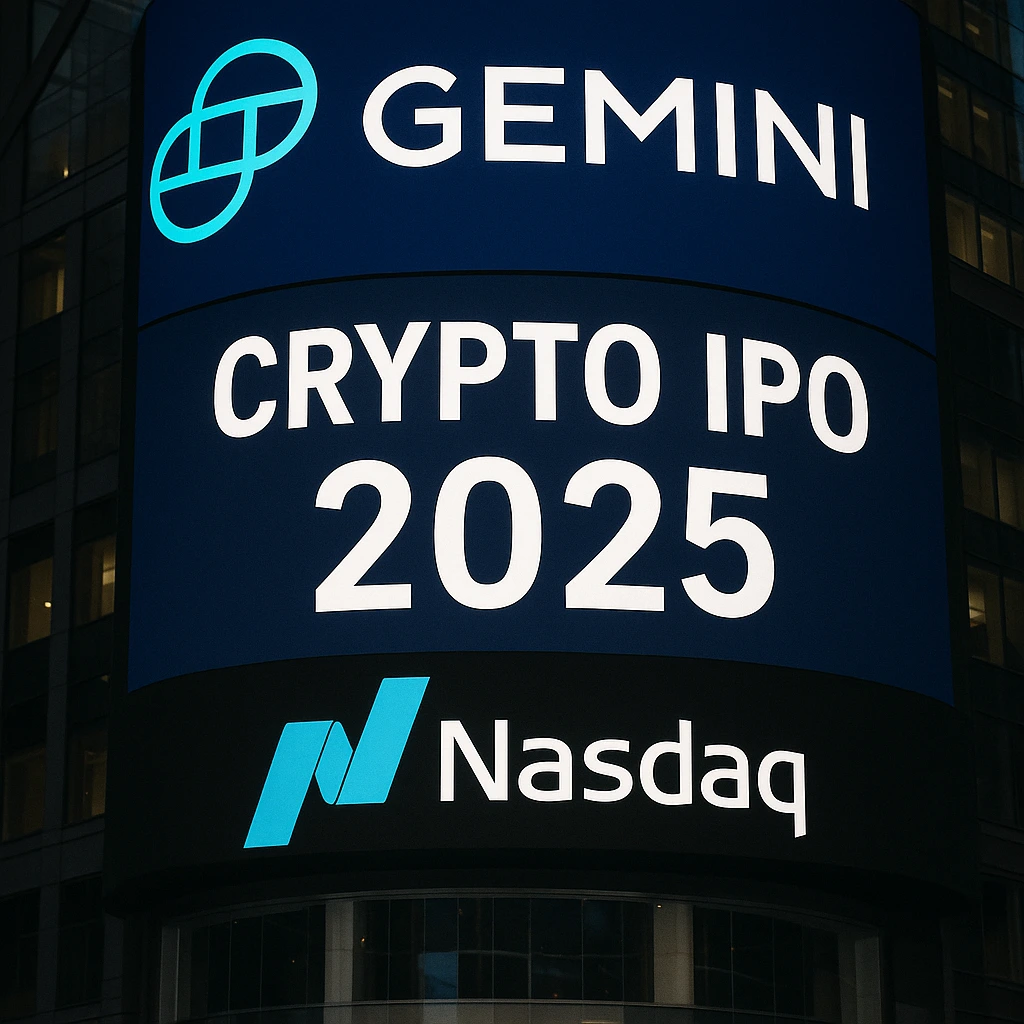
Gemini’s much-anticipated Nasdaq debut marks a pivotal test for the future of regulated crypto exchanges. Priced at $28 per share, the offering raised approximately $425 million and surged by 32% on its first trading day — a move signaling renewed investor confidence in compliant digital-asset platforms. The opening valuation ranged between $3.3 billion and $4.4 billion, positioning Gemini among the most closely watched public market entrants in 2025.
Despite this bullish reception, the company’s financials — including a first-half 2025 net loss of roughly $282.5 million and substantial liabilities in the $2 billion range — raise serious questions about long-term profitability.
Key Details
| Item | Highlights (Gemini) | Sources |
|---|---|---|
|
IPO Offer |
$28 per share; ~$425 m raised on 15.2 m shares; oversubscribed more than 20× |
|
|
First-Day Performance |
Opened at $37.01, peaked in the mid-$40s |
Reuters |
|
Valuation |
~$4.4 billion debut market cap |
Reuters |
|
Strategic Investor |
Nasdaq invested $50 million via a private placement for custody/collateral collaboration |
|
|
Financial Snapshot (H1-2025) |
Loss ≈ $282.5 m; liabilities ≈ $2 billion pre-IPO |
Market Context: Crypto Listings Regain Momentum
The revival of regulated crypto listings has reshaped investor sentiment:
-
Bullish (NYSE): Listed in August 2025; shares climbed >150% intraday, implying ~$13.2 billion valuation (see Reuters report).
-
Circle (NYSE): Went public in June 2025 at $31/share; opened $69, closed $83.23; raised $1.05 billion (see Reuters report).
-
Coinbase (Nasdaq): The enduring benchmark, reporting Q2-2025 revenue of $1.5 billion and Adj. EBITDA of $512 million, supported by strong liquidity.
(Sources: Reuters, s27.q4cdn.com)
Comparative Snapshot
| Company | Exchange / Timing | IPO Proceeds | Day-One Movement | Indicative Valuation |
|---|---|---|---|---|
|
Gemini (GEMI) |
Nasdaq, Sept 2025 |
$425 m (primary) |
+32% on debut |
$3.3–4.4 billion |
|
Bullish (BLSH) |
NYSE, Aug 2025 |
$1.11 billion |
+100% intraday |
$13.2 billion |
|
Circle (CRCL) |
NYSE, June 2025 |
$1.05 billion @ $31 |
+168% day-one close ($83.23) |
$18 billion FDV |
|
Coinbase (COIN) |
Nasdaq, 2021 direct listing |
— |
— |
$7 billion TTM revenue, positive EBITDA |
Strategic Positioning
-
Gemini – Dual-focus on retail and institutional clients with offerings in exchange trading, custody, staking, and debit card products. The new Nasdaq partnership strengthens its “compliance-first” narrative.
-
Coinbase – Operates a diversified ecosystem: spot, derivatives, stablecoin economics, and Base L2 infrastructure.
-
Bullish – Institutional-heavy exchange pursuing BitLicense authorization and leveraging stablecoin-related treasury strategies.
-
Circle – USDC issuer transforming into a public stablecoin infrastructure provider; its IPO re-rated “regulated digital cash” assets.
Regulatory Signaling
| Company | Regulatory Posture |
|---|---|
|
Gemini |
Nasdaq listing + institutional partnerships reinforce its bridge to traditional finance; still needs to demonstrate leverage within U.S. and EU frameworks. |
|
Coinbase |
Positioned to gain from U.S. policy initiatives (GENIUS/CLARITY programs) and USDC expansion. |
|
Bullish |
Actively licensing in New York; compliance-driven under ex-NYSE leadership. |
|
Circle |
Set a precedent as the first publicly traded stablecoin issuer. |
Interpreting the Peer Comparisons
Strengths in Gemini’s Setup
-
Trust Signal: Oversubscription and Nasdaq backing elevate credibility among institutions.
-
Product Expansion: Custody, staking, card solutions, and international scaling offer multiple revenue levers.
Challenges Ahead
-
Profitability Gap: Coinbase’s size and margin profile highlight Gemini’s deficit in operating leverage.
-
Aggressive Peer Benchmarks: The strong debuts of Bullish and Circle set lofty valuation and performance expectations Gemini must sustain.
Industry-Wide Risks
-
Regulatory Flux: New U.S. and EU rules around staking, custody, and stablecoins could dramatically alter revenue structures.
-
Fee Pressure: Intensifying competition between retail and institutional exchanges may compress margins.
-
Operational Shocks: Any data breach, partner default, or enforcement action can rapidly impact valuations — as past years have shown.
Bottom-Line Assessment
Gemini (GEMI): The IPO success and Nasdaq alliance deliver strong optics of legitimacy, yet its loss profile and leverage keep execution risk high. Long-term investors may consider gradual exposure contingent on sustained revenue growth and cost control.
Coinbase (COIN): Remains the performance benchmark — diversified revenue, strong cash generation, and policy alignment.
Bullish (BLSH): Institutional exchange with a promising trajectory; must now build recurring income streams to justify its valuation.
Circle (CRCL): Functions as a pure-play stablecoin equity proxy; future valuations hinge on competitive entries and regulation.
Key Multiples & Metrics
| Peer | Latest Revenue / Metrics | Valuation | EV / Revenue Multiple |
|---|---|---|---|
|
Coinbase (COIN) |
TTM ≈ $7.0–7.1 B revenue |
Market cap + EV profitable / EBITDA positive |
≈ 10–11× |
|
Circle (CRCL) |
Q2-2025 rev. ≈ $658 M (+50% YoY); FY 2024 rev. ≈ $1.66 B |
IPO ≈ $6.9–7.2 B FDV |
mid-single to low-double digit EV/Sales |
|
Bullish (BLSH) |
Annualized rev. ≈ $200 M; losses ≈ $369 M TTM |
IPO ≈ $5.4 B equity value |
~15×–25× EV/Sales |
|
Gemini (post-IPO) |
H1 2025 rev. ≈ $68.6 M (vs $74.3 M H1 2024); net loss ≈ $282.5 M |
IPO ≈ $3.3–4.4 B |
— (high risk/low revenue base) |
Valuation Perspective
The IPO price already integrates moderate optimism: investors expect Gemini’s pivot toward growth and eventual profitability.
A fair-value projection could place Gemini’s equity between $8 and $12 billion within 12–18 months if revenue expands and margins improve — potentially $10–20 billion EV under favorable conditions.
However, persistent losses, slow scaling, or regulatory setbacks could compress multiples sharply.
(Sources: Scam-Or Project analysis of Reuters, Coindesk, and Nasdaq filings)