
Investor Briefing: Bitcoin Sets a New ATH — Signals from the Post-Halving Phase

Executive Summary
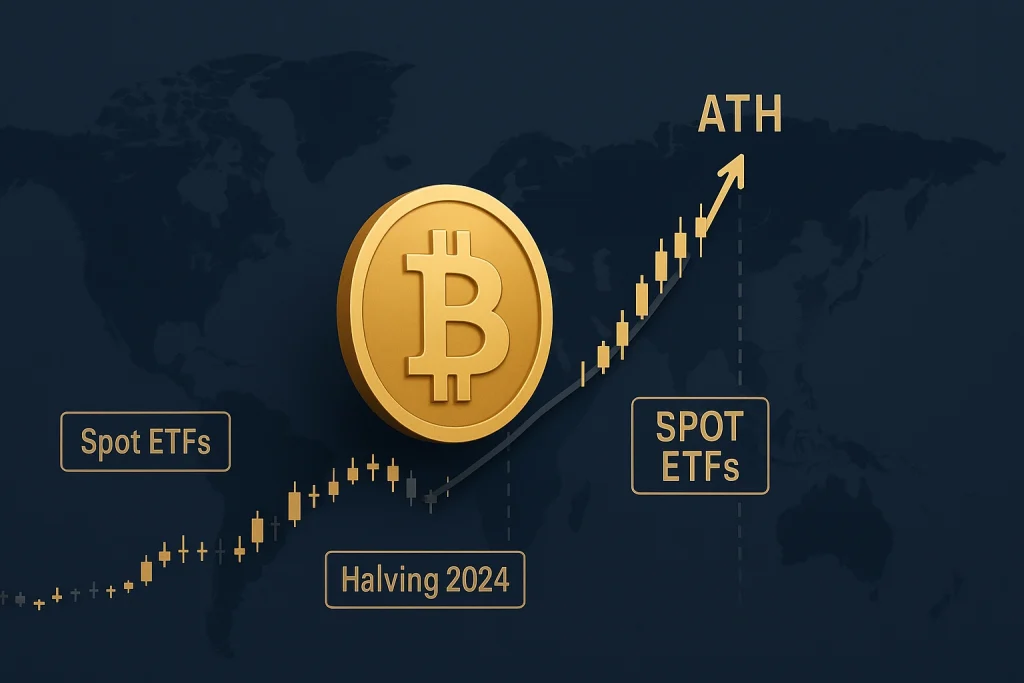
Over the weekend, Bitcoin printed a fresh all-time high near $125,000 and, as of Mon, 6 Oct 2025 (Europe/Vienna), is consolidating just below that level. The advance caps a year defined by powerful spot-ETF demand and reduced new issuance following the Apr 20, 2024 halving (block 840,000). Versus Oct 2017 and Oct 2021, today’s setup features deeper institutional rails (U.S. spot ETFs) and clearer EU regulation (MiCA)—factors that can temper, but not remove, typical post-peak drawdowns.
Opportunity Set
1) Structural demand via U.S. spot ETFs
The SEC’s Jan 10, 2024 approvals created a persistent, brokerage-native buy channel for RIAs and traditional portfolios, with multi-billion weekly net inflows reported around the new highs (source: sec.gov).
2) Programmed supply squeeze
Halving cut per-block issuance from 6.25 BTC to 3.125 BTC on Apr 20, 2024, mechanically reducing miner-driven sell pressure and tightening float (source: wikipedia.org).
3) Regulatory normalization in the EU
MiCA has moved from text to application (stablecoin rules effective 30 Jun 2024; key CASP/issuer provisions effective 30 Dec 2024), improving market conduct, disclosures, and institutional comfort (source: amf-france.org).
Principal Risks
-
Cycle reflexivity & precedent: Post-halving peaks historically arrived ~12–18 months later, followed by 70–80% bear-market drawdowns (notably 2018 and 2022). ETF outflows or macro shocks could re-create deep retracements (source: coindesk.com).
-
Miner economics & fee volatility: With issuance lower, miners lean more on fees (periodically elevated by Ordinals/Runes activity). Fee cycles can amplify network-wide liquidity swings (source: investopedia.com).
-
Policy or liquidity shocks: 2025 has already delivered double-digit monthly selloffs; unexpected political developments or rate-path surprises can unwind momentum abruptly (source: theguardian.com).
Cycle Context — Then vs Now
| Snapshot Date | Post-Halving Context | Market Access & Rails | Outcome/Pattern |
|---|---|---|---|
|
Oct 2017 (post-2016 halving) |
Retail-led melt-up into Dec 2017 |
No spot ETFs; minimal institutional infrastructure |
ATH near $20k followed by ~70–80% drawdown in 2018 (source: reuters.com) |
|
Oct 2021 (post-2020 halving) |
Futures-ETF era (e.g., BITO, Oct 2021) |
Institutional interest rising; still no spot ETF |
Run toward ~$69k (Nov 2021) before 2022 bear market (source: reuters.com) |
|
Oct 2025 (post-2024 halving) |
Spot ETF era + friendlier U.S. tone + EU MiCA in force |
Robust brokerage-native access; stronger custody/market-abuse standards |
New ATH ~$125k with meaningful ETF inflows amid macro uncertainty (source: reuters.com) |
Regulatory Landscape
-
United States: On Jan 10, 2024, the SEC approved 11 spot Bitcoin ETPs, transforming access for traditional portfolios and advisory platforms.
-
European Union: MiCA is now applicable—stablecoin provisions since Jun 30, 2024; remaining CASP/issuer rules from Dec 30, 2024—raising the baseline for custody, market-abuse controls, and disclosures.
Actionable Takeaways
-
Size positions for volatility
Treat 30–50% pullbacks as base-case risk even within an up-cycle. Pre-define add levels; avoid chasing vertical strength. -
Use the rails you have
Where mandates require wrappers, favor spot-ETF exposure. Track net-flow momentum as a leading gauge of trend health (source: marketwatch.com). -
Diversify drivers
If your thesis leans on a “debasement” narrative, pair BTC with liquid rates hedges or gold to balance macro shocks. -
Monitor miners closely
Follow hashrate, fee/issuance mix, and public-miner margins. Stress in mining often foreshadows broader market weakness (source: cointelegraph.com).
Working Hypothesis: Will the “post-halving crash” repeat?
-
Base case (>50%): This cycle peaks later and the downside proves shallower than 2018/2022, thanks to steadier spot-ETF demand and MiCA-era clarity. Expect cyclical retracements of 30–50%, not an 80% collapse—unless a regulatory shock, large ETF outflows, or a major exchange failure intervenes.
-
Tail risk (<25%): A policy/credit/liquidity event triggers a >60% drawdown reminiscent of prior severe bears.
Notes & Sources (reader guide)
Regulatory dates and mechanisms referenced above align with public communications around SEC spot-ETF approvals (Jan 2024) and the phased application of MiCA (stablecoins from Jun 30, 2024; core CASP/issuer provisions from Dec 30, 2024). Market behavior comparisons reference widely reported cycle peaks and subsequent drawdowns in 2017–2018 and 2021–2022.