
Bloodbath at Coinbase: $394M Loss, Workforce Cuts, and the High-Risk AI Transformation


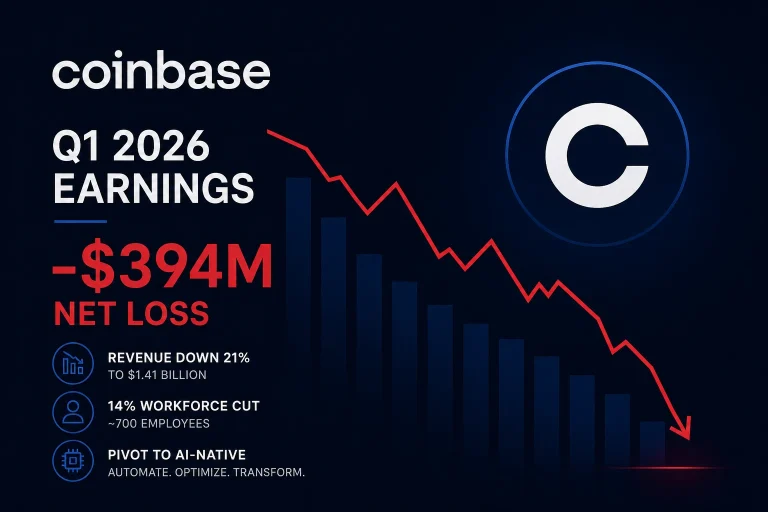
The crypto downturn continues to pressure even the largest market participants. In its Q1 2026 earnings release, U.S.-based crypto exchange Coinbase disclosed a severe financial setback, reporting a net loss of $394 million after another disappointing quarter. As retail trading activity collapsed, CEO Brian Armstrong launched a sweeping restructuring program that includes cutting approximately 14% of the company’s workforce — around 700 employees — while repositioning the company as an “AI-native” organization.
Scam-Or Project reviewed the quarterly results and the controversial strategic overhaul centered around artificial intelligence and operational automation.
Key Findings
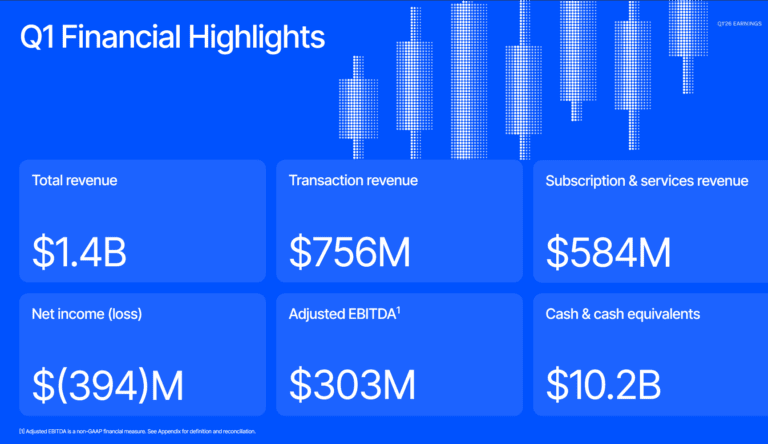
- Coinbase generated Q1 2026 revenue of $1.41 billion, representing a 21% decline compared to the previous quarter and missing Wall Street forecasts of $1.56 billion.
- The exchange posted a net loss of $394 million.
- Earnings Per Share (EPS) came in at -$1.49, far below the expected positive EPS of $0.29.
- Around 700 employees — approximately 14% of the global workforce — are being dismissed.
- Coinbase plans to reduce management layers to only five levels beneath executive leadership.
- The company claims the restructuring is part of a transition toward “AI-native pods,” where artificial intelligence tools handle coding and workflow automation.
- Estimated restructuring expenses are expected to range between $50 million and $60 million, including severance packages, equity vesting, and termination-related costs.
Q1 2026 Financial Breakdown
| Metric | Q1 2026 Result | Analyst Expectation | QoQ Trend |
|---|---|---|---|
| Total Revenue | $1.41 Billion | $1.56 Billion | Down 21% |
| Net Income / Loss | -$394 Million | Positive Net Income | Continuing Decline |
| EPS | -$1.49 | $0.29 | Missed by $1.78 |
| Workforce Reduction | ~700 Employees (14%) | N/A | N/A |
| Restructuring Costs | $50M – $60M | N/A | N/A |
CyberFinance Analysis: AI Narrative or Emergency Cost Cutting?
Coinbase’s latest earnings report reflects a company struggling to stabilize itself amid weak market conditions, declining trading activity, and broader macroeconomic pressure affecting the digital asset sector.
Both crypto market capitalization and trading volumes reportedly fell by more than 20% during the quarter. Retail transaction revenue suffered the sharpest decline, dropping 23% as consumer spot trading activity weakened significantly. Although Coinbase still achieved its 13th straight quarter of positive adjusted EBITDA — reporting $303 million — the broader financial picture remains deeply negative.
The more controversial aspect of the quarter, however, is the aggressive workforce reduction presented as part of an “AI-native” restructuring strategy.
According to Brian Armstrong, AI systems are now capable of completing engineering tasks in days instead of weeks. He further suggested that between 40% and 50% of daily code generation could soon be handled by artificial intelligence, reducing dependence on traditional engineering and middle-management structures.
Supporters argue that flattening corporate hierarchies and automating repetitive workflows could improve efficiency and reduce excessive operational overhead. Critics, however, believe the “AI pivot” may simply serve as a public-relations shield for urgent cost-cutting measures triggered by deteriorating financial performance.
Analysts are now questioning whether a heavily automated exchange can maintain adequate levels of:
-
Security auditing
-
Infrastructure reliability
-
Regulatory compliance
-
Human operational oversight
-
Smart contract risk management
This concern is particularly relevant in a highly regulated financial environment where operational failures could rapidly escalate into systemic risks.
Industry Implications for the Crypto Sector
Scam-Or Project believes Coinbase’s restructuring could become a defining signal for the wider crypto industry.
As regulatory scrutiny from agencies such as the U.S. Securities and Exchange Commission intensifies and retail trading demand weakens, major exchanges may increasingly rely on AI-driven automation to reduce operational costs.
If Coinbase successfully maintains platform performance and compliance standards while operating with a significantly smaller workforce, competitors such as Binance, Kraken, and Gemini may follow a similar path.
However, the risks remain substantial.
A reduction in human oversight within crypto infrastructure could potentially lead to:
-
Security vulnerabilities
-
Code instability
-
Compliance failures
-
Operational breakdowns
-
Large-scale systemic breaches
Coinbase is effectively placing a high-stakes bet on artificial intelligence becoming capable of managing the complexity of modern Web3 infrastructure with minimal human intervention.
Questions Raised by the Coinbase Restructuring
Key concerns now emerging within the industry include:
-
Can AI-generated code safely replace experienced blockchain engineers?
-
Will automated compliance systems satisfy U.S. regulators?
-
Could workforce reductions weaken cybersecurity defenses?
-
Are other crypto exchanges preparing similar AI-driven layoffs?
-
Will investors accept aggressive automation as a long-term operational model?
The coming quarters will likely determine whether Coinbase’s restructuring becomes a successful blueprint for survival — or a cautionary example of over-automation in financial infrastructure.
Call for Whistleblowers
Are you a current or former employee of Coinbase? Do you possess internal information regarding:
-
The recent layoffs
-
The operational reality of the “AI-native” model
-
Internal security concerns
-
Compliance weaknesses
-
Financial risks not disclosed publicly
Scam-Or Project encourages insiders to share relevant information securely and anonymously. Whistleblowers can help expose potential corporate misconduct, hidden operational risks, and regulatory circumvention within the crypto ecosystem.