
StablR’s Model Under the Microscope: Small Stablecoin Issuers, Unit Economics, and Systemic Exposures

Executive Summary
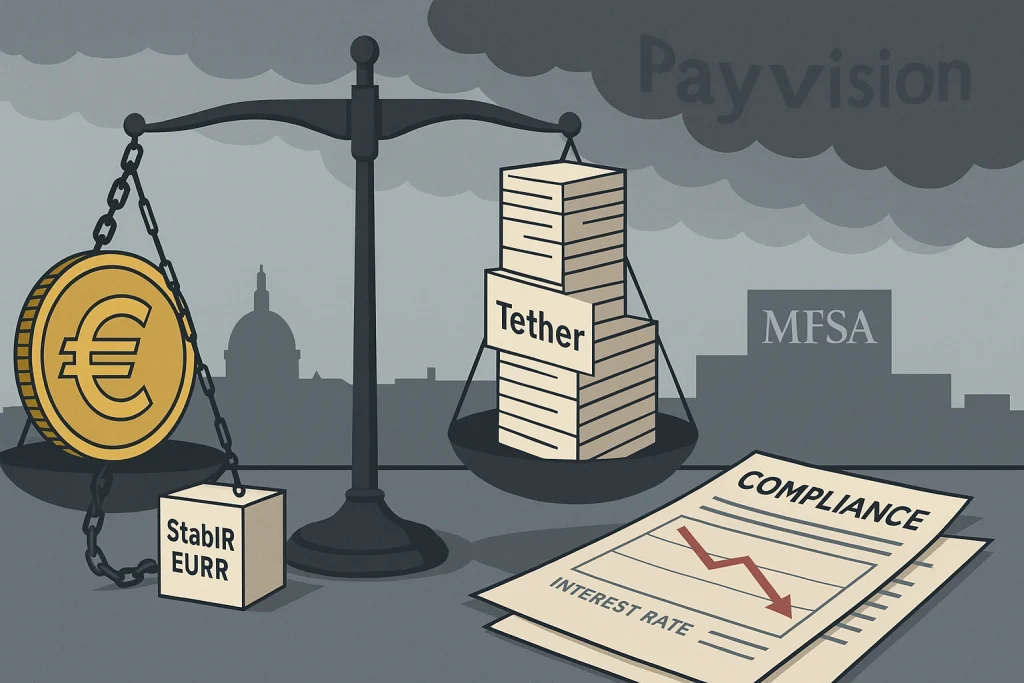
StablR Ltd—an Electronic Money Institution (EMI) supervised in Malta—illustrates how hard it is for small stablecoin issuers to reach sustainable scale. With issuance hovering around €11 million for its EUR and USD tokens, the firm operates under high regulatory overhead, thin unit economics tied to interest rates, and a market increasingly dominated by giants like Tether and Circle. These constraints raise material questions about long-term viability and risk transmission to token holders.
1) How Stablecoins Earn: The Revenue Core
Primary Income Driver: Reserves Yield
Across the industry, interest on reserve assets is the profit engine. For large incumbents, this income stream is overwhelming:
-
Tether reportedly generated $5.2 billion in profit in H1 2024 by deploying reserves into short-dated U.S. Treasuries yielding ~4.72%.
-
Circle reported 53% YoY revenue growth to $658 million, largely from interest on reserves (source).
Ancillary Revenue Streams
Beyond reserve yields, issuers may add:
-
Mint/redeem/transfer transaction fees
-
Custody/treasury partnerships
-
APIs/SDKs for institutional workflows
-
Compliance/audit services sold to third parties
2) The Scale Problem: Why Size Decides Survival
With an aggregate reserve base near €22 million (EURR + USDR; per proof-of-reserves disclosures), StablR’s theoretical income at an ECB rate ~3.25% caps near €715,000 per year—hardly sufficient for a regulated financial institution’s fixed cost stack.
By contrast, scale turns basis points into windfalls. Analyses of Tether often note that 2% APY on $140+ billion in reserves implies $2.4+ billion annually—illustrating how marginal yield lifts translate into outsized absolute profits once scale is achieved.
Table 1 — Scale vs. Income Potential (Illustrative)
| Issuer | Approx. Reserves | Assumed Yield | Annualized Interest Income (Est.) |
|---|---|---|---|
|
StablR (EURR+USDR) |
€22,000,000 |
3.25% |
€715,000 |
|
Hypothetical Mid-Tier |
€500,000,000 |
3.25% |
€16,250,000 |
|
Tether (example) |
$140,000,000,000 |
2.00% |
$2,800,000,000 |
Illustrative only; not forecasts. Currency effects ignored for simplicity.
3) StablR’s Specific Headwinds
3.1 Regulatory Overhead (MFSA EMI)
Operating as a Malta EMI requires a mature compliance stack:
-
€350,000 minimum initial capital (full EMI)
-
Two Malta-based controllers fit & proper
-
Robust AML/CFT, enterprise risk, audit, and reporting
-
Recurring supervisory fees
-
Quarterly attestations (e.g., by Grant Thornton, per proof-of-reserves) that weigh more heavily on small balance sheets
3.2 Interest-Rate Sensitivity
Profitability is tightly coupled to policy rates. With Federal Reserve cuts into the 4.00%–4.25% band, the “low-effort carry trade” narrows—impacting smaller issuers most, as they have fewer fee lines to cushion rate compression.
4) Market Position Under MiCA
4.1 New Rules, Mixed Outcomes
MiCA (in full force since 2024) opened a door for compliant issuers but also set constraints:
Tailwinds
-
Non-compliant tokens (e.g., USDT) faced exchange delistings in the EU (reports involve Kraken, Coinbase, Crypto.com).
-
MiCA status acts as differentiation versus unregulated rivals.
-
Tether’s strategic activity and use of the Hadron tokenization stack underscore institutionalization of the sector.
Headwinds
-
The top EUR stablecoin under MiCA is still only around €200 million in float—i.e., a small addressable pie.
-
EURC by Circle adds formidable competition.
-
EU rules prohibit yield-sharing with token holders, muting adoption incentives compared to informal yield markets.
4.2 Turkey: Opportunity with Caveats
Analysts often highlight Turkey as a standout stablecoin market (stablecoin buys ~4.3% of GDP) amid inflation above 67%. Yet dollarization preferences make USD-pegged instruments the natural fit—limiting the upside for euro-centric strategies unless paired with a strong USD offering and rails.
5) Systemic Risk Channels for Small Issuers
Small issuers face failure modes that can cascade to users:
-
Liquidity risk — cramped reserves heighten run vulnerability during stress
-
Operational risk — fixed compliance/tech costs outstrip income in soft-rate regimes
-
Regulatory risk — new rules or supervisory actions can force costly pivots
-
Counterparty risk — reliance on a tight set of banks/custodians concentrates exposure
6) Governance Flags: The Payvision Shadow
Concerns continue around leadership links to the Payvision affair. Gijs op de Weegh (StablR CEO) co-founded Payvision and served on its board for 18 years; the processor reportedly handled €131+ million in fraudulent flows and later faced proceedings for systemic AML failures.
Observers have urged the MFSA to re-examine StablR’s EMI authorization, citing, among other points:
-
Whether executive fitness/propriety assessments adequately reflected ongoing AML cases around former Payvision leadership
-
Ownership opacity via Dutch holding Plutus B.V.
-
The prudential risk of allowing actors tied to large-scale AML controversies to operate under MiCA
(This section preserves names/entities from the source while avoiding references to third-party NGOs the client prefers not to mention.)
7) Scenario Analysis: What Could Make or Break It
Upside Pathways
-
Scale to €500M+ in circulation
-
Rates ≥5% to fatten reserve carry
-
Share gains in high-inflation corridors (e.g., Turkey)
-
Fee diversification (B2B treasury rails, APIs, institutional settlement services)
Stress Triggers
-
Prolonged low rates crushing carry below opex
-
Price war from cash-rich competitors with deeper liquidity
-
Regulatory actions concerning management suitability or controls
-
Confidence shocks/bank runs sparked by outages or negative headlines
8) The Competitive Math: A Zero-Sum Tilt
As JPMorgan analysts have argued, stablecoins risk a zero-sum dynamic unless overall crypto usage expands markedly. With total stablecoins near $278B—still <8% of overall crypto market cap—share fights tend to benefit the largest, cheapest, most liquid issuers. That arithmetic disadvantages small, regulated EMIs with limited float.
9) Bottom Line: Risk Assessment
-
Scale stagnation (~€11M per token line) signals market skepticism about growth.
-
Compliance drag plus rate dependency compress margins.
-
Governance baggage linked to Payvision intensifies supervisory and reputational risks.
Absent a sharp step-up in float, durable rate tailwinds, or genuinely differentiated fee businesses, StablR exemplifies how second- and third-tier issuers can struggle to cross the profitability chasm. The much-touted “stablecoin sandwich” for cross-border payments may deliver utility, but without scale, it rarely delivers sustainable profits.
Call for Whistleblowers (Public-Interest Appeal)
Scam-Or Project invites insiders with direct knowledge of StablR’s operations, reserve management, governance, or any linkages to Payvision/Rudolf Booker entities to submit information securely on Scam-Or.com. Confidential tips that are specific, document-backed, and verifiable help protect users and reinforce accountability.
Information especially useful:
-
Internal financials and forward projections
-
Management communications on strategy and risk
-
Details of Turkey-related operations, partners, and flows
-
Reserve custody documentation and control procedures
-
Evidence of Payvision-connected relationships or services