
BGH Confirms Prison Term for Former Freshfields Tax Partner in Landmark Cum-Ex Ruling

Overview
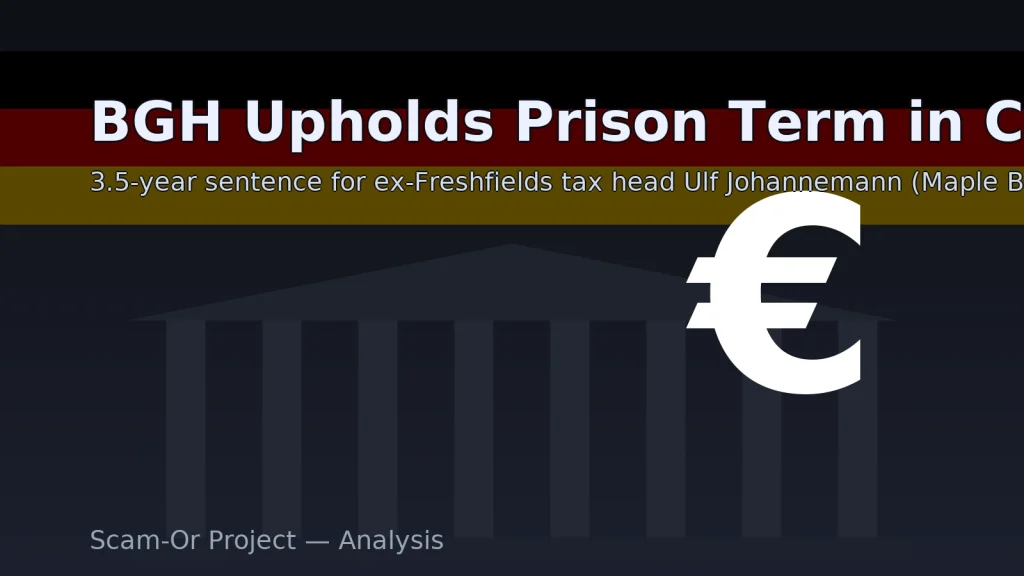
Germany’s Federal Court of Justice (BGH) has upheld a three-and-a-half-year prison sentence for Ulf Johannemann, the former Head of Global Tax at Freshfields, for aiding serious tax evasion tied to the Cum-Ex trades. The decision is a pivotal step in Germany’s response to what many regard as the country’s most intricate tax-fraud affair.
Case Snapshot
| Item | Detail |
|---|---|
|
Court |
German Federal Court of Justice (BGH) |
|
Defendant |
Ulf Johannemann, former Freshfields tax partner |
|
Conduct |
Legal opinions enabling Cum-Ex transactions |
|
Affected Bank |
Maple Bank (Germany) |
|
Confirmed Loss |
€374 million in state tax losses tied to Maple Bank trades |
|
Broader Context |
Approx. €30 billion tax loss in Germany (2001–2016) |
Background: How Cum-Ex Worked
Cum-Ex transactions revolved around ultra-fast trading of shares around the dividend record date. By blurring who actually owned the shares at the critical moment, multiple parties claimed refunds of dividend withholding tax that was, in reality, paid only once.
-
Period: Roughly 2001–2016
-
Mechanism: Share lending and rapid turnover around dividend cut-off dates
-
Impact: Germany is estimated to have lost ~€30 billion to the practice
Courts have since determined that such constructions were not legitimate tax optimization but deliberate and aggravated tax evasion.
What the BGH Decided
The BGH confirmed that Johannemann provided Maple Bank with legal opinions that minimized legal risks and omitted key counterarguments regarding Cum-Ex legality. According to the ruling:
-
His opinions conveyed an unfounded sense of legal certainty to executives.
-
This enabled trades that produced €374 million in tax losses for the state.
-
Crafting manipulative or one-sided legal assessments that facilitate such schemes constitutes criminal participation in tax fraud.
The court also underscored that Maple Bank’s responsible managers would likely not have executed the trades without the reassurance created by these opinions.
Why This Ruling Matters
The judgment widens the circle of potential criminal liability beyond traders and banks to include external enablers whose professional work is integral to the execution of unlawful schemes.
Key Takeaways for Professionals
-
Legal advisors under scrutiny: Opinions used to justify high-risk tax structures will face heightened forensic review.
-
Accountability for enablers: Law firm partners, tax advisors, and compliance consultants can be criminally liable if their work materially enables fraud.
-
Precedent for ongoing cases: The decision sets a clear tone for current and future Cum-Ex-related prosecutions and similar aggressive tax structures.
Practical Implications: A Short Checklist
For banks, brokers, and advisory firms:
-
Reassess Opinion Letters
-
Ensure balanced analysis that explicitly includes counterarguments and legal uncertainty.
-
Strengthen Governance
-
Require independent review and challenge functions for opinions supporting complex tax plays.
-
Document Decision-Making
-
Keep an auditable trail of risk assessments and board-level discussions.
-
Training & Culture
-
Update training on tax-abuse indicators and personal liability exposure.
Conclusion
By affirming the sentence for Ulf Johannemann, the BGH signals a new enforcement era: criminal accountability reaches beyond direct perpetrators to those providing legal and regulatory cover for abusive structures. The message is unambiguous—expert advice that enables large-scale public harm through intentional evasion invites severe personal consequences.