
Operation Endgame: Expert Assessment of EuroJust’s Cybercrime Takedown

1. Overview of EuroJust’s Operation Endgame
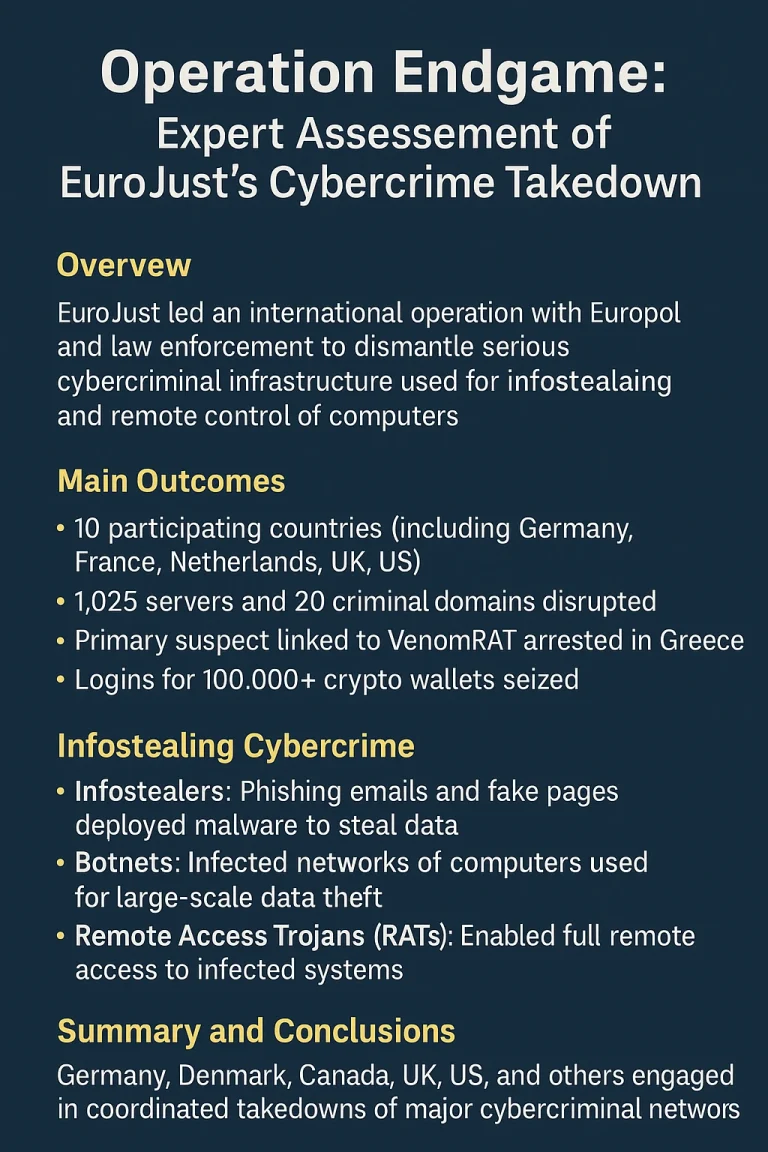
EuroJust, working together with Europol and law enforcement agencies from ten jurisdictions, led a large-scale cybercrime action known as Operation Endgame, with its main phase completed in November 2025.
This coordinated effort reflects the EU’s strategic, cross-border model for dismantling serious cybercriminal infrastructure used to distribute malware, especially infostealers, Remote Access Trojans (RATs), and botnets.
2. Main Operational Outcomes
2.1 International Cooperation
-
Multi-country participation: 10 countries took part, including Germany, France, Netherlands, Denmark, UK, US, Australia, and Canada.
-
Judicial and law enforcement synergy: The action highlighted strong alignment between prosecutors, investigators, and cyber units across borders.
2.2 Disruption of Criminal Infrastructure
-
Servers neutralized: Authorities took down 1,025 servers used to run and manage malware operations.
-
Domains seized: 20 criminal domain names were confiscated, directly impacting infostealer and botnet networks that had infected hundreds of thousands of computers worldwide.
2.3 Arrests and Evidence Seizures
-
Key suspect detained: The main individual associated with VenomRAT was arrested in Greece.
-
Search operations: Law enforcement carried out 11 searches, resulting in the seizure of login credentials for more than 100,000 cryptocurrency wallets and other digital evidence.
2.4 Operational and Analytical Support
-
EuroJust’s role:
-
Enabled real-time handling of judicial requests
-
Facilitated live communication among prosecutors during the action
-
Europol’s contribution:
-
Delivered analytical and forensic assistance
-
Supported crypto-tracing and technical attribution efforts
3. Infostealing Cybercrime: Context and Threat Landscape
Infostealing malware – including families such as Rhadamanthys and VenomRAT – is engineered to covertly extract sensitive data from compromised devices. This data often includes:
-
Passwords and logins
-
Online banking credentials
-
Email and messaging account access
-
Cryptocurrency wallet information
The stolen information is then monetized through:
-
Financial fraud
-
Identity theft
-
Secondary cyber-attacks (e.g., account takeovers, targeted phishing)
3.1 Key Malware Categories
Infostealers
-
Malicious software often delivered via:
-
Phishing emails
-
Fake antivirus or software-update pages
-
Designed to harvest data from:
-
Web browsers
-
Email clients
-
Messaging apps and other installed software
-
Example: “Rhadamanthys”, marketed as “malware-as-a-service”, allowing criminals to rent the tool.
Botnets
-
Networks of compromised computers (“bots”) controlled remotely by criminals.
-
Enable:
-
Coordinated data theft at scale
-
Distributed attacks
-
Further malware distribution and abuse of infected hosts.
Remote Access Trojans (RATs)
-
Grant attackers remote control over infected systems.
-
In the case of “VenomRAT”, operators obtained:
-
Full unauthorized access to victim devices
-
The ability to exfiltrate files, capture credentials, and manipulate systems in real time.
4. EuroJust’s Model of EU Judicial Cooperation
EuroJust functions as the central coordination hub for legal and procedural issues among EU member states and partner countries. In Operation Endgame, this model allowed:
-
Rapid evidence sharing across borders
-
Synchronized enforcement actions (arrests, searches, server seizures)
-
Harmonized legal responses, ensuring that takedowns and arrests were aligned with national and EU law
By intervening at the level of infrastructure – command-and-control servers, domains, and payment channels – authorities targeted the cybercrime “kill chain” at an early stage, limiting:
-
The expansion of ransomware campaigns
-
Large-scale data theft
-
Subsequent fraud and laundering activity
5. Compliance and Regulatory Implications
5.1 Cross-Border Enforcement as the New Standard
-
Modern cybercrime is inherently transnational, often involving infrastructure, victims, and perpetrators across multiple continents.
-
The EuroJust network streamlines:
-
Multi-country investigations
-
Parallel arrest operations
-
Coordinated evidence collection and preservation
5.2 Public–Private Collaboration
-
Cybersecurity companies played a supporting role, providing:
-
Technical intelligence on malware families and infrastructure
-
Indicators of compromise (IOCs)
-
Threat analytics and attribution support
-
The operation underlines that industry expertise is now a core element of effective cybercrime enforcement.
5.3 Crypto Asset Tracing and Seizure
-
The seizure of login data for over 100,000 cryptocurrency wallets signals a mature approach to digital asset enforcement.
-
Authorities are increasingly capable of:
-
Identifying illicit crypto flows
-
Freezing and confiscating assets
-
Linking wallet activity to real-world actors.
5.4 Preventive Action and Risk Reduction
By proactively dismantling the malware and botnet infrastructure rather than reacting only to individual incidents, Operation Endgame:
-
Reduced exposure for millions of private users and businesses
-
Limited the potential for:
-
Further credential theft
-
Fraudulent transactions
-
Downstream identity abuse
6. Summary and Strategic Conclusions
Operation Endgame represents a mature, integrated model of EU and international cybercrime enforcement. Key strategic elements include:
-
Targeting the core infrastructure behind infostealers, RATs, and botnets
-
Leveraging EuroJust’s legal coordination and Europol’s technical capabilities
-
Combining law enforcement, judicial authorities, and private-sector specialists in a single operational framework
For regulators, compliance officers, and cybersecurity professionals, Operation Endgame illustrates:
-
Best practices in transnational cooperation
-
Effective regulatory synchronization across jurisdictions
-
The importance of public–private partnerships in responding to modern cyber threats
In practice, this model offers a blueprint for future operations seeking to disrupt complex, cross-border cybercriminal ecosystems before they result in large-scale financial and reputational damage.