
Gambling Compliance Clash: ECJ to Examine Malta’s Protective Framework in Mr Green Case

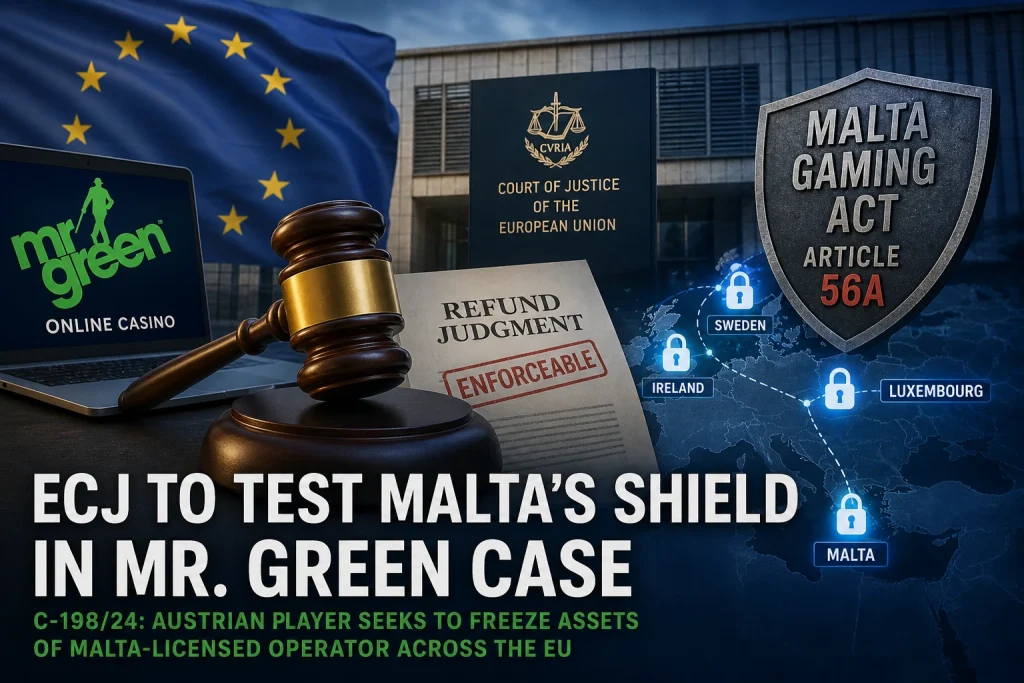
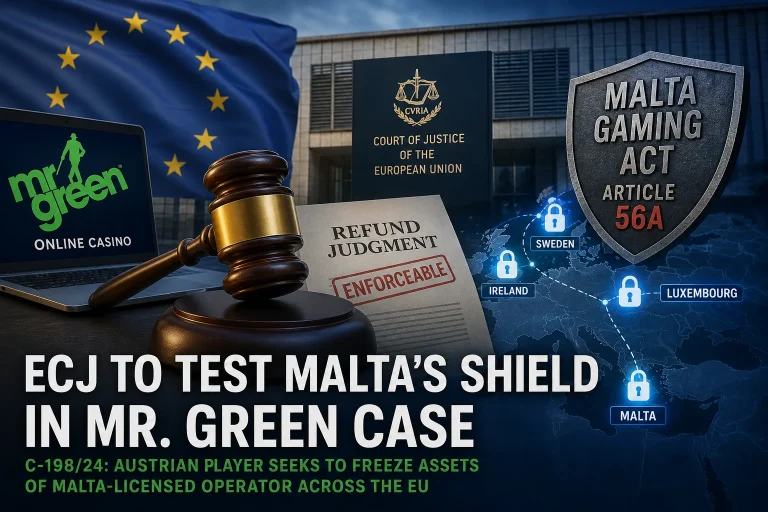
A pending judgment from the Court of Justice of the European Union (CJEU) in Case C-198/24, TQ v. Mr Green Limited, is poised to become a landmark decision for cross-border enforcement of player claims within the EU. The dispute brings together several critical elements: illegal online gambling, asset preservation under the European Account Preservation Order (EAPO), and Malta’s controversial attempt to shield its licensed operators via Article 56A of the Gaming Act.
Key Findings
- Case C-198/24 involves an Austrian claimant seeking to enforce final refund judgments against Mr Green Limited, a Malta-licensed operator, using an EAPO mechanism.
- Austrian courts had already ruled the gambling relationship unlawful, with enforceable judgments in place by April 13, 2022—yet payment remains outstanding.
- The Vienna court referred key questions to the CJEU regarding when cross-border asset-freezing is justified under the EAPO framework.
- The claimant identified accounts linked to the operator across multiple jurisdictions: Malta, Sweden, Luxembourg, and Ireland.
- Advocate General Emiliou issued his opinion on October 30, 2025. A final judgment is scheduled for May 21, 2026, before the Fourth Chamber of the CJEU.
- The broader legal context includes Malta’s Article 56A, which the European Commission has challenged for potentially obstructing enforcement of foreign judgments.
Case Overview
| Item | Details |
|---|---|
| Case Number | C-198/24, TQ v. Mr Green Limited |
| Court | Court of Justice of the European Union (Fourth Chamber) |
| Judgment Date | Scheduled for May 21, 2026 |
| Opinion | Advocate General Emiliou (October 30, 2025) |
| Core Issue | Use of EAPO to freeze assets of a Malta-licensed gambling operator |
| Claimant | TQ (Austria) |
| Respondent | Mr Green Limited (Malta) |
| Legislation | EAPO Regulation; Malta Gaming Act (Article 56A / Act XXI of 2023) |
| Jurisdictions Involved | Malta, Sweden, Luxembourg, Ireland |
| Significance | Cross-border enforcement, player restitution, EU compliance risks |
Legal and Compliance Analysis
The importance of the Mr Green case extends far beyond a standard refund dispute. At its core lies a fundamental question: can claimants effectively use EU mechanisms to secure assets across borders when there is evidence that a gambling operator may be restructuring or relocating funds to avoid enforcement?
According to the case file, the claimant alleged that Mr Green Limited adjusted its financial arrangements after enforcement proceedings began—specifically by terminating its relationship with Dimoco Europe GmbH, an Austrian third-party payment entity. There were also concerns that assets might be shifted from other EU jurisdictions back to Malta.
This transforms the dispute into a broader compliance issue. It tests whether financial structuring, payment routing, and treasury management can be leveraged to delay or obstruct enforcement of court decisions.
Malta’s Article 56A Under Scrutiny
The case highlights ongoing friction between Malta’s licensing framework and the legal expectations of other EU member states.
- Supporters of Article 56A argue it reflects legitimate public-policy protections against foreign judgments.
- Critics, including the European Commission, view it as a legal barrier that undermines EU-wide judicial cooperation.
Even if the CJEU does not directly rule on Article 56A, its interpretation of the EAPO framework could significantly weaken Malta’s defensive position by enabling more aggressive asset-freezing across borders.
Why This Matters for Compliance
If a gambling operator continues to use EU-based financial infrastructure while refusing to comply with final court rulings, then its payment flows, acquiring setup, and treasury structure become critical compliance risk indicators.
Courts are increasingly focusing not just on licensing status, but on actual operational behavior, including:
- Movement of funds between jurisdictions
- Changes in payment partners
- Timing of financial restructuring relative to enforcement actions
Implications for the Gambling Industry
A ruling in favor of the claimant could reshape enforcement dynamics across Europe:
Potential Outcomes:
- Stronger recovery tools for players and litigation funders
- Increased use of cross-border asset preservation measures
- Greater legal exposure for operators targeting markets without proper authorization
Strategic Impact on Operators:
- Reduced reliance on domestic legal shields like Article 56A
- Increased pressure to settle claims early
- Need to reassess market-entry strategies and legal risk management
Impact on Payment Facilitators
Payment service providers—including acquiring banks, e-money institutions, and intermediaries—should treat the Mr Green case as a warning signal.
The involvement of Dimoco Europe GmbH illustrates how third-party processors can become central to enforcement narratives.
Key Risks for Payment Providers:
- Enabling transactions for operators accused of illegal activity
- Indirectly facilitating avoidance of court-ordered payments
- Exposure to regulatory scrutiny and reputational damage
Required Compliance Enhancements:
- Deeper jurisdictional risk assessments
- Monitoring of merchant litigation status
- Analysis of beneficial ownership and operational footprint
- Detection of unusual asset movements linked to enforcement pressure
Whistleblower Call
Players, insiders, and industry professionals with knowledge of illegal gambling operations, payment routing structures, or enforcement evasion tactics are encouraged to submit information through the Scam-Or Project Complaints.
Relevant intelligence includes:
- Acquiring banks and PSP relationships
- E-money and EMI partnerships
- Merchant entities and front companies
- Affiliate networks and traffic funnels
- Withdrawal and payout mechanisms
Such contributions are essential for ongoing investigations into unlawful gambling ecosystems and their financial enablers.