
Coinbase–Morpho DeFi Lending: Bitcoin-Backed Loans, New Regulatory Frictions, and Market Access

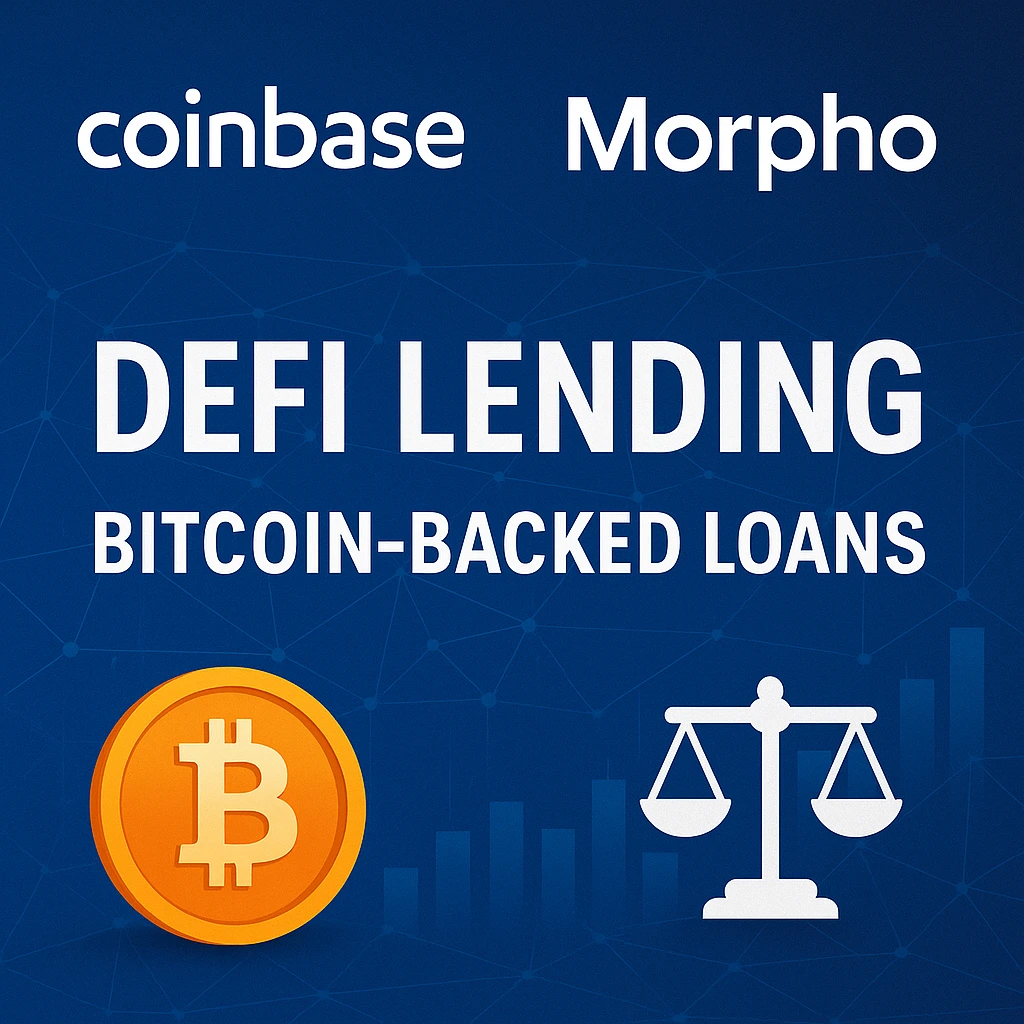
Coinbase, the leading U.S. cryptocurrency exchange, has rolled out a major decentralized lending feature by integrating directly with the Morpho protocol. The offering enables users to take out crypto-backed loans and supply liquidity as lenders, while Coinbase positions itself primarily as a “technology facilitator” rather than a traditional lender. This hybrid model is quietly reshaping how lending, regulation, and market access intersect in the crypto-finance space.
Coinbase x Morpho: Context and Structure of the Integration
In 2025, Coinbase introduced a new onchain lending product powered by Morpho, one of the largest DeFi integrations by a regulated exchange to date. The setup allows users to:
-
Post Bitcoin as collateral in order to borrow USDC
-
Lend USDC into Morpho markets to earn yield
-
Use Coinbase’s familiar app interface while all lending logic runs through Morpho’s decentralized smart contracts in the background
From the user’s perspective, the experience is mostly centralized and user-friendly. Behind the scenes, collateral, loans, and yields are administered programmatically onchain.
Key Features of the Offering
-
Instant USDC loans against Bitcoin collateral
Users can lock up BTC and receive USDC almost immediately. The collateral is managed transparently onchain via Morpho’s smart contracts. -
Algorithmic interest rates and yields
Borrowing costs and lender returns are determined by market dynamics within the Morpho lending pools—supply and demand set the price. -
Expanded U.S. availability
The product is accessible to a wide swath of U.S. customers. This contrasts with competitors that must secure separate state lending licenses, because Coinbase is not directly issuing the loans from its own balance sheet.
How Morpho-Based DeFi Lending Works
Morpho is a permissionless, peer-to-peer lending protocol operating on a public blockchain. It replaces traditional intermediaries with smart contracts and open market mechanisms.
Core Mechanics
-
Isolated Lending Markets
-
Anyone can create a lending market that pairs two assets (e.g., BTC/USDC).
-
Market creators define parameters such as collateral ratios, interest rate models, and liquidation thresholds.
-
Lenders and Borrowers
-
Depositors supply assets like USDC to earn interest driven by borrower demand.
-
Borrowers lock collateral (e.g., BTC) to draw loans denominated in another asset (e.g., USDC).
-
Intent-Based Matching
-
Morpho’s design focuses on matching lenders and borrowers directly when possible.
-
This can offer more efficient and customizable terms than traditional pooled lending models.
-
Smart Contract Governance of Risk
-
Collateralization, interest accrual, and liquidations are enforced by immutable smart contracts.
-
This reduces custodial risk and provides full onchain transparency over positions and flows.
Architectural Advantages of Morpho
Morpho’s technical design supports:
-
Permissionless market creation – any participant can deploy a new lending market with custom parameters.
-
Isolated risk per market – each lending pair operates independently, similar to isolated trading pairs on Uniswap.
-
Programmability for diverse use cases – suitable for both retail users and institutional structures that want programmable credit markets.
Regulatory Angle: Coinbase as a “Technology Facilitator”
U.S. financial regulation typically requires lending institutions to conduct full Know Your Customer (KYC) checks, comply with Anti-Money Laundering (AML) rules, and obtain appropriate licensing in each jurisdiction where they operate.
Coinbase’s Morpho-backed loans take a different route:
-
Coinbase’s Role
-
Coinbase does not extend credit from its own balance sheet.
-
It largely avoids taking custody of most of the funds involved in the lending transactions.
-
Instead, Coinbase’s interface routes user instructions to Morpho’s non-custodial protocol, functioning more like a gateway or facilitator.
-
Morpho’s Role
-
Morpho is a permissionless, non-custodial protocol.
-
The protocol itself does not natively identify users or enforce KYC.
-
Any address can interact with its smart contracts, consistent with the open-access ethos of DeFi.
Traditional Lending vs Coinbase–Morpho Model
| Aspect | Traditional Lender | Coinbase–Morpho DeFi Lending Model |
|---|---|---|
|
Who issues the loan? |
Regulated financial institution |
Smart contracts on Morpho |
|
Lender licensing requirements |
Full lending licenses in relevant jurisdictions |
Reduced, as Coinbase frames itself as a facilitator |
|
KYC/AML collection |
Directly by the lender |
Coinbase may KYC its users; Morpho protocol itself does not |
|
Custody of funds |
Typically held by the lender or intermediary |
Non-custodial smart contracts manage most funds onchain |
|
Regulatory exposure |
High, direct supervision as a financial institution |
More indirect; regulatory focus shifting to access points |
This structure lets Coinbase sidestep some of the heaviest licensing requirements that apply to entities lending from their own balance sheet or directly holding client assets. Competitors that operate as conventional lenders face a fragmented landscape of state and federal licenses.
At the same time, regulators and policy analysts are debating whether this “facilitator” model leaves gaps in consumer protection, AML enforcement, and supervision of cross-border flows.
Compliance Implications and DeFi Lending Outlook
The Coinbase–Morpho integration marks an important step in the evolution of DeFi lending:
-
Brand plus protocol
A highly regulated and recognizable exchange front-ends a non-custodial, open DeFi protocol. This blends user trust and UX quality with global liquidity that remains, in many respects, outside traditional regulatory perimeters. -
Transparency vs identity
Onchain records and automated rule enforcement offer exceptional auditability for transactions and positions. However, reduced reliance on direct KYC at the protocol level raises questions for financial crime prevention and sanctions screening. -
Jurisdictional complexity
Because Morpho is accessible worldwide, enforcement and supervision issues become cross-jurisdictional by default, challenging the standard country-by-country licensing approach used for legacy lenders.
Some DeFi projects are trialing “permissioned pools” and whitelisted markets designed specifically for institutions that require strict compliance frameworks. Nevertheless, fully permissionless and non-custodial lending remains resistant to the depth of oversight found in traditional finance.
Why This Matters for Analysts and Market Participants
For financial crime investigators, risk officers, and policy experts, Coinbase’s Bitcoin-backed lending via Morpho is a key case study:
-
It showcases how regulated access points can plug into permissionless protocols while attempting to minimize their own direct regulatory exposure.
-
It illustrates new combinations of onchain transparency and offchain opacity (especially around user identity and cross-border activity).
-
It sets a precedent for how other exchanges might structure similar offerings in the future.
This context is essential for interpreting Coinbase’s Bitcoin-backed lending product and evaluating its broader market and regulatory impact, including the issues highlighted in the referenced Decrypt segment.