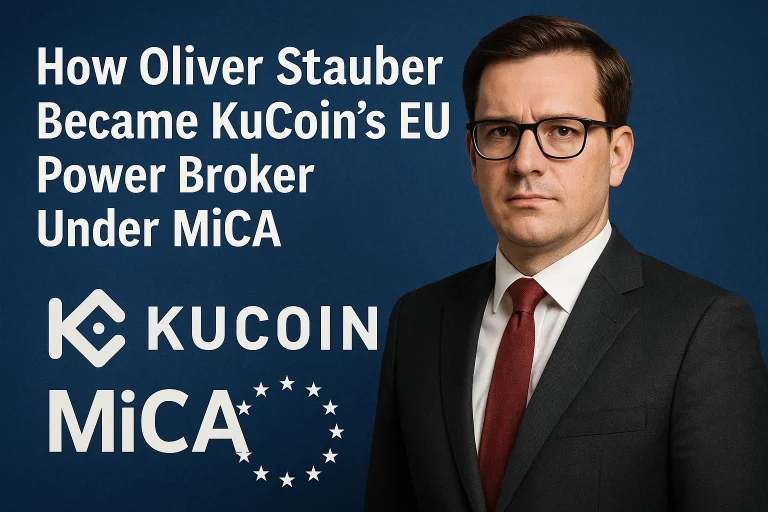

Austrian MiCA Power Play: How Political Lawyer Oliver Stauber Became KuCoin’s EU Gatekeeper

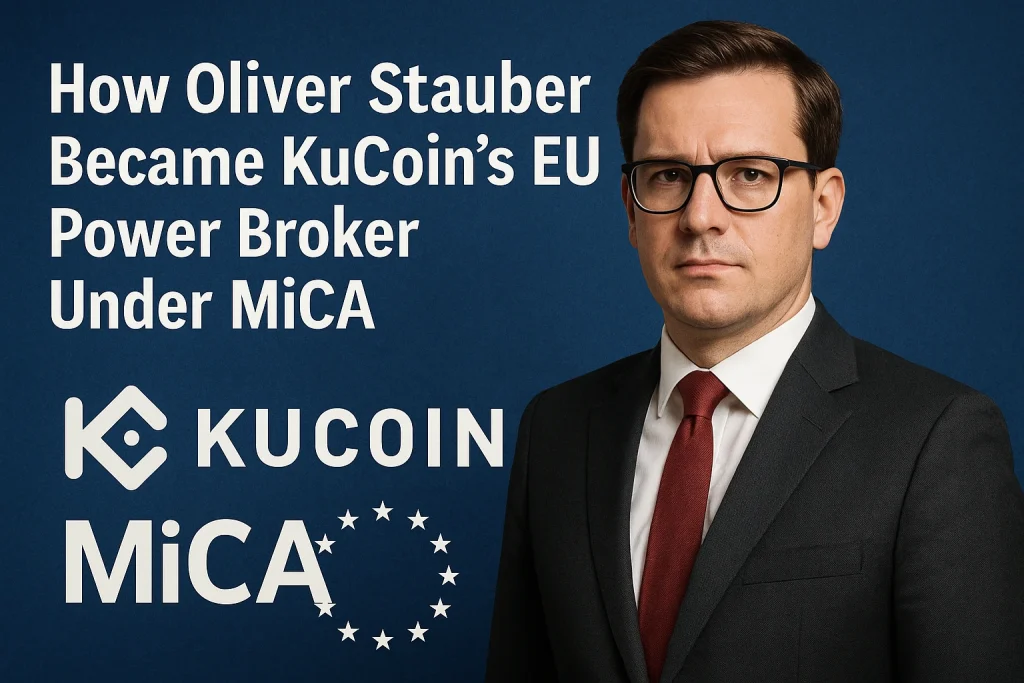
Introduction: Politics, MiCA, and a “Repeat Offender”
Viennese lawyer and long-standing Social Democratic (SPÖ) networker Oliver Stauber has travelled an unusual path: from running a Social Democratic “think tank” under former chancellor Christian Kern to heading KuCoin’s new EU hub in Vienna.
At the same time, Austria’s regulator FMA co-authored a paper arguing that national supervisors cannot effectively control global crypto platforms—then, only weeks later, granted a full MiCA licence to KuCoin, a platform repeatedly cited in major AML enforcement actions in the US and Canada.
The timeline fuels concerns about political networks, regulatory capture, and the way MiCA is already being stretched in practice.
1. The Political Lawyer: SPÖ Insider with His Own “Section”
Before being marketed as a crypto-compliance expert, Oliver Stauber (see LinkedIn) was embedded in Austria’s Social Democratic ecosystem:
- For years he served as deputy federal chair of the SPÖ youth organisation Junge Generation and sat on the board of the association of Social Democratic lawyers (source: Trending Topics).
- In 2016, he founded and chaired the SPÖ “Sektion ohne Namen” (Section without a Name) in Vienna’s first district – a self-declared “think tank” and Realo counterweight to the left-wing Sektion 8 (source: Der Standard).
- Media such as Der Standard and Die Presse portrayed this section as a modern, business-friendly SPÖ hub in which Niko Kern, son of chancellor Christian Kern, was active, and where Kern presented his “Plan A” for a modernised Austria.
In effect, Stauber did not merely “support” the SPÖ. He built a power centre inside the party, positioning the Sektion ohne Namen as a junction between party politics, consultants, and business interests in Vienna’s inner city.
This political background matters because it is precisely the combination of law, lobbying, and party networks that now underpins his role in Austria’s crypto-policy landscape.
2. From SPÖ Networker to Crypto and FinTech Insider
Over roughly a decade, Stauber rebranded himself as a specialist in crypto and digital finance:
- He became Chief Legal Officer at Bitpanda, Austria’s most prominent crypto platform, and managing director of its regulated entities (source: brutkasten).
- He joined the FinTech Advisory Board at the Austrian Ministry of Finance, a body involved in shaping the “regulatory sandbox” and broader digital-finance policy (source: brutkasten).
- He co-founded and sat on the board of the Digital Assets Association Austria (DAAA), an industry and lobbying association that emerged directly from this advisory work.
By the time MiCA was negotiated, Stauber occupied a rare junction of:
- Political networks: SPÖ positions, the Sektion ohne Namen, and proximity to the Kern circle.
- Regulatory networks: Ministry of Finance advisory boards, sandbox-related structures, and DAAA.
- Crypto-industry roles: senior positions at Bitpanda and later KuCoin.
This cocktail becomes highly controversial once his next move—fronting KuCoin’s EU structure—is added.
3. KuCoin’s Global AML Track Record: A “Repeat Offender”
KuCoin is far from an untainted newcomer looking for a quiet EU home. Its enforcement history includes:
| Year / Date | Authority / Country | Entity / Persons | Core Allegations / Outcome |
|---|---|---|---|
| March 2024 | US DOJ (United States) | KuCoin; founders Chun Gan & Ke Tang | Alleged evasion of US AML laws, systemic KYC/AML failures, billions in suspicious flows |
| 27 January 2025 | US DOJ, New York federal court | Peken Global Limited (Seychelles KuCoin vehicle) | Guilty plea for operating an unlicensed money-transmitting business; nearly USD 300m fines and forfeitures; exit from US market for at least two years |
| 2024 (additional) | CFTC (United States) | KuCoin | Action for illegally offering leveraged crypto derivatives to US customers |
| 2024 (earlier) | NY Attorney General | KuCoin | Case for operating an unregistered platform |
| 25 September 2025 | FINTRAC (Canada) | Peken Global Limited | Record CAD 19.6m penalty for lacking proper registration and failing major reporting obligations (source: Reuters) |
Key themes from the US and Canadian enforcement material and legal commentary include:
- Absence of an effective KYC programme,
- Systematic failures to file suspicious activity reports,
- Facilitation of more than USD 5 billion in illicit flows from darknet markets, ransomware, and online-fraud schemes. (Source: wp.nyu.edu)
At the structural level, KuCoin is widely reported as:
- Founded by Chinese nationals,
- Operating through entities in Seychelles, Singapore and Hong Kong,
- Fitting the precise “third-country, complex-structure” pattern that European supervisors describe as high risk under MiCA passporting rules.
Source: Wikipedia.
4. September 2025: FMA Admits National Regulators Are Outmatched
On 15 September 2025, the French AMF, Austrian FMA, and Italian Consob issued a joint position paper calling for a stronger, more centralised European framework for crypto-asset markets under MiCA (sources: FMA Österreich, Ashurst).
According to summaries by legal analysts, the paper stresses that:
- Fragmented national supervision encourages regulatory arbitrage; CASPs engage in “regulatory shopping” across Europe, seeking the weakest jurisdiction.
- For “significant” CASPs, direct ESMA supervision—including licensing and sanctioning powers—is recommended, because national authorities alone cannot effectively oversee global platforms.
- Complex cross-border and third-country structures servicing EU users through intra-group arrangements are identified as a systemic weakness for investor protection.
Translated into plain language:
The FMA and its partners publicly acknowledged that national regulators are structurally too weak to comprehensively police global crypto platforms and that MiCA’s passporting regime creates genuine regulatory-shopping risks.
5. November 2025: FMA Licences KuCoin EU in Vienna
Barely two months later, on 27 November 2025, the same FMA authorised KuCoin EU Exchange GmbH in Vienna under Article 63 MiCA (source: FMA Österreich).
According to the FMA’s announcement, KuCoin EU is allowed to:
- Provide custody and administration of crypto-assets,
- Exchange crypto-assets for fiat and for other crypto-assets,
- Place crypto-assets,
- Offer transfer services on behalf of clients.
Under MiCA, this licence can be passported across the EU, potentially turning Vienna into KuCoin’s gateway to the entire European market—even though:
- KuCoin has just entered a guilty plea in the US,
- Its Seychelles vehicle has been hit with a record AML penalty in Canada,
- Additional US supervisory and civil matters remain ongoing.
Scam-Or Project and other investor-protection observers have already questioned whether Austria has effectively “whitewashed a repeat offender” and positioned itself as a MiCA hub for high-risk platforms (source: Scam-Or Project).
The FMA, for now, has offered only general explanations that MiCA criteria were met—without a detailed public account of how KuCoin’s global AML history was weighed against those criteria.
6. Where Oliver Stauber Fits into the Picture
The KuCoin EU licence was granted precisely at a moment when:
- National regulators, including the FMA, have warned they cannot adequately supervise global CASPs alone, and
- The same regulators have highlighted that regulatory shopping and third-country structures undermine investor protection.
Austria nonetheless chose to license such a platform, with the public face of the move being a lawyer whose CV combines:
- Party-political networking: SPÖ roles, founder of Sektion ohne Namen, integration into the Kern orbit.
- Regulatory insider functions: advisory roles at the Ministry of Finance, involvement in sandbox-related bodies, DAAA as a spin-off from that ecosystem.
- Top crypto-industry positions: CLO and managing-director roles at Bitpanda, followed by the CEO role at KuCoin EU in Vienna.
This constellation does not in itself prove illegal conduct or direct political interference in the FMA’s licensing process. But from a compliance-risk point of view, it creates a textbook appearance-of-conflict scenario:
- The same network that promoted a pro-innovation, industry-friendly stance in Austrian FinTech policy appears to have facilitated a full MiCA licence for one of the most heavily sanctioned crypto platforms globally.
- The same authority (FMA) that co-authored a paper on the limits of national supervision chose to act as home regulator for a CASP with a fresh criminal plea and major AML penalties.
For investors, partners, and counterparties, this raises a blunt question:
Is Austria showcasing that MiCA can be applied rigorously even to high-risk global exchanges, or is it illustrating how political networks and regulatory arbitrage can still prevail under the new regime?
At this stage, only the FMA and the KuCoin EU team know:
- How the licensing file was argued internally,
- What conditions, remediation plans, or monitoring commitments were attached,
- Which fit-and-proper assessments were made in light of the US and Canadian enforcement cases.
7. What Should Happen Next to Restore Confidence
From a professional compliance and governance perspective, several concrete steps would be necessary to rebuild trust.
7.1 Transparency from the FMA
- Publish a detailed, non-confidential summary of the KuCoin EU authorisation.
- Explain explicitly how the US guilty plea, the FINTRAC penalty, and the CFTC/NYAG measures were evaluated under MiCA’s fit-and-proper, organisational, and AML requirements. (Sources: moneylaunderingnews.com, uk.practicallaw.thomsonreuters.com, fincrimecentral.com)
7.2 Clarification from KuCoin EU and Its Management
- Set out how KuCoin’s group-wide AML framework has been overhauled after these enforcement actions.
- Describe which on-chain monitoring tools, KYC/EDD controls, and transaction-monitoring systems will be implemented in the EU hub.
- Clarify how governance independence from sanctioned non-EU entities will be ensured, including decision-making and data-sharing boundaries.
7.3 Clear Statements on Conflicts of Interest
- Disclose any political advisory mandates, lobbying contracts, party positions or side roles held by KuCoin EU’s key managers—including Stauber—that might intersect with Austrian or EU crypto-policy formation.
7.4 ESMA’s Role
- In light of the September position paper, ESMA should assess whether KuCoin qualifies as a “significant CASP” requiring direct EU-level supervision.
- ESMA should also examine whether Austria’s licensing decisions are consistent with the logic and risk concerns formulated in that same paper.
Without steps along these lines, Austria risks cementing a reputation as Europe’s weak link—a jurisdiction that warns loudly about regulatory shopping, yet grants an EU passport to one of the market’s most controversial exchanges.
8. Call for Information and Whistleblower Appeal
This report relies exclusively on publicly accessible information and official enforcement documents. It does not allege criminal activity beyond what authorities have already established in their own proceedings, and it does not assert that any Austrian official or lawyer has violated the law.
However, the combination of:
- Political networks,
- Regulatory insider positions, and
- The licensing of KuCoin EU in Vienna
raises serious questions about:
- The real independence of Austria’s MiCA supervision,
- The influence of insider networks on European crypto regulation, and
- The concrete conditions attached to KuCoin EU’s authorisation.
Individuals with inside knowledge—current or former employees of KuCoin, Bitpanda, the FMA, the Ministry of Finance, or related advisory and lobbying bodies—who can shed light on:
- The licensing process of KuCoin EU in Vienna,
- Stauber’s role, contacts and interactions during that process, or
- Internal considerations surrounding the September 2025 MiCA position paper,
are invited to contact us securely via encrypted channels, including the Scam-Or Project whistleblower section, or other secure means.
Confidentiality and source protection remain paramount. The credibility of MiCA supervision in Europe depends on understanding how this licence was granted—and whether political networks are already reshaping the rules before the framework is fully in force.