
The “Stellar” Casino Blueprint

Anonymous Operators, Boilerplate Jurisdiction Language, and Reused USDC.e “Fake-Fiat” Deposit Pipelines
Scam-Or Project has extended its analysis beyond the Legiano case and identified a consistent, repeatable operating model across several online casino brands linked to Stellar Ltd. The reviewed platforms display nearly identical website layouts, limited or opaque operator disclosures, copy-paste legal clauses regarding governing law, and—critically—the same payment infrastructure.
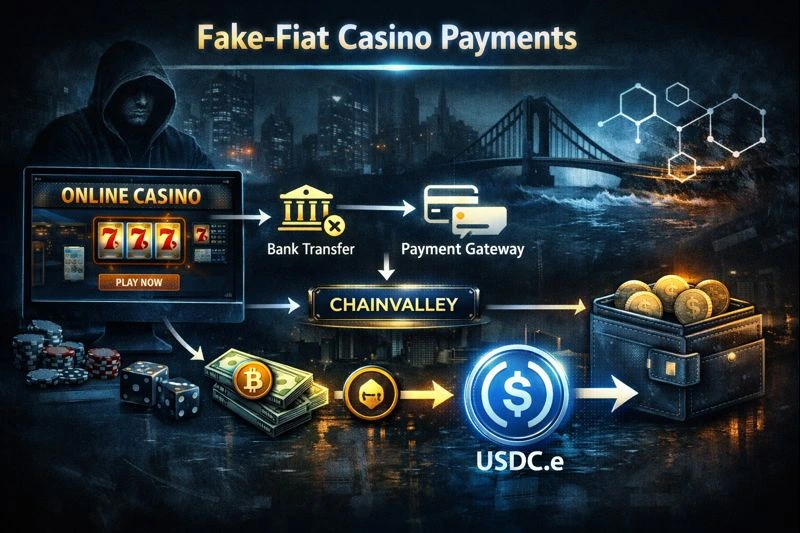
That infrastructure relies on so-called “bank transfer” deposits which, in reality, route user funds through Chainvalley (Poland), convert fiat into USDC.e, and forward the tokens directly to casino-controlled wallets. This consolidated report documents the recurring pattern and explains why the use of USDC.e introduces additional bridge-related risk on top of an already misleading “fake-fiat” user experience.
Key Findings at a Glance
- Casino review platforms attribute brands such as Ragnaro, Astromania, SpinFin, and others to Stellar Ltd (Source: Online Casino Groups).
- Across multiple Stellar-linked sites, operator identification and jurisdictional disclosure are weak or generic. In some cases, legal texts appear unfinished—for example, SpinFin’s terms include the placeholder phrase “laws of [insert jurisdiction]” (Source: SpinFin Casino).
-
The previously documented Legiano payment flow appears reusable throughout the network:
utPay / Chainvalley checkout → Skrill or Neteller funding → USDC or USDC.e acquisition → automated transfer to a casino wallet (Source: Scam-Or Project, Chainvalley). - In cashier flows branded under MiFinity, the payee CANAMONEY EXCHANGE LTD (Canada), operating as CenturaPay, reappears as the settlement entity (Source: CenturaPay).
Analytical Observations
1) Built-In Anonymity as an Operating Principle
Established and compliant gambling operators typically provide clear disclosure of:
- the licensed legal entity,
- the issuing regulator,
- and a defined governing law and jurisdiction.
Within the Stellar-associated cluster, these elements are often absent, reduced to vague statements, or replaced with template language. In some cases, placeholders remain unedited. This is more than a presentational issue—it materially complicates dispute resolution, regulatory oversight, and legal enforcement.
2) A Standardized Payment Stack, Reused Across Brands
What players are presented with as a standard fiat deposit or bank transfer functions, in practice, as a crypto on-ramp transaction. Funds are processed by third-party intermediaries and converted into digital assets before being delivered to a wallet specified by the casino.
Chainvalley’s own contractual documentation anticipates this structure. Its terms explicitly allow for the delivery of virtual assets to designated wallet addresses and include provisions for freezing both fiat and crypto balances under certain conditions. This confirms that the product is architected as an exchange or on-ramp service—not as a direct gambling merchant payment solution.
For end users, the implications are significant:
- the transaction narrative becomes “I purchased cryptocurrency” rather than “I paid a gambling operator,”
- chargeback attempts may be weakened,
- and complaints to banks or PSPs become harder to substantiate.
3) USDC.e as an Additional Risk Multiplier
Screenshots reviewed by Scam-Or Project indicate that USDC.e is used in these cashier flows. USDC.e is commonly understood as a bridged representation of USDC rather than a native issuance on the destination blockchain.
According to Circle’s own documentation and legal terms, bridged USDC tokens are not issued or redeemed by Circle and are not backed by Circle’s USDC reserves. Instead, their reliability depends on third-party bridge infrastructure, introducing what is commonly referred to as bridge risk (Sources: Circle, Circle, USDC, Avalanche).
In practical terms:
| Layer | Risk Introduced |
|---|---|
| “Fake-fiat” UX | Reduced transparency and weaker consumer protection |
| USDC.e (bridged) | Dependence on bridge security and operational integrity |
The combination results in lower clarity, diminished avenues for redress, and a greater number of technical and operational failure points.
Request for Information
Scam-Or Project is expanding the Stellar / Legiano analysis into a broader investigation of this casino deployment model and its associated payment chokepoints.
We invite submissions from:
- players,
- affiliate managers,
- PSP or acquiring-bank insiders,
- and compliance professionals
who possess information regarding:
- merchant descriptors,
- settlement or safeguarding accounts,
- smart-contract addresses linked to the USDC.e used,
- wallet clusters,
- chargeback outcomes,
- or payout and withdrawal behavior across Legiano, SpinFin, Ragnaro, Astromania, MonsterWin, and related brands.
Secure submissions can be made via the Scam-Or Project whistleblower section. Further compliance-focused deep-dives into Chainvalley and CenturaPay / CANAMONEY EXCHANGE LTD will be published as the investigation develops.