
Breaking: utPay Shutdown – MiCA Pressure Forces High-Risk Gambling Gateway to Halt Crypto Operations

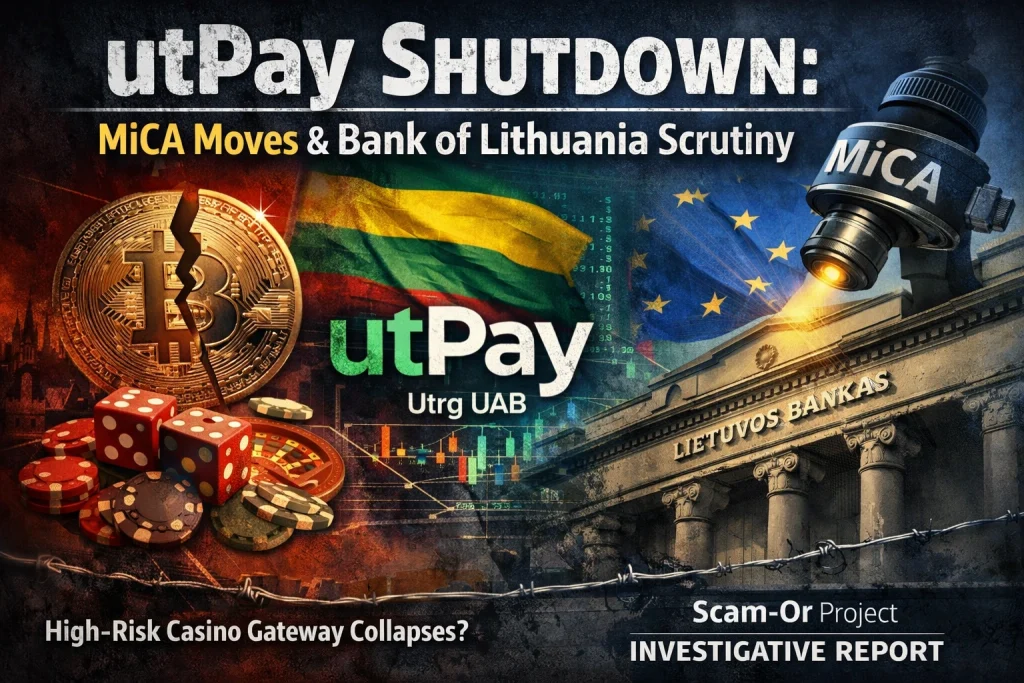
Lithuanian VASP utPay (Utrg UAB) has unexpectedly suspended its crypto-related activities, officially citing alignment with the EU’s Markets in Crypto-Assets (MiCA) framework. However, beyond the formal compliance narrative lies a far more complex background. For years, utPay was widely associated with servicing offshore gambling operators operating outside regulated markets. Now, with increased scrutiny from the Bank of Lithuania, the suspension raises a critical question: is this a strategic restructuring—or the collapse of a high-risk payment channel?
The Analysis: The End of a “Dark Rail”?
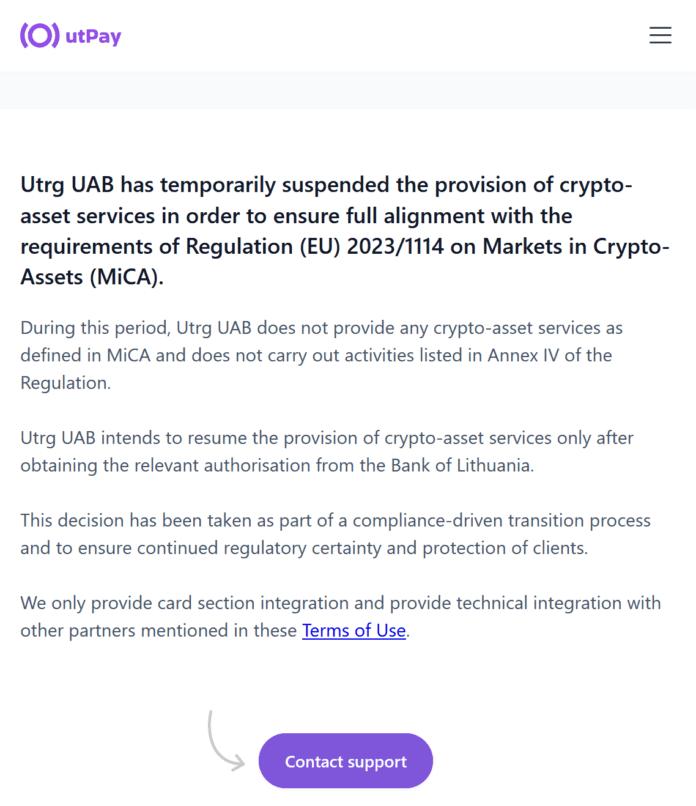
The announcement published on utpay.io presents the move as a responsible step toward achieving regulatory clarity under MiCA. Yet intelligence previously published by Scam-Or Project suggests a deeper regulatory confrontation.
Rather than a routine compliance adjustment, the halt of crypto services appears to reflect mounting supervisory pressure within Lithuania’s increasingly restrictive VASP environment.
1. The Hypothesis: A Regulatory Choke-Point
For several years, utPay has been linked to payment infrastructures supporting unlicensed offshore casinos. Acting as a fiat-to-crypto bridge, utPay enabled gambling operators to circumvent traditional banking controls that typically block or restrict gambling transactions.
Regulatory Context
Lithuania hosts more than 500 registered VASPs and has gradually intensified supervisory oversight. Under MiCA, crypto service providers must meet significantly higher AML/CFT standards.
Working Theory
It is plausible that the Bank of Lithuania signaled that utPay’s existing business model—facilitating high-risk gambling-related flows—would jeopardize eligibility for a MiCA license.
Under this scenario, the suspension represents not a voluntary pivot, but an urgent attempt to restructure operations ahead of enhanced regulatory audits.
2. The “Technical Integration” Narrative
Despite halting crypto operations, utPay has stated it continues to offer:
- “Card section integration”
- “Technical integration with other partners”
This distinction may be strategically important.
Potential Risk
By positioning itself as a technical service provider rather than a direct crypto intermediary, utPay could seek to maintain involvement in payment processing while avoiding immediate crypto licensing exposure.
However, if these “partners” include previously identified high-risk processors such as SegoPay or Daxchain, then systemic AML/CFT risks remain materially unchanged.
The structural risk lies not in branding—but in transactional reality.
3. Immediate Impact on High-Risk Merchants
The suspension has direct consequences for merchants relying on utPay infrastructure, particularly:
- Unlicensed offshore casinos
- High-risk e-commerce entities
Key Consequences
| Risk Factor | Potential Outcome |
|---|---|
| Liquidity Freeze | Crypto-assets held within utPay’s ecosystem may face delayed withdrawals pending compliance reviews |
| Cascade Failure | Payment stacks relying on utPay as an intermediary layer may experience operational disruption |
| Jurisdictional Flight | Gambling operators may relocate processing flows to less regulated jurisdictions such as the Comoros or Anjouan |
In layered “cascading gateway” architectures, the removal of a single VASP can destabilize multiple downstream processors.
Compliance Assessment: Transition or Capitulation?
From a regulatory perspective, MiCA introduces strict governance, transparency, and AML/CFT requirements that are incompatible with high-volume exposure to unlicensed gambling sectors.
A firm that derived substantial volume from unregulated gambling flows would likely face:
- Mandatory client base restructuring
- Enhanced due diligence on merchant portfolios
- Termination of high-risk partnerships
Such adjustments could fundamentally undermine the economics of the prior business model.
Accordingly, the so-called “MiCA compliance-driven transition” may reflect a structural surrender to regulatory realities rather than a routine operational update.
A Call to Insiders
Are you:
- An employee of Utrg UAB with knowledge of communications involving the Bank of Lithuania?
- A merchant experiencing frozen balances or disrupted settlements?
- A compliance officer aware of restructuring decisions related to MiCA readiness?
Investigative teams continue to monitor developments in Lithuania’s VASP sector.
Information can be submitted confidentially via the Scam-Or Project whistleblower section. Verified documentation may contribute to a broader understanding of regulatory enforcement trends across the EU crypto landscape.