
Narco-Terror Prosecution or Energy Leverage?

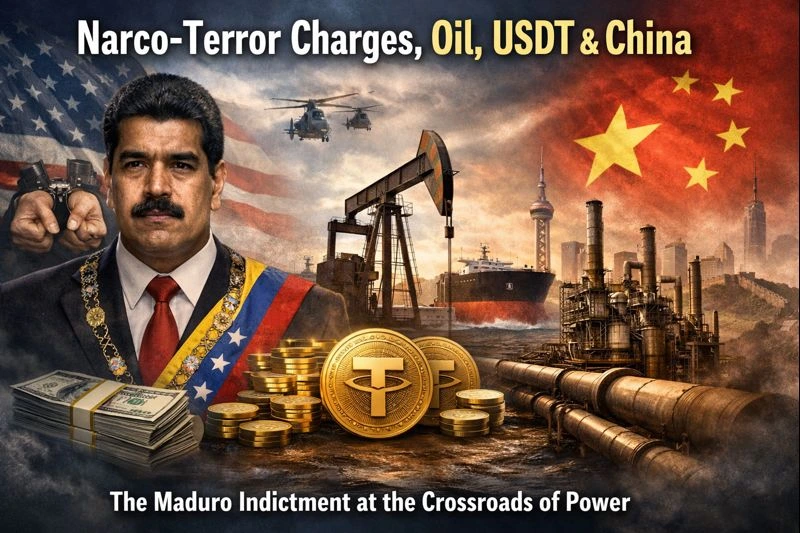
The Maduro Indictment at the Crossroads of Oil, Stablecoins, and China
The United States has reactivated its 2020 “narco-terrorism” prosecution against Venezuelan president Nicolás Maduro, who is now in U.S. custody following a military operation in Caracas that Washington characterizes as a law-enforcement action.
However, earlier reporting by Scam-Or Project indicates that the legal narrative may represent only part of a broader equation. Venezuela’s heavy crude exports, USDT-based settlement mechanisms, and China’s entrenched position in the country’s oil sector appear uncomfortably aligned with the timing, framing, and execution of the escalation.
Key Takeaways
-
The indictment
U.S. prosecutors accuse Nicolás Maduro and associates of narco-terrorism, conspiracy to import cocaine into the United States, and additional criminal counts outlined in Department of Justice filings.
Source: U.S. Department of Justice -
The capture
On January 3, U.S. forces detained Maduro and Cilia Flores in Caracas. The administration publicly presented the action as part of a counter-narcotics and anti-“narco-terror” campaign.
Source: TIME -
Refinery constraints
Many U.S. Gulf Coast refineries were engineered for heavy crude grades, such as those produced by Venezuela. By contrast, a large share of U.S. shale output is lighter, sustaining long-term reliance on imports.
Source: U.S. Energy Information Administration -
Stablecoin settlement
In 2024, PDVSA reportedly expanded its use of USDT in oil-trade settlement, prompting renewed sanctions, compliance, and AML concerns.
Source: Reuters -
China’s exposure
Reuters has documented China as a major buyer and investor in Venezuela’s oil industry. The post-Maduro political reset is being framed as a direct blow to Beijing’s strategic footprint.
Source: Reuters
Background: A Case Years in the Making
This prosecution did not originate in January. It traces back to March 2020, when the U.S. Department of Justice unsealed charges portraying Maduro and allied officials as leaders of a transnational narcotics network. The legal offensive was paired with a U.S. State Department reward offer, signaling that the case was always as political as it was judicial.
Over the following years, sanctions intensified, offshore trading structures proliferated, and Venezuela adapted. One of the most notable adjustments was PDVSA’s move toward stablecoin-based settlement, particularly USDT, reportedly to prevent export proceeds from being frozen within the traditional banking system.
That adaptation was followed by a decisive kinetic phase: a U.S. operation in early January resulting in Maduro and Flores being transferred to U.S. custody. While FinCrime Observer has examined the procedural mechanics of the criminal case, Scam-Or Project has focused on the political-economic pressures surrounding the trigger.
Extended Analysis
1. Heavy crude: the structural factor rarely highlighted
The United States is a leading oil producer, but not all barrels are interchangeable. According to long-standing EIA assessments, U.S. production skews toward lighter crude, while many domestic refineries—particularly along the Gulf Coast—are optimized for heavy grades.
Reuters has directly linked the post-Maduro shock to refinery economics, noting that despite the shale boom, numerous facilities still require heavy crude imports to operate efficiently. Venezuela’s oil fits that requirement.
As a result, claims that the U.S. “needs Venezuelan oil because domestic production is the wrong quality” are not speculative—they are rooted in refinery design. The unresolved question is whether this physical constraint influenced the policy timetable.
2. USDT and the myth of “de-dollarization”
Venezuela’s increasing reliance on USDT is often framed as a move away from the U.S. dollar. In practice, the opposite may be true. USDT is a dollar-denominated instrument, but one that can circulate outside the traditional correspondent-banking framework dominated by U.S. oversight.
Reuters reported in 2024 that PDVSA planned to expand digital-currency usage for oil exports amid sanctions pressure, while compliance experts warned that such channels raise acute AML and traceability challenges.
Earlier Scam-Or Project analysis described this shift as a form of petro-dollar internalization: pricing remains dollar-based, but settlement infrastructure migrates into crypto rails that are harder to freeze, slower to attribute, and more easily obscured through intermediaries.
If that assessment holds, then Maduro’s legal exposure and PDVSA’s stablecoin infrastructure are not parallel developments. They represent a single chokepoint, viewed through legal and financial lenses.
3. China: the silent stakeholder
Reuters has consistently described China as a central buyer and investor in Venezuela’s oil economy. Recent U.S. messaging surrounding the operation has repeatedly extended beyond narcotics enforcement, touching on control of oil flows and post-Maduro “transition management.”
From that perspective, the crackdown functions not only as a criminal prosecution but also as a strategic intervention aimed at reducing Beijing’s leverage.
This leads to a question that regulators, investors, and courts may ultimately confront:
Was the “narco-terrorism” indictment primarily the legal instrument, while oil access, USDT settlement rails, and China’s influence constituted the strategic objective?
Washington may argue that both rationales coexist. Judicial proceedings will determine whether that claim withstands due-process scrutiny.
Call for Information
Do you have documents relating to PDVSA’s USDT settlement flows, intermediary trading desks, shipping or ship-to-ship operations, escrow arrangements, or court filings connected to the Maduro / Cilia Flores case?
Submissions can be made securely via the Scam-Or Project whistleblower section. All sources are verified prior to publication.