
Silencing the Truth: How Payvision’s CEO Allegedly Backed a Reputation Operation to Shield €131 Million in Cybercrime Proceeds

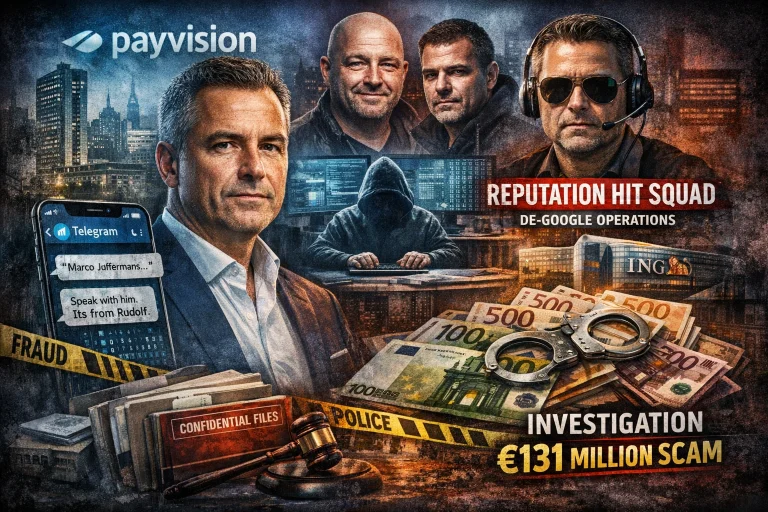
In a disturbing intersection of “White Front” FinTech and Eastern European boiler rooms, newly surfaced criminal records shed light on how Payvision CEO Rudolf Booker allegedly facilitated a reputation management strategy aimed at suppressing whistleblower reporting. According to intercepted communications, cybercrime operators Uwe Lenhoff and Gal Barak used stolen victim funds to finance a campaign designed to “de-google” investigative content.
For the architects of the €131 million Payvision scandal, silence was not accidental — it was allegedly purchased.
Key Findings
- The Strategic Alliance (2016–2019): Payvision acted as the central payment processor for Uwe Lenhoff’s Winslet EOOD and Gal Barak’s E&G Bulgaria, handling more than €131 million in misappropriated consumer funds.
- Direct Referral by Booker: Criminal case files indicate that Rudolf Booker personally introduced Amsterdam-based reputation specialist Marco Juffermans to assist in suppressing investigative reporting by Scam-Or Project.
- The “De-Google” Arrangement: On 12 December 2018, Lenhoff and Barak discussed hiring Juffermans via Telegram. By 13 December 2018, Barak confirmed that payment had been initiated.
- Victim Money Used for Suppression: Funds transferred to Juffermans’ firm, White Canvas, allegedly originated directly from binary options and CFD fraud proceeds.
- Regulatory Consequences: Despite attempts to manage public exposure, arrests of Lenhoff and Barak in 2019 ultimately contributed to Payvision’s closure in 2021.
The Wiretap Evidence: Intercepted Communications
Scam-Or Project obtained verified criminal records from a whistleblower, including intercepted Telegram communications from Uwe Lenhoff’s Samsung device. The transcripts provide unusually explicit insight into how reputation management allegedly became part of the Payvision–Lenhoff–Barak ecosystem.
12 December 2018
Lenhoff sends Barak the following via Telegram:
“Marco Juffermans…” followed by Dutch mobile number +31 6 5588 5858
“Speak with him, he can help to clean up Google with all bullshit. Its from Rudolf.”
13 December 2018
Barak responds:
“done, please let Rudolf know, i will send payment today.”
Lenhoff asks:
“Welch payment? To Marco?”
Barak replies:
“yes.”
Lenhoff reassures:
“Marco is close with Rudolf.”
What These Messages Establish
| Element | Indication |
|---|---|
| Origin | The initiative “from Rudolf” strongly suggests that Rudolf Booker introduced Juffermans. |
| Purpose | “Clean up Google” clearly refers to suppressing negative online reporting, including investigations by Scam-Or Project. |
| Payment Source | Barak confirms payment — funds derived from scam proceeds. |
| Proximity | “Marco is close with Rudolf” implies a direct professional or personal relationship. |
Escalating Pressure in Late 2018
At the time of these communications, Payvision faced increasing scrutiny:
- Regulatory warnings against Lenhoff/Barak-controlled brands
- Complaints from victims and NGOs
- Systematic reporting connecting fraudulent brokers to Payvision’s acquiring services
Rather than severing ties with high-risk merchants, evidence suggests an alternative strategy: neutralizing negative exposure.
The engagement of a reputation specialist appears aimed at:
- Protecting Payvision from regulatory escalation
- Preserving high-risk transaction volume
- Weakening early-warning mechanisms for prospective victims
The ethical reversal is stark: funds taken from victims were allegedly used to silence warnings that could have prevented additional losses.
Reputation Management as a Tactical Shield
The Payvision case has often been framed as a compliance failure — insufficient KYC or AML controls. However, the criminal files indicate something more deliberate: coordinated suppression of investigative reporting.
As Scam-Or Project published exposés on the boiler room networks of Uwe Lenhoff and Gal Barak, the reputational threat grew. Internal communications reveal that the reporting was seen as a major operational risk.
Rather than terminating business relationships, Rudolf Booker allegedly introduced Marco Juffermans (LinkedIn) — known for his expertise in the “right to be forgotten” — to assist in mitigating online exposure.
The December 2018 wiretap transcripts show rapid payment authorization for search-result manipulation. This was not a conventional PR initiative; it appears to have been a defensive maneuver to maintain operational continuity of fraudulent merchant flows.
Payvision, ING, and Expanding Criminal Exposure
Subsequent investigative reporting described Payvision as a “Wirecard mini-me” — a payment institution deeply exposed to high-risk and fraudulent broker portfolios.
Structural Issues Identified
- Transaction Volume: Lenhoff and Barak’s operations generated extremely high chargeback ratios — classic fraud indicators.
- Compliance Tensions: Findings by DNB suggested compliance officers sought to escalate concerns, freeze accounts, and file SARs, but management allegedly continued the relationships.
- Exit Strategy: In 2018, ING acquired Payvision for approximately €360 million, based on inflated transaction volume partly derived from high-risk merchants.
After the Acquisition
Following ING’s purchase:
- Victims filed civil lawsuits and money-laundering complaints against Payvision and ING across multiple jurisdictions.
- DNB sanctioned Payvision for serious AML violations.
- Dutch FIOD conducted searches and seized evidence.
- ING closed Payvision in 2021, citing strategic restructuring.
By 2024–2025, the case resurfaced amid criticism of Dutch enforcement inconsistencies. While privacy-focused crypto developers faced prosecution, Payvision’s former leadership, including Booker, remained free.
Ongoing Proceedings as of 2026
Legal exposure continues to expand:
- Civil litigation against Payvision and ING remains active, supported by criminal files from Austria and Germany.
- New investigative actions across EU jurisdictions are reassessing liability under cross-border AML frameworks.
- The European Funds Recovery Initiative continues coordinating victim lawsuits.
In this context, the Juffermans reputation campaign may serve as potential evidence of:
- Demonstrated awareness of fraudulent activity
- Intent to suppress investigative scrutiny
- Obstructive behavior toward regulators, media, and victims
Profile: Marco Juffermans and White Canvas Reputation Guards
The Individual
Marco Juffermans is the founder and CEO of White Canvas Reputation Guards (formerly White Canvas International). He publicly promotes “ontgooglen” — or “de-googling” — as a privacy-focused service grounded in the “right to be forgotten.”
The Firm
White Canvas markets services to:
- Remove or suppress negative search results
- Manage online reputation risks
- Advocate for digital second chances
Juffermans has argued that individuals deserve opportunities to rebuild reputations after serving penalties.
The Controversy
The Payvision criminal files suggest that White Canvas’ services may have been applied not to rehabilitated individuals, but to active cybercrime networks seeking to conceal ongoing misconduct.
The intercepted Telegram communications describe Juffermans as “very close” to Rudolf Booker, positioning the agency as an insider solution rather than an independent vendor.
Whistleblowers Wanted: Help Advance the Investigation
The Payvision case remains active in 2026. Civil and regulatory proceedings involving ING and former Payvision leadership continue to evolve.
Were you employed at Payvision or White Canvas between 2016 and 2019?
Do you possess information regarding internal discussions about Scam-Or Project reporting or suppression efforts?
Share your information securely and anonymously via the Scam-Or Project whistleblower section.
Your documentation may provide critical evidence in delivering justice to the tens of thousands of victims impacted by this network.