
SHUTDOWN OR COVER-UP? Grinex Collapse Raises Questions Over $15M Crypto Drain and Sanctions-Evasion Network

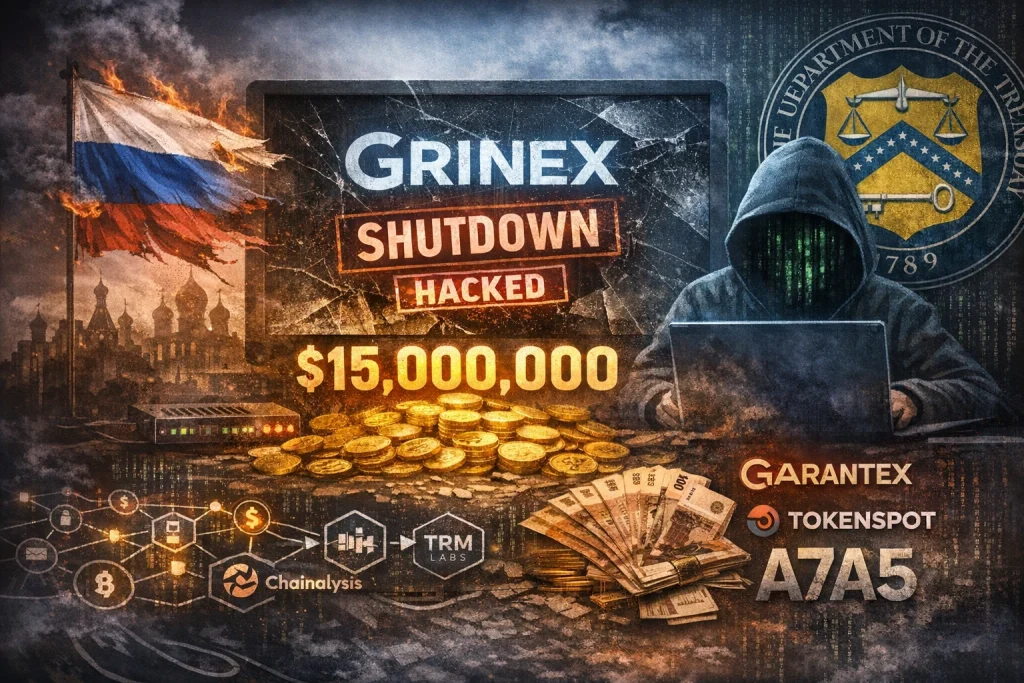
The sanctioned crypto exchange Grinex has suddenly halted its operations after reporting the loss of approximately 1 billion rubles in digital assets. While the platform claims the incident was the result of a coordinated attack by “foreign intelligence services,” blockchain analysts point to transaction patterns that resemble classic laundering tactics rather than a geopolitical seizure.
Beyond the immediate incident lies a broader issue: Grinex was widely identified by U.S. authorities and blockchain intelligence firms as a successor to Garantex, a Russia-linked exchange associated with money laundering, sanctions evasion, and the A7A5 shadow-payment infrastructure.
Key Findings
- Operational shutdown: Grinex suspended services following a reported cyberattack on April 16, 2026, involving losses of around 1 billion rubles.
- Unverified attribution: Claims of “foreign intelligence involvement” remain unconfirmed. Reuters explicitly stated it could not validate these assertions.
- Suspicious on-chain activity: Chainalysis observed rapid conversion of stolen stablecoins into TRX via a decentralized exchange, suggesting attempts to avoid asset freezing.
- Expanded breach scope: TRM Labs identified a broader incident footprint and linked wallet activity to both Grinex and TokenSpot, another Kyrgyzstan-based exchange believed to be tied to Garantex.
- U.S. Treasury position: Authorities indicated Grinex was established by former Garantex personnel after enforcement actions in March 2025.
- A7A5 involvement: Grinex played a key role in trading the ruble-backed token A7A5, issued by Old Vector, linked to sanctions-evasion networks.
- Regulatory history: Garantex had already lost its Estonian authorization in 2022 due to major AML/CFT failures and links to illicit financial flows.
Compliance Analysis
1. The Official Narrative: A Geopolitical Attack?
Grinex maintains that it suffered a large-scale cyberattack orchestrated by hostile foreign actors. According to its public messaging, the incident was framed as an attempt to undermine Russia’s financial sovereignty.
However, this narrative lacks independent confirmation. Reuters, reporting on the shutdown, stated clearly that it could not verify the claim regarding foreign intelligence involvement. At present, this remains an allegation rather than an established fact.
2. Blockchain Evidence Suggests Alternative Scenario
The movement of funds provides a more objective lens.
According to Chainalysis:
- Stolen assets were primarily centralized stablecoins
- These assets were quickly swapped into TRX via a Tron-based DEX
This behavior is inconsistent with typical law enforcement seizures, where stablecoins are usually frozen at the issuer level. Instead, rapid conversion into non-freezable assets suggests a deliberate attempt to evade such controls.
TRM Labs added further detail:
- Approximately 45.9 million TRX (~$15 million) was consolidated into a single wallet
- Conversions were executed via SunSwap
- Activity spanned multiple wallets and platforms
While TRM leans toward an external cyberattack rather than an exit scam, it also confirms that Grinex’s attribution to “unfriendly states” remains unproven.
3. Grinex as a Successor to Garantex
The compliance concerns extend far beyond the hack.
According to the U.S. Treasury:
- Grinex was created by former Garantex staff after the March 2025 crackdown
- It was used to migrate customer funds and continue operations
- The platform facilitated billions in transactions tied to sanctions evasion
Blockchain intelligence aligns with this view:
- Grinex was registered in Kyrgyzstan in December 2024
- It was promoted through Garantex-linked Telegram channels as a replacement platform
- Registration records reference Duulat-eldar Sagynbeki Subankulov, though ultimate control remains unclear
4. Garantex Legacy: Persistent Compliance Failures
The roots of this case trace directly to Garantex.
According to the U.S. Department of Justice:
- Domains were seized in March 2025
- Servers in Germany and Finland were confiscated
- Over $26 million linked to laundering operations was frozen
Earlier, Estonia’s Financial Intelligence Unit found:
- Systemic AML/CFT violations
- Failure to verify identities for over 90% of users
- Lack of suspicious transaction reporting
- Connections to criminal wallets
Annual transaction volumes exceeded €5 billion, with significant exposure to high-risk jurisdictions.
5. A7A5 Token: Core of the Sanctions-Evasion System
Grinex’s strategic importance lies in its role within the A7A5 ecosystem.
Key facts:
| Element | Description |
|---|---|
| Token | A7A5 (ruble-backed) |
| Issuer | Old Vector (Kyrgyzstan) |
| Purpose | Cross-border settlements and sanctions evasion |
| Volume | Over $51 billion processed (Chainalysis estimate) |
| Key links | Promsvyazbank, Ilan Shor |
The token enabled users to regain access to funds after Garantex’s disruption and functioned within a controlled network of Russian-linked financial services.
6. TokenSpot Connection Deepens Concerns
TRM Labs identified strong links between Grinex and TokenSpot:
- Shared consolidation wallet activity
- Coordinated timing of incidents
- Financial flows include:
- $88 million sent to Garantex and Grinex
- $12+ million received back
- $257.5 million routed into the A7 network
This pattern suggests systemic interconnectivity rather than an isolated breach.
7. Compliance Implications
The current situation can be summarized as follows:
- Shutdown confirmed: Verified by Reuters
- Attribution unclear: No independent confirmation of geopolitical involvement
- Risk profile unchanged: Grinex was already embedded in a sanctions-evasion framework
For regulated entities, the lesson is clear:
Rebranding, relocation, or structural changes do not eliminate compliance risk.
They merely disguise it.
Conclusion: Collapse, Cover, or Controlled Exit?
The shutdown of Grinex represents a major disruption within a broader sanctions-evasion ecosystem. Whether the incident was caused by external attackers, insider involvement, or a coordinated withdrawal of funds remains unresolved.
However, one conclusion stands out:
Participants in this network are unlikely to recover their assets. The collapse leaves users exposed, while responsibility is shifted toward external actors.
Call to Whistleblowers
Insiders with knowledge of Grinex, Garantex, TokenSpot, Old Vector, or the A7A5 infrastructure are encouraged to come forward via the Scam-Or Project whistleblower section.
Relevant information may include:
- Wallet data and transaction trails
- KYC and onboarding documentation
- Internal communications
- Payment routing schemes
- Banking relationships
Such disclosures could play a critical role in uncovering one of the most significant crypto compliance cases tied to Russian sanctions evasion.