
MiCA Stress Test: How Market Turbulence and Regulation Are Forcing a Radical Reset of EU Crypto

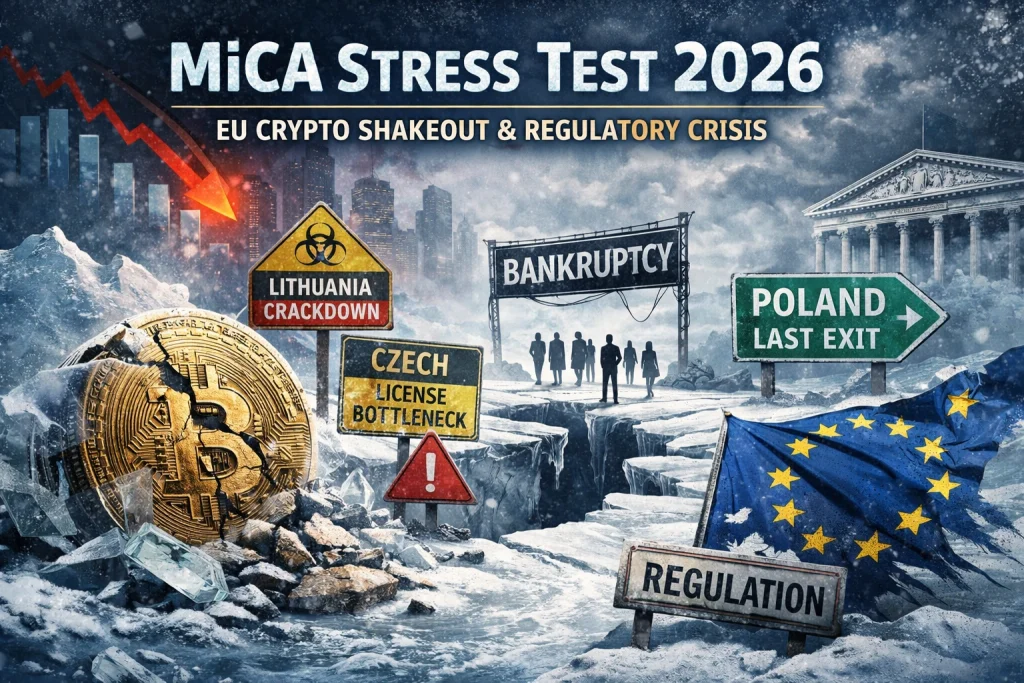
The global cryptocurrency downturn in late 2025—underscored by Coinbase’s heavy Q4 losses—has collided head-on with Europe’s newly enforced regulatory regime. The European Union is no longer experiencing merely a “crypto winter” driven by falling prices. It is entering a prolonged period of regulatory deep freeze.
As the Markets in Crypto-Assets (MiCA) framework moves through its decisive transition stage, developments in the so-called “Lithuanian laboratory” have already illustrated the harsh consequences for companies unable to comply. This briefing examines the expected large-scale consolidation of EU crypto service providers in 2026 and highlights the mounting dangers for investors and merchants operating within this rapidly contracting ecosystem.
Key Findings: The European Market Shakeout
1. A Dual-Front Crisis
EU crypto providers are trapped in a tightening squeeze:
- Collapsing trading income following the market downturn (Bitcoin below $90k).
- Surging compliance expenses required to meet MiCA’s quasi-banking standards, including capital, governance, and AML obligations.
The combination creates severe pressure on business models that were previously sustainable under looser regulatory conditions.
2. The Lithuanian Precedent
The expiry of Lithuania’s grandfathering regime at the end of 2025 triggered the immediate disappearance of multiple entities, including:
- Utrg, dba utPay
- Dream Finance, dba CoinsPaid and CryptoProcessing
These events serve as an early warning for the rest of the EU market.
3. Regulatory Bottleneck
Preliminary data from Czechia suggests a dramatic imbalance between applications and approvals. Reports indicate:
| Country | MiCA Applications | Licenses Granted |
|---|---|---|
| Czechia | 240+ | 6 |
This gap underscores how demanding the MiCA authorization process truly is.
4. The End of Jurisdictional Arbitrage
Relocating operations to comparatively lenient jurisdictions such as Poland—currently operating under a lighter VASP framework—has provided temporary relief for some firms. However, this strategy is short-lived.
When MiCA becomes fully enforceable across all EU member states by the end of 2026, the remaining regulatory loopholes will close. A final, large-scale market contraction appears inevitable.
5. Elevated Counterparty Risk
The convergence of financial distress and regulatory enforcement creates a high-risk environment. In 2026, we expect:
- “Quiet bankruptcies” (voluntary shutdowns without formal insolvency proceedings).
- Forced “regulatory bankruptcies” initiated by supervisory authorities.
Analysis: The Structural Overhaul of the EU Crypto Market
The financial strain reflected in Coinbase’s Q4 2025 performance is being amplified in Europe by MiCA’s implementation. For years, crypto companies could engage in jurisdiction shopping—seeking out the least restrictive regulatory environment within the EU.
That flexibility has now effectively ended.
Lithuania: From Crypto Hub to Compliance Test Case
Lithuania once promoted itself as a crypto-friendly jurisdiction, hosting a large number of registered Virtual Asset Service Providers (VASPs). With MiCA’s transition phase in effect, however, mass deregistrations in early 2026 revealed that many of these entities were either:
- Shell structures, or
- Operationally incapable of meeting enhanced AML and capital requirements.
The shutdowns of utPay and Dream Finance (distinct from major global operators with similar branding) represent the first wave of what may become a continent-wide restructuring.
Czechia’s Reality Check and Poland’s Temporary Refuge
The Czech data—hundreds of applications, only a handful of approvals—demonstrates that MiCA is designed to eliminate undercapitalized or weakly governed operators. Only the most compliant and well-funded firms are likely to survive.
Meanwhile, smaller crypto companies are relocating to Poland under its current VASP regime. This move provides only temporary shelter.
Once MiCA is uniformly applicable across the EU by the end of 2026:
- Poland will no longer offer regulatory flexibility.
- A significant number of relocated firms may disappear.
- The market will likely consolidate into a limited group of large, regulated players.
The result: an emerging oligopoly replacing a fragmented ecosystem of thousands of smaller entities.
2026 Risk Briefing for Merchants and Investors
The defining feature of 2026 is extreme counterparty uncertainty. The entity holding your digital assets or processing your crypto payments today may not exist tomorrow.
For EU Merchants Accepting Crypto Payments
Counterparty Risk Assessment
Treat every crypto service provider as a potential default risk unless it can demonstrate:
- A formally submitted MiCA application.
- Documented supervisory engagement.
- Verified capital adequacy and governance structures.
Jurisdictional Due Diligence
Map your partners’ regulatory status carefully:
- Are they licensed in Lithuania, Poland, Czechia, or elsewhere?
- Have they secured MiCA approval?
- Are they relying solely on expired or transitional VASP registrations?
Entities still operating under Lithuanian VASP status without MiCA authorization are already exposed.
Immediate Compliance Verification
Do not assume your processor will survive 2026. Demand evidence of:
- MiCA transition plans.
- Capital reserves.
- Operational continuity strategies.
Risk of Frozen Funds
If regulators shut down a provider (“regulatory bankruptcy”), unsettled merchant funds may be frozen indefinitely during enforcement proceedings.
Operational Redundancy
Implement multi-provider structures:
- Work with at least one fully licensed MiCA CASP in a core jurisdiction.
- Establish technical fallback mechanisms to prevent single-provider dependency.
Contractual Safeguards
Strengthen merchant agreements to include:
- Client fund segregation clauses.
- Immediate termination rights upon license loss.
- Mandatory disclosure of supervisory actions or license denials.
Expect Higher Costs
The few surviving MiCA-compliant processors will transfer their compliance expenses to clients. Low-cost crypto payment processing in the EU is becoming a relic of the past.
For EU Crypto Investors
Exit the “Long Tail”
If assets are held on:
- Small, obscure, or offshore-linked European exchanges.
- Platforms relying on regulatory arbitrage (e.g., temporarily based in Poland without a credible MiCA roadmap).
Withdraw funds promptly. These platforms are prime candidates for abrupt shutdowns.
Verify, Do Not Assume
Engage only with exchanges that:
- Publicly pursue MiCA authorization in strict jurisdictions such as France or Germany.
- Provide transparent, verifiable proof of reserves.
Liquidity Risks
As smaller exchanges close:
- Liquidity for niche altcoins will deteriorate.
- Selling positions—even at discounted prices—may become impossible.
Consolidating holdings into major assets on well-regulated platforms may mitigate this risk.
A Call to Industry Insiders
Are you employed by an EU crypto firm misrepresenting its MiCA preparedness?
Is your company facing hidden insolvency while using client funds to maintain operations?
Is a “quiet exit” being planned before regulators intervene?
Merchants and investors deserve transparency before the next collapse unfolds.
You can submit information securely and anonymously through the Scam-Or Project whistleblower section.