
UK vs. MiCA: Two Regulatory Models for Crypto and What Cross-Border Operators Must Understand

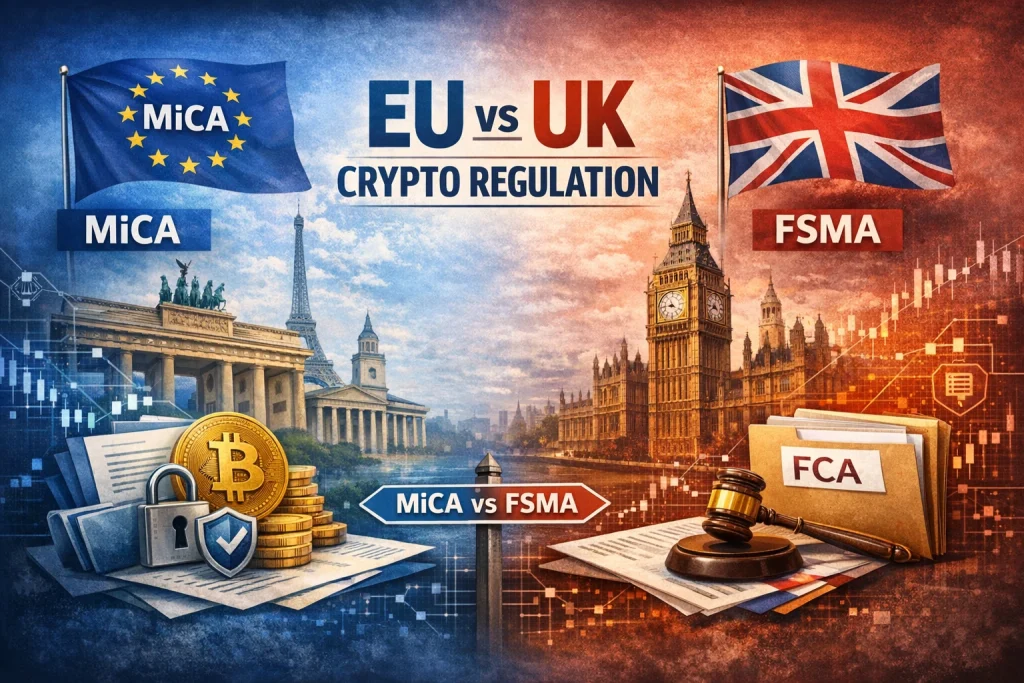
The European Union and the United Kingdom have taken distinctly different approaches to regulating crypto-assets. The EU has rolled out MiCA as a fully functioning, passportable licensing regime. The UK, meanwhile, is developing a phased system led by the Financial Conduct Authority (FCA) under established financial services legislation.
For crypto service providers, merchants, investors, and compliance professionals, recognizing these structural differences is critical for licensing strategy, risk assessment, and cross-border expansion.
Key Findings
- MiCA is fully operational across the EU and introduces a harmonized CASP license with passporting rights throughout Member States.
- The UK does not apply MiCA and currently operates an AML registration regime while preparing a broader authorization framework under FSMA.
- MiCA authorization is already mandatory in the EU; comprehensive UK authorization for core crypto services is expected around 2027.
- The upcoming UK framework may cover a wider range of activities, including lending and certain centralized DeFi intermediation.
- MiCA establishes a dedicated regime for token issuance (ARTs and EMTs), while the UK treats stablecoins under payment and systemic regulatory structures.
- Cross-border operators must pursue separate regulatory tracks in the EU and the UK.
- Although market abuse and consumer protection frameworks differ in design, both jurisdictions demonstrate increasing regulatory intensity.
1. The EU Regulatory Architecture: MiCA as a Unified Licensing Framework
The Markets in Crypto-Assets Regulation (MiCA) creates a comprehensive and standardized legal framework across the European Union.
Licensing Requirements Under MiCA (EU)
Who Must Obtain Authorization?
Crypto-Asset Service Providers (CASPs), including:
- Trading platforms (exchanges)
- Custody providers
- Brokers
- Portfolio managers
- Crypto transfer service providers
- Placement service providers
Authorization Process
Applicants must submit to the relevant national competent authority (e.g., BaFin, AMF, Bank of Lithuania).
The assessment covers:
- Corporate governance arrangements
- Own-funds and capital adequacy
- AML/CFT controls
- IT security and operational resilience
Once approved, firms gain passporting rights across the EU.
Capital Requirements
MiCA applies tiered own-funds requirements depending on the nature of services provided. CASPs are subject to ongoing prudential supervision by national authorities.
Implementation Timeline
- Transitional arrangements in Member States are expiring or have expired.
- Grandfathering periods (for example, in Lithuania through end-2025) have closed.
- By 2026, MiCA compliance is expected to be the standard across the EU.
Reporting and Consumer Protection in the EU
MiCA imposes structured disclosure and conduct obligations:
- Mandatory whitepapers for token issuance
- Strict marketing transparency requirements
- Formal complaint-handling procedures
- Segregation of client assets
- Periodic prudential reporting
- ESG disclosures for certain token categories
Market Abuse Framework Under MiCA
MiCA introduces a crypto-specific market abuse regime that includes:
- Prohibition of insider dealing
- Ban on unlawful disclosure of inside information
- Prohibition of market manipulation
- Monitoring and surveillance duties for trading platforms
While robust, the crypto MAR regime under MiCA remains somewhat lighter compared to traditional securities market abuse rules.
2. The UK Approach: AML Registration Now, Full FSMA Authorization Later
The United Kingdom is implementing crypto regulation in two distinct stages.
Stage 1: AML Registration (Currently in Force)
Crypto businesses operating in the UK must register with the Financial Conduct Authority (FCA) under anti-money laundering regulations.
This is not full financial services authorization but focuses on:
- KYC and AML compliance
- Suspicious activity reporting
- Financial crime risk management
The FCA has rejected a substantial percentage of applications, indicating rigorous supervisory scrutiny.
Stage 2: Full FSMA Authorization (Expected ~2027)
The UK government is developing a broader regime under the Financial Services and Markets Act (FSMA).
Activities expected to require authorization include:
- Operating crypto trading platforms
- Dealing in crypto-assets
- Custody services
- Lending and staking intermediation
- Arranging crypto transactions
- Certain centralized DeFi models
Under this regime, crypto firms will effectively become FCA-authorized financial services institutions.
3. Structural Comparison: MiCA vs. UK FSMA Regime
| Feature | EU (MiCA) | UK (FSMA-Based Regime) |
|---|---|---|
| Legal Basis | Direct EU Regulation | Domestic financial services law |
| Passporting | Yes, across EU | No EU passport; UK-only authorization |
| Stablecoins | ART/EMT regime | Treated as payment instruments; systemic oversight focus |
| Market Abuse | Dedicated crypto MAR | Likely aligned with traditional financial MAR |
| Scope | CASPs and issuers | Potentially broader (incl. lending and staking) |
| Implementation Status | Fully active | Full regime expected ~2027 |
4. Strategic Implications for Cross-Border Crypto Operators
Entities active in both the EU and the UK must prepare for:
- Parallel authorization procedures
- Distinct prudential capital standards
- Separate reporting frameworks
- Diverging consumer protection rules
- No passport equivalence between EU and UK systems
The UK has intentionally avoided replicating MiCA. Instead, it is integrating crypto-assets into its existing financial regulatory framework.
This strategy may result in:
- Elevated governance expectations
- Closer supervisory engagement
- A broader enforcement perimeter
5. Convergence or Competitive Divergence?
The EU model emphasizes harmonization and passporting efficiency.
The UK model prioritizes supervisory depth and integration within traditional financial regulation.
Although both jurisdictions pursue similar objectives — consumer protection and market integrity — their implementation methods diverge.
There is currently no formal equivalence or mutual recognition mechanism between MiCA and the UK framework.
As a result, cross-border crypto businesses must maintain parallel compliance infrastructures.
Conclusion: Two Jurisdictions, One Compliance Reality
MiCA provides regulatory clarity across the EU, but imposes strict licensing, capital, and governance standards.
The UK is moving toward deeper integration of crypto into mainstream financial regulation, potentially covering a broader range of activities.
Crypto firms must now operate as fully regulated financial institutions rather than lightly supervised technology platforms.
The era of permissive crypto oversight in Europe and the UK has ended.
Call for Information
If you have information regarding MiCA licensing delays, FCA authorization obstacles, transitional failures, or regulatory migration strategies, you may share it confidentially through the Scam-Or Project whistleblower section. Your contribution supports transparency and regulatory accountability in the digital asset market.