
What Happened to Payeer After the EU Ban: Funds, Deadlines, and Unanswered Questions

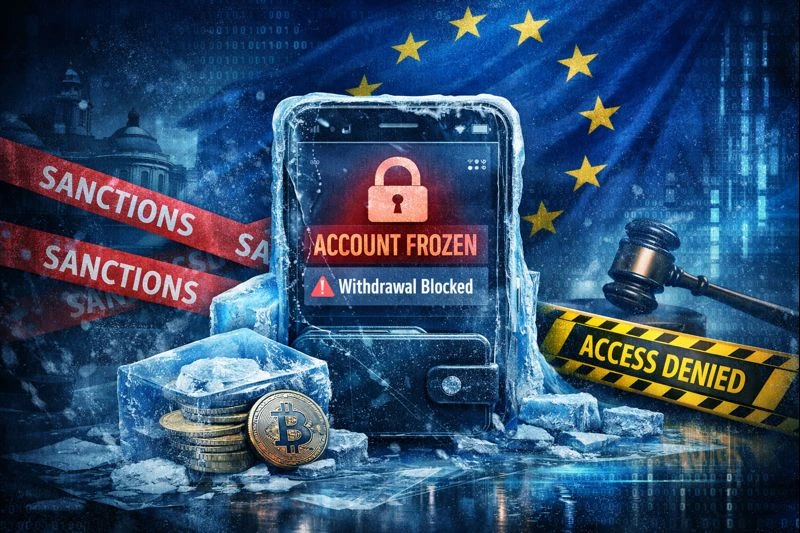
The payment and crypto platform Payeer, long associated with high-risk markets and Russian-linked operations, has entered a critical phase following the introduction of a direct EU transaction prohibition. The measure does not merely limit Payeer’s activities—it effectively isolates the platform from the European financial system.
As Payeer announces withdrawal deadlines and explains disruptions as the result of partner actions, Scam-Or Project continues to receive information from users describing account freezes, stalled payouts, and balances that remain inaccessible.
The situation has evolved into a broader question of financial exposure and asset location, rather than simple compliance risk.
EU Measures: What Exactly Changed
With the adoption of the EU’s 19th Russia sanctions package, the Union expanded its toolkit by reinforcing the transaction-ban mechanism. Within this framework, Payeer was explicitly listed in Annex XLV (Part A), with legal effect starting 25 November 2025.
From that date forward:
- EU persons and companies are prohibited from transacting with Payeer
- EU-based banks, PSPs, and CASPs must terminate relationships
- Settlement, correspondent, and clearing channels become unavailable
This measure operates independently of whether assets are formally frozen.
Source: Альта-Софт
Payeer’s Exit Strategy as Communicated to Users
In response to the sanctions listing, Payeer issued a sequence of public notices outlining how and when users should disengage from the platform:
-
Regional withdrawal window
Services for EU and Russian users were scheduled to end, with withdrawals allowed until 24 November 2025. -
Global wind-down announcement
A later update urged all users worldwide to withdraw remaining funds by 05 January 2026, after which Payeer would remain available only for limited support purposes.
Source: PAYEER
The Partner Freeze Explanation
Payeer has publicly stated that multiple “key partners” blocked accounts linked to the platform, allegedly including accounts holding customer funds. According to Payeer, these actions were taken in reaction to sanctions exposure rather than by Payeer itself.
This narrative leaves several material issues unresolved:
- Were customer funds segregated or pooled?
- Which legal entity had contractual responsibility?
- Which third parties actually controlled custody?
- Under which jurisdiction could claims realistically be enforced?
Source: PAYEER
A Warning That Came Earlier: Lithuania
The EU-wide prohibition was not the first regulatory signal. Prior to it, Lithuania’s Financial Crime Investigation Service (FCIS / FNTT) imposed an administrative fine of approximately €9.3 million on Payeer UAB.
The penalty related to:
- Sanctions compliance failures
- Deficiencies in AML/CFT controls
This enforcement action already highlighted weaknesses in Payeer’s governance and compliance architecture.
Source: FNTT
Why a “Transaction Ban” Is Usually Terminal
Although the EU measure is framed as a transaction restriction rather than an asset freeze, its practical consequences are severe.
Once enforcement begins:
- Regulated institutions disengage immediately
- Payment rails collapse
- On- and off-ramps cease to function
- Remaining operations become legally and technically unviable
For platforms operating in payment and crypto markets, this typically results in a functional shutdown, regardless of branding or public messaging.
Expanded EU Focus on Successor Structures
The updated sanctions regime also addresses a common evasion pattern: the reappearance of restricted services under new legal forms.
The framework now captures entities that:
- Act on behalf of a listed party
- Retain branding, interface, or infrastructure continuity
- Share ownership, management, or operational control
- Facilitate user or balance migration
This is particularly relevant in ecosystems where payment platforms have historically restructured across jurisdictions.
User Reports and Why They Matter Now
Submissions received by Scam-Or Project describe recurring issues, including:
- Accounts becoming inaccessible without explanation
- Withdrawal requests remaining pending for extended periods
- Balances that have not been returned despite public withdrawal windows
These reports gain additional relevance given Payeer’s acknowledgment that funds may be blocked at partner institutions. For affected users, the problem becomes one of traceability: identifying the responsible entity, the custodian of funds, and the applicable legal venue.
Corporate and Jurisdictional Footprint
| Category | Information |
|---|---|
| Trading name | Payeer |
| Operational profile | High-risk payment processing, crypto exchange activity, merchant services |
| Domains |
https://payeer.com https://payeer.cc |
| Legal entities |
Payeer E.A.S. (Paraguay) Payeer OÜ (Estonia) Payeer UAB (Lithuania) PayCorp Limited (Vanuatu) Fincana OÜ (Estonia) Runwill Sp. z o. o. (Poland) PAYEER LLC (Georgia) FINGATE LLC (Georgia) AKKORD WELT LP (Scotland) Worldwide System K/S (Denmark) Mayzus Financial Services Ltd (UK) PAYMENT SOLUTIONS LTD (BVI) PAYEER RUS LLC (Russia) PB24 CORP (Panama) |
| Associated individuals |
Anton Stjopotškin (Estonia, UBO) Joseph Olatilewa Jaiyeola (Estonia) Ekaterina Olegovna Gorshkova (Russia) Liubov Svezhentseva (Russia) Kosolapova Evgenia Nikolaevna (Russia) Elena Kulbikova (Russia) Sergey Mayzus (Russia) Dmitri Allikas (former) Stanislav Lattu (former) |
| Jurisdictions | Estonia, Vanuatu, Russia, BVI, Poland, Panama, Georgia, Denmark |
| Supervisory bodies |
FIU Estonia (license renounced January 2023) FCIS Lithuania VFSC |
| Public rating | Trustpilot: 4.6 stars (“Excellent”) |
| Known facilitated schemes | PO Trade, Pocket Option, Capital Letter, FXTradePremiums, Deal Trade, Optimus Markets, Spintop Capital, SuperForex, among others |
Information Request
Scam-Or Project is collecting substantiated information regarding Payeer’s current status and the handling of customer funds.
If you are a user, merchant, banking or PSP partner, exchange or CASP partner, affiliate, or internal source, you may submit information via the Scam-Or Project whistleblower section. Anonymous submissions are supported.