
Meme Coins: Speculation Frenzy and Pump-and-Dump Risks Disguised as Investment Opportunities

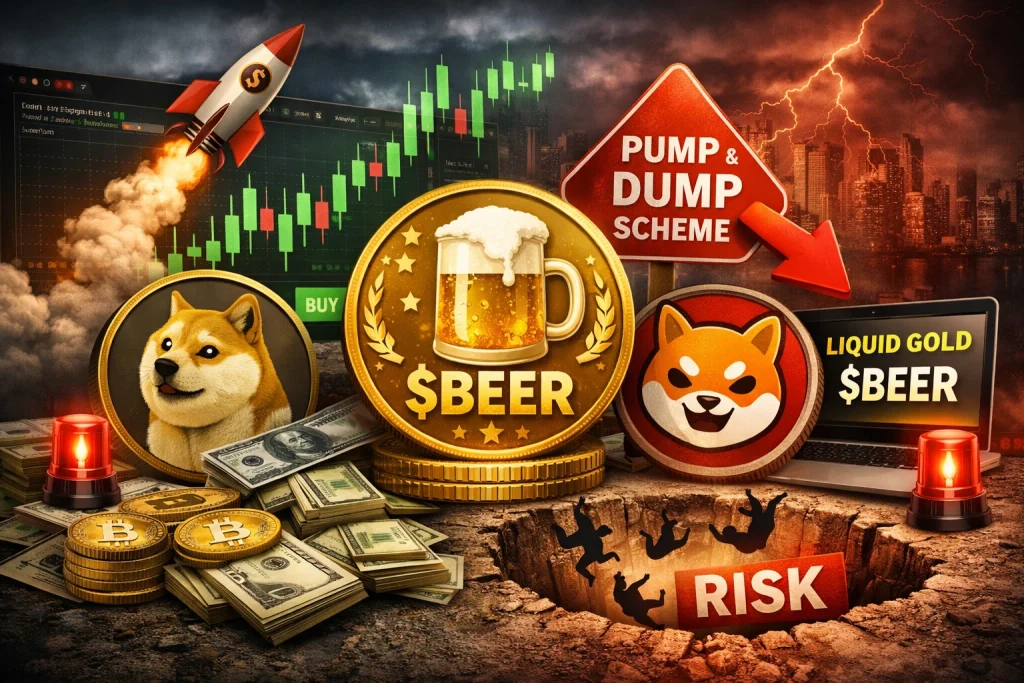
During the ongoing crypto bull cycle, a disturbing pattern has intensified: an increasing number of crypto exchanges are aggressively pushing the trading of meme coins. These digital tokens, typically rooted in internet memes and viral culture, carry substantial risks for retail investors. A striking example is the $BEER coin, widely marketed across multiple exchanges as “liquid gold.”
The active promotion of such ultra-speculative instruments raises serious concerns about the responsibility, transparency, and ethical standards of the platforms involved.
What Are Meme Coins?
Meme coins represent a class of cryptocurrencies inspired by internet jokes, social media trends, or pop culture phenomena. Unlike established cryptocurrencies such as Bitcoin or Ethereum — which were created to solve technological challenges or serve defined blockchain-based purposes — meme coins generally lack meaningful technical innovation or long-term utility.
Their valuation is largely driven by:
- Social media hype
- Online communities
- Influencer endorsements
- Viral marketing campaigns
One of the earliest and most famous examples is Dogecoin, which began as satire but rapidly gained mainstream attention. Subsequent tokens such as Shiba Inu, SafeMoon, and more recently $BEER have followed a similar trajectory, drawing in investors seeking fast and outsized returns.
The Core Risks of Meme Coins
1. Extreme Volatility
Meme coins are notorious for dramatic and unpredictable price swings. While professional traders may attempt to capitalize on this volatility, inexperienced investors often enter during hype-driven peaks — only to experience steep losses.
2. Absence of Fundamental Value
Unlike Bitcoin or Ethereum, meme coins frequently lack:
- Clear technological roadmaps
- Sustainable business models
- Tangible use cases
Their pricing is typically speculation-driven rather than anchored in innovation or real-world adoption.
3. Pump-and-Dump Exposure
Meme coins are especially vulnerable to pump-and-dump schemes, where coordinated actors artificially inflate prices before liquidating their holdings. Retail participants who enter late are often left holding rapidly depreciating assets.
The Central Role of Crypto Exchanges
Crypto exchanges serve as gatekeepers of market access. Their listing decisions, marketing strategies, and risk disclosures significantly influence investor behavior. The promotion of $BEER illustrates several problematic dynamics.
Exchanges Actively Promoting $BEER
The following platforms have played a central role in amplifying $BEER visibility:
- KUCOIN
- BITPANDA
- BYBIT
- BINGX
- GATE.IO
- MEXC
- BITGET
These exchanges have advertised the token using emotionally charged language such as “liquid gold,” supported by visually striking campaigns designed to attract speculative interest. Such messaging can intensify hype cycles and stimulate impulsive trading behavior.
Key Compliance Concerns
| Risk Area | Description |
|---|---|
| Insufficient Risk Disclosure | Many exchanges highlight upside potential while failing to provide clear warnings regarding extreme volatility and total loss risk. |
| Revenue-Driven Incentives | Exchanges earn trading fees from volume. This creates potential conflicts of interest when promoting high-turnover speculative assets. |
| Retail Investor Exposure | Inexperienced users may interpret exchange listings as implicit endorsements of legitimacy. |
| Regulatory Scrutiny | Promotion of highly speculative assets may trigger increased attention from regulators in multiple jurisdictions. |
Compliance Perspective: Utility Token or Online Gambling?
From a formal classification standpoint, meme coins could fall under the utility token category due to their community-based engagement mechanisms. However, from a risk-management and investor-protection perspective, their speculative characteristics closely resemble online gambling dynamics rather than structured financial investments.
While meme coins sometimes exhibit superficial similarities to Ponzi schemes — particularly in their hype-driven growth patterns — they are not automatically fraudulent. Transparent projects that do not promise guaranteed returns funded by incoming investors do not meet the strict definition of a Ponzi structure.
However, projects engaging in deception, misrepresentation, or coordinated price manipulation may face legal consequences and could, under certain conditions, be classified as fraudulent schemes.
In a recent statement, the cyberfinance rating agency PayRate42 announced that it will downgrade crypto exchanges that:
- Promote meme coins without visible and clear risk warnings
- Fail to implement proper KYC routines for token issuers
This signals a growing shift toward stricter oversight and accountability standards within the digital asset ecosystem.
Conclusion
Investors must approach meme coins with heightened caution. Comprehensive due diligence, critical risk assessment, and an understanding of speculative dynamics are essential before allocating capital to such assets.
Regulators are likely to continue monitoring this segment closely, particularly where misleading marketing practices or market manipulation patterns are identified.
Crypto exchanges carry significant responsibility. Transparent communication, balanced risk disclosure, and ethical listing practices are crucial to preserving trust in the broader crypto ecosystem. Short-term trading revenues should not outweigh long-term market integrity.
For whistleblowers and insiders wishing to report questionable exchange practices or token promotion strategies, submissions can be made through the Scam-Or Project whistleblower section.
Ultimately, strengthening accountability and prioritizing investor protection are essential steps toward ensuring long-term credibility and sustainability within the digital asset market.