
Stablecoin Gambling Economy Exposed: How an $81 Billion Crypto Casino Market Operates

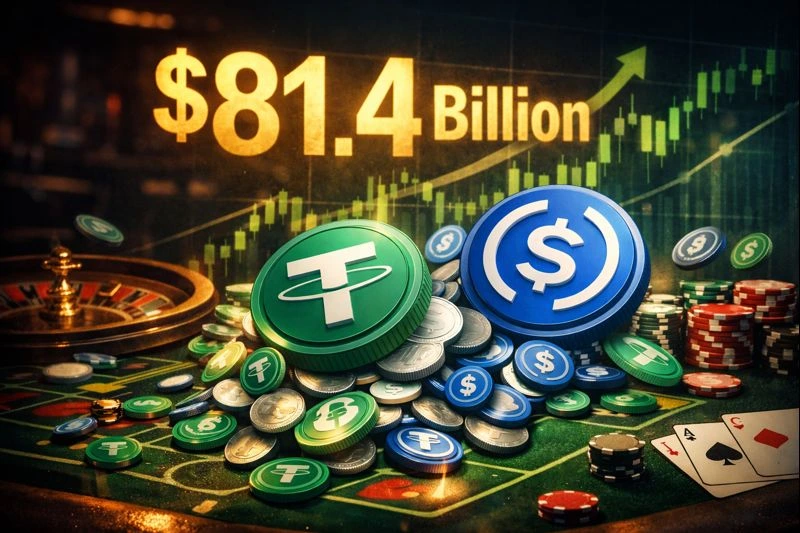
The incorporation of stablecoins into online gambling has reshaped the digital betting industry into one of crypto’s most profitable commercial verticals. By 2025, dollar-pegged tokens no longer function as a niche payment option but instead form the core financial infrastructure of a global crypto gambling market generating approximately $81.4 billion in annual revenue—a figure representing nearly fivefold growth since 2022.
This analysis by Scam-Or Project examines the largest stablecoin-enabled casinos, reviews their licensing frameworks, and evaluates the compliance, AML, and financial crime exposure inherent to this fast-scaling ecosystem.
The Economic Logic Behind Stablecoin Gambling
From Speculation to Predictability
Prior to stablecoin adoption, crypto gambling suffered from structural inefficiencies caused by asset volatility. Players wagering with Bitcoin or Ethereum faced compounded uncertainty: the outcome of the game and unpredictable price movements of the underlying asset. This dual-risk model discouraged broader adoption among users accustomed to fiat-based value stability.
The introduction of stablecoins such as USDT (Tether) and USDC (Circle) eliminated this friction. Casinos gained access to blockchain-based payment rails while preserving price certainty. A USDT-denominated balance mirrors fiat value regardless of crypto market fluctuations, allowing users to manage risk with predictable monetary exposure.
Low transaction costs further accelerated adoption. Networks like Tron (TRC-20) consistently process transfers for less than $1, even during high congestion, while Bitcoin fees may exceed $20–50. Combined with settlement times measured in minutes rather than days, stablecoins enabled global scalability unmatched by traditional banking systems.
Stablecoins’ Expanding Share of Global Wagering
By 2025, stablecoins facilitate roughly 30% of all online gambling activity worldwide, compared to 20% in 2022. During Q1 2025, stablecoin-based wagers totaled nearly $26 billion, almost doubling year-over-year transaction volume. This trajectory reflects infrastructure-driven adoption rather than speculative hype.
Dominant Stablecoin Casinos and Market Leaders
Tier-One Operators
Stake.com
Stake.com leads the crypto gambling sector, processing more than $1.1 billion in monthly transaction volume and reporting $4.7 billion in gross gaming revenue in 2024. Licensed in Curaçao, the platform supports USDT, USDC, and over 14 cryptocurrencies. Its extensive sports sponsorships and influencer-driven campaigns have fueled rapid user growth while drawing increased regulatory scrutiny.
BC.Game
BC.Game offers access to over 9,000 casino games and supports USDT, USDC, and DAI. Its ecosystem includes a 69-tier VIP system and a proprietary BC Dollar (BCD) token pegged to USD. Players can convert BCD into USDT or BTC. Despite aggressive promotions—such as bonuses reaching 360% up to $500,000—the platform voluntarily surrendered its Curaçao license in December 2024, raising concerns regarding oversight continuity.
Cloudbet
Established in 2013, Cloudbet represents one of the longest-operating crypto casinos. Licensed by the Curaçao Gaming Control Board, it supports USDT via TRC-20 and ERC-20, allowing users to select networks based on speed and cost. Cloudbet enables direct stablecoin wagering without automatic conversion and offers a welcome package valued at up to $2,500.
Rollbit
Founded in 2020, Rollbit expanded rapidly during the crypto casino boom. Its ecosystem revolves around the RLB token, which provides access to fee reductions and lottery participation. The platform distributes 20% of daily casino profits through a buyback-and-burn model. Recent disclosures, however, indicate unresolved licensing challenges that may impact operational stability.
Duelbits
Duelbits supports USDT and BUSD across more than 5,000 games, offering a structured loyalty system with up to 60% rakeback. Deposit bonuses reach 125% up to $250, and withdrawals for smaller amounts typically do not require mandatory KYC. Like most competitors, Duelbits operates under a Curaçao license.
Secondary Platforms and Niche Operators
Several platforms focus on specific user segments:
- Betpanda: Zero KYC, unlimited withdrawals, bonuses up to 1 BTC
- CoinCasino: USDT-focused casino offerings
- Betplay.io: USDC support across Tron, Ethereum, Solana, Polygon, and BNB Chain
- 500 Casino: USDT deposits on Ethereum, Solana, Avalanche, and BNB Chain
- Bets.io: USDC support on Ethereum, Base, Sui, NEAR, and BNB Chain
CryptoCasino.com exemplifies Web3-oriented platforms, offering Telegram-based access and support for more than 18 cryptocurrencies, including USDT, USDC, and its native $CASINO token. Its bonus mechanism releases rewards incrementally, unlocking 10% for every 6x wagering cycle.
Offshore Stablecoin Casinos Serving the United States
While most crypto casinos prohibit U.S. users in their terms, several offshore operators explicitly accept American players through jurisdictions such as Panama and Costa Rica.
- BetOnline processes USDT withdrawals within 24 hours and routinely approves U.S. KYC documentation
- Wild Casino markets fast USDT payouts and bonuses up to $5,000
- Super Slots, Cafe Casino (Bovada network), and Sportsbetting.ag also support USDT via TRC-20 and ERC-20
These platforms convert stablecoin deposits into USD balances for gameplay and reverse the process upon withdrawal, maintaining effective 1:1 parity.
Curaçao Licensing as the Industry Standard
The majority of stablecoin casinos operate under licenses issued by the Curaçao Gaming Control Board (GCB). Curaçao remains attractive due to its explicit accommodation of cryptocurrency gambling, provided AML and KYC obligations are met.
The 2023 National Ordinance on Offshore Games of Hazard (LOK) replaced the former master–sub-license structure with direct licensing, introducing stricter AML/CFT requirements aligned with FATF and EU standards.
Key Characteristics of Curaçao Licensing
| Parameter | Details |
|---|---|
| Coverage | Casino, sportsbook, poker, lottery |
| Annual Fees | €40,000–50,000 |
| Approval Timeline | 2–3 months |
| Stablecoin Policy | No explicit restrictions |
Despite these reforms, consumer protection remains limited compared to Malta or the UK. The BC.Game license withdrawal and Rollbit’s reported expiration illustrate enforcement gaps.
Compliance Expectations and AML Obligations
KYC and Transaction Monitoring
Most stablecoin casinos require KYC verification prior to withdrawal, typically involving government-issued ID, proof of address, and biometric confirmation. Offshore casinos serving U.S. customers generally approve American documents, while crypto-native platforms have been accused of selectively enforcing KYC to deny withdrawals from restricted regions.
Some casinos promote “no KYC” thresholds, which significantly increases exposure to illicit financial activity.
Regulatory Pressure
The GENIUS Act, enacted in July 2025, mandates that U.S.-based stablecoin issuers register as Permitted Payment Stablecoin Issuers and implement bank-grade AML programs. Platforms facilitating fiat-to-stablecoin conversions increasingly fall under this regulatory scope.
Stablecoin issuers are classified as financial institutions under the Bank Secrecy Act, while the EU’s Markets in Crypto-Assets (MiCA) regulation imposes parallel obligations across Europe.
Financial Crime Exposure in Stablecoin Gambling
Online gambling is classified as a high-risk sector for money laundering. In 2024, Chainalysis estimated that stablecoins were involved in nearly $25 billion in illicit transactions. The UN Office on Drugs and Crime identified USDT as particularly attractive due to its liquidity, price stability, and minimal transaction fees.
Risk vectors include:
- Cross-chain laundering across Ethereum, Tron, BNB Chain, and others
- DeFi-based layering via lending pools and liquidity protocols
- Rapid conversion between crypto assets and fiat
- Sanctions evasion linked to jurisdictions such as Iran and Russia
On-ramps, off-ramps, and P2P exchanges remain the most vulnerable choke points.
Provably Fair Gaming: Transparency With Structural Limits
Many stablecoin casinos promote provably fair gaming systems, enabling players to cryptographically verify game outcomes. This model relies on:
- A casino-generated server seed
- A player-controlled client seed
- A nonce incrementing per wager
After each game, users can validate that the outcome corresponds to the original hash commitment.
Platforms including BC.Game, Cloudbet, Rollbit, and Duelbits apply provably fair verification to in-house games such as Dice, Crash, and Plinko. However, this transparency does not extend to third-party slots from providers like Pragmatic Play or Evolution Gaming, nor does it address custody or licensing risks.
Payment Infrastructure and Settlement Mechanics
USDT is supported via TRC-20, ERC-20, and BEP-20, while USDC operates across Ethereum, Solana, Polygon, Base, and other networks. Deposits typically clear within 5–15 minutes, while withdrawals range from minutes to 48 hours depending on internal controls.
Most casinos display balances in USD and perform automatic conversion upon withdrawal. Some platforms, including Cloudbet, allow direct stablecoin wagering without intermediate conversion.
Risk Profile and Consumer Protection Issues
Key risk factors include:
- Limited dispute resolution in offshore jurisdictions
- Confiscation risks linked to KYC enforcement
- Centralized custody and insolvency exposure
- Bonus wagering requirements ranging from 8x to 45x
- Absence of deposit insurance protections
- VPN-enabled access creating legal uncertainty
Market Trajectory and Regulatory Outlook
The crypto casino sector is projected to approach $400 billion by 2028, driven by adoption in emerging markets where stablecoins also function as inflation hedges. Platforms leveraging Solana and BNB Chain report user growth exceeding 30% in developing regions.
At the same time, regulatory convergence is accelerating. The combined impact of the GENIUS Act, MiCA, and updated FATF guidance is pushing the industry toward institutional-grade compliance standards.
Operators that invest in robust AML, transaction monitoring, and sanctions screening are likely to consolidate market share. Those operating at the margins of compliance face increasing enforcement pressure.
Final Assessment
Stablecoins have transformed crypto gambling by removing volatility barriers and enabling frictionless global payments. However, the resulting $81 billion ecosystem now operates under growing regulatory scrutiny. The long-term viability of stablecoin casinos will depend on their ability to reconcile borderless blockchain architecture with rising demands for transparency, compliance, and consumer protection.