
Dutch Kansspelautoriteit (KSA) Orders Polymarket to Cease Operations: Why Crypto-Based “Prediction Markets” Are Being Treated as Unlicensed Gambling in the EU

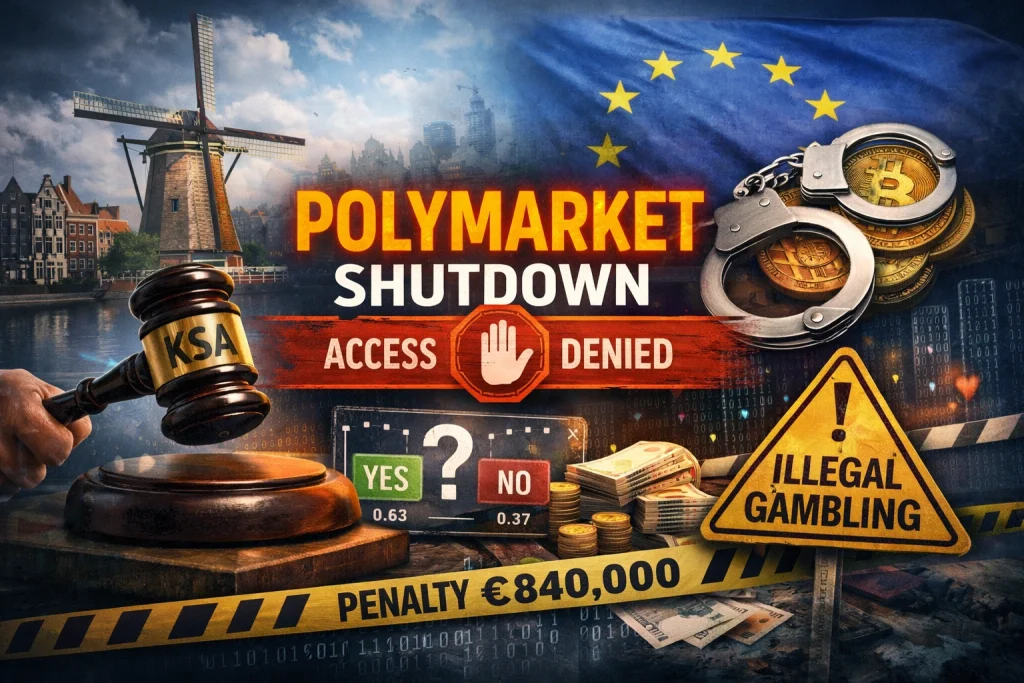
The Dutch gambling regulator Kansspelautoriteit (KSA) has formally instructed Polymarket’s operator, Adventure One QSS Inc., to immediately stop offering its crypto-powered prediction markets to residents of the Netherlands. The enforcement order is backed by escalating weekly penalty payments that may reach up to €840,000.
Although the decision originates in the Dutch market, its implications extend across the European Union. The case illustrates how EU regulators may classify so-called “event contracts” as unlicensed remote gambling when offered without national authorization—regardless of whether the platform describes the activity as “trading.”
Key Points
- The KSA imposed a “last onder dwangsom” (order under penalty) on Adventure One QSS Inc., requiring it to stop offering what the regulator considers unlicensed games of chance to Dutch residents.
- €420,000 per week
- Maximum exposure: €840,000
- According to the KSA’s published findings, Dutch residents were able to:
- Open accounts
- Deposit funds
- Participate in prediction markets without meaningful technical barriers such as effective geo-blocking. Investigations were conducted in July and November 2025.
- Polymarket maintained that it operates a “market” where users trade positions and prices reflect collective information and market mechanics. The KSA rejected this argument and determined that the activity constitutes a prohibited offering under the Dutch Gambling Act (Wok) without a local licence.
- The United Kingdom has clarified that prediction markets accessible in Great Britain fall within gambling legislation and require appropriate licensing.
- In the United States, regulatory treatment differs. The Commodity Futures Trading Commission (CFTC) previously sanctioned Polymarket in 2022 for offering event-based binary options and swaps through an unregistered facility, imposing a $1.4 million penalty and ordering a wind-down of certain activities.
Regulatory Position: Access Equals Gambling
The KSA’s position is straightforward: if Dutch users can access a platform and stake monetary value on uncertain events, the activity qualifies as remote gambling under Dutch law. Licensing is therefore mandatory.
The decision emphasizes that Polymarket provided an “opportunity to participate” in games of chance without proper authorization. The regulator reinforced the order with substantial weekly penalties to ensure compliance.
Beyond formal consumer protection arguments, the Dutch debate has also focused on politically sensitive prediction markets, such as elections or coalition formation. Authorities have expressed concern that such markets could:
- Encourage manipulation
- Enable insider behavior
- Undermine public trust
- Complicate oversight through crypto-based rails and pseudonymity
Extended Analysis
1) How Prediction Markets Operate — and Why Regulators Reject the “It’s Just Trading” Argument
Most prediction markets list binary “Yes/No” contracts tied to real-world events. For example:
- “Candidate X wins the election”
- “Policy Y passes Parliament”
A contract trading at 0.63 is marketed as implying a 63% probability. Participants can buy and sell positions prior to settlement. Upon resolution:
- Winning shares pay out
- Losing shares expire worthless
- Settlement typically relies on predefined data sources or oracle mechanisms
From a compliance standpoint, regulators apply a functional test:
| Element | Description |
|---|---|
| Stake | Users commit funds or value |
| Uncertainty | Outcome depends on a future event |
| Payout | Monetary return based on result |
Whether the interface labels the activity as “trading” or “betting,” and whether pricing arises from an order book or automated market maker (AMM), regulators often classify the product as gambling in the EU and UK—or as a derivative in the United States.
In its reasoning, the KSA acknowledged Polymarket’s argument that informed trading reduces reliance on pure chance. Nonetheless, it concluded that the product meets the legal threshold for an unauthorized game of chance under Dutch law.
2) Why the KSA Moved Against Polymarket
The Dutch enforcement decision reads like a compliance roadmap for cross-border platforms.
Core Findings
- Accessible from the Netherlands: Investigators were able to register and participate using Dutch IP addresses.
- No Local Licence: The operator lacked authorization for remote gambling in the Netherlands.
- Regulatory Objectives: The KSA cited fundamental gambling supervision pillars:
- Consumer protection
- Addiction prevention
- Fraud and crime prevention
- Safe payment systems
Importantly, the regulator approached the matter primarily as a gambling issue rather than a crypto or financial regulation question. The classification focused on the substance of the activity, not the technology used.
3) United States vs. United Kingdom: Different Legal Frameworks, Similar Compliance Pressure
United States
The CFTC has already taken enforcement action against Polymarket’s earlier structure. It treated event-based binary options as swaps and penalized the platform for operating an unregistered facility. The 2022 order included:
- A $1.4 million civil monetary penalty
- Obligations to cease certain operations
At the same time, the U.S. regulatory landscape remains divided between federal derivatives regulation and state-level gambling considerations.
United Kingdom
The UK Gambling Commission has clarified that prediction markets offered in Great Britain fall within existing gambling law. Operators must obtain the relevant gambling permissions.
This approach effectively channels compliance toward a betting-exchange licensing model rather than a financial markets framework.
4) What This Means for the European Union
There is no EU-wide passport for prediction markets. Gambling regulation remains largely at the Member State level.
The KSA’s enforcement signals a broader principle:
Accessibility + Participation = Local Licensing Exposure
Practical Consequences for Platforms Targeting or Reaching EU Users
- Geo-fencing is mandatory: Authorities will test IP access, onboarding processes, deposit mechanisms, and marketing localization.
- Crypto does not eliminate regulatory risk: In many cases, crypto infrastructure intensifies AML and consumer protection scrutiny.
- Financial-product framing is unlikely to succeed: Regulators are prioritizing gambling law classification.
- Enforcement may spread across Member States: The Dutch decision provides a replicable template for other EU authorities.
Actionable Insight for Operators and Investors
For platforms operating in or accessible from the EU, the KSA decision functions as a regulatory signal.
The principal risk is not token compliance but unlicensed gambling distribution triggered simply by availability.
A minimum compliance posture may now include:
- Strict geo-blocking for restricted jurisdictions
- Default exclusion of EU markets absent licensing
- A country-by-country authorization strategy
- Consideration of transitioning to regulated betting-exchange frameworks where available
Call for Information
Have you accessed Polymarket or similar prediction market platforms from within the EU—particularly the Netherlands?
Have you observed:
- Payment facilitators serving EU users
- Wallet integrations or crypto rails aimed at local markets
- Localization tactics
- Influencer campaigns targeting EU audiences
- Affiliate links or domain mirrors
Evidence such as screenshots, transaction records, onboarding flows, affiliate structures, or domain clones may be submitted through the Scam-Or Project website.
Individuals with knowledge of geo-blocking decisions, market targeting strategies, or payment service provider relationships are also encouraged to provide relevant information.