
“Entity of Interest” on OpenSanctions: A Compliance Alert No Regulated PSP Can Disregard

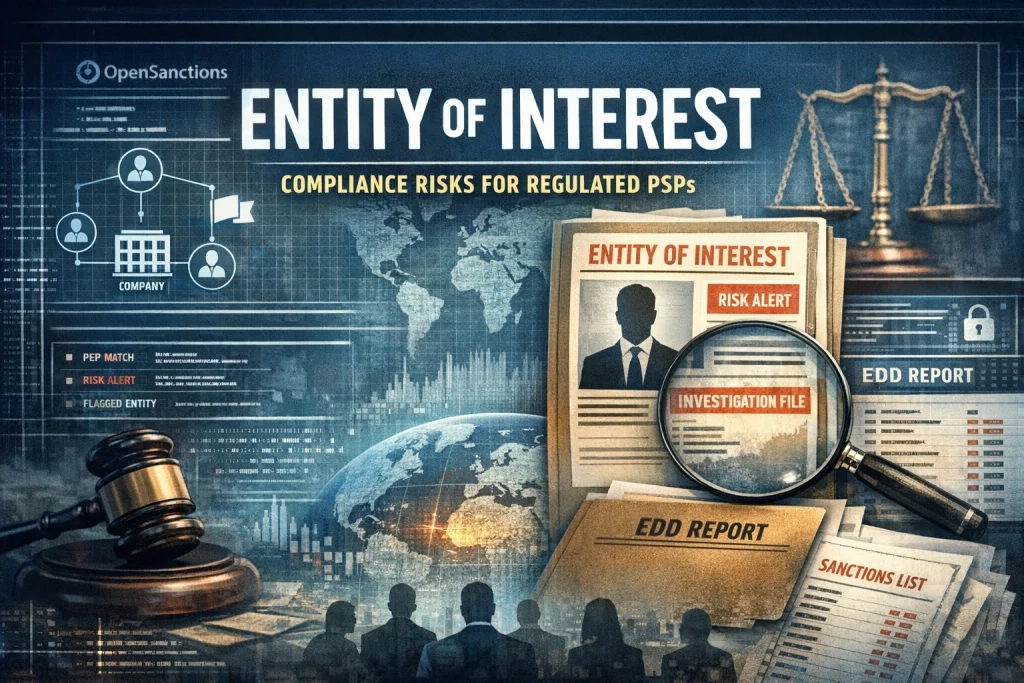
OpenSanctions is broadly integrated into compliance and screening workflows to identify sanctions targets, politically exposed persons (PEPs), and other entities associated with elevated risk across multiple public data sources.
Being categorized as an “entity of interest” does not equate to being sanctioned. However, for a regulated payment service provider (PSP) or financial institution, such a designation represents a material risk signal that should automatically initiate enhanced review procedures, source validation, and properly documented decision-making suitable for audit scrutiny.
Key Facts
- OpenSanctions operates as an aggregation and normalization framework for sanctions lists, PEP datasets, and related risk intelligence, supporting investigative and AML screening processes.
- The OpenSanctions API, known as “yente,” enables structured search and matching against individuals, companies, vessels, and associated entities appearing in sanctions and risk-related datasets.
- The term “entity of interest” is a broad due-diligence classification and does not constitute a formal legal determination.
- The essential compliance issue is always the underlying source: the specific dataset, authority, public filing, allegation, or relational link that caused the flag. OpenSanctions facilitates discovery — it does not independently validate or adjudicate the accuracy of the underlying data.
Short Narrative
The label “entity of interest” functions primarily as a screening alert. It indicates that a name — or associated identifiers, ownership structures, or relationships — appears in one or more datasets relevant to sanctions, AML, PEP, or adverse-risk monitoring.
OpenSanctions’ core role is to collect, standardize, deduplicate, and structure watchlist-style entity data so that compliance teams and investigators can query risk consistently and efficiently.
In practical terms, OpenSanctions provides risk discovery infrastructure. It is not:
- A judicial ruling
- A regulatory enforcement action
- A criminal conviction
- A formal sanctions designation
It is a screening signal — nothing more, and nothing less.
Extended Analysis
1) What the Label Means — and What It Does Not Mean
What It Does Mean
- The entity is present within a structured risk graph used for compliance screening.
- There may be documented connections such as:
- Aliases
- Registration identifiers
- Corporate officers
- Ownership links
- Addresses
- Intermediaries
- The presence in datasets may indicate potential exposure requiring review.
What It Does Not Mean
- It does not automatically mean the entity is sanctioned.
- It does not confirm proven misconduct.
- It does not represent regulator-imposed enforcement.
- It does not create an automatic prohibition on conducting business.
2) Why This Matters More for a Regulated Payment Institution
For a regulated PSP or payment institution, compliance standards operate under a risk-based framework. The expectation is not to disregard alerts until legal proof emerges. Instead, institutions must:
- Identify relevant risk signals through screening systems.
- Verify the underlying dataset and the reason for inclusion.
- Assess exposure, including:
- Customers and merchants
- Counterparties
- Transaction corridors
- Beneficial owners
- Agents and intermediaries
- Nested or indirect relationships
- Document and decide, including:
- Enhanced Due Diligence (EDD), where proportionate
- Monitoring adjustments
- Restrictions or termination decisions
- Consideration of SAR/STR filings where applicable
OpenSanctions plays a central role in the identification and verification stages because it is designed specifically as a search-and-match infrastructure layer for watchlist entities and relational data.
3) What Proper, Audit-Ready Handling Looks Like
If a regulated payment institution — or its principals — appears as an “entity of interest,” a defensible and supervisory-compliant response generally includes:
| Step | Action |
|---|---|
| 1 | Retrieve the full OpenSanctions entity record. |
| 2 | Identify the precise datasets and sources triggering the match. |
| 3 | Confirm identifiers (company numbers, addresses, officers) to rule out false positives. |
| 4 | Evaluate the nature of the source (sanctions, PEP listing, adverse media, enforcement adjacency). |
| 5 | Apply proportionate EDD where appropriate — avoiding both automatic de-risking and dismissive inaction. |
| 6 | Prepare a documented decision memo including: match rationale, source credibility, mitigation measures, monitoring plan, and review frequency. |
Supervisors typically focus on whether the institution demonstrated structured verification and documented reasoning — not whether it eliminated all theoretical risk.
Actionable Insight
For compliance officers, auditors, correspondent banks, and regulated partners, an “entity of interest” label should be treated as a triage trigger, not a conclusive finding.
The expected standard is:
- Source-level verification
- Proportionate risk assessment
- Clearly documented decision-making
These are precisely the elements regulators examine when a screening alert evolves into a supervisory inquiry.
Call for Information
Scam-Or Project is analyzing how compliance risk signals move across payment infrastructures and correspondent networks.
If you possess primary documentation — including:
- Bank or PSP correspondence
- KYC or EDD findings
- Account termination notices
- Card scheme onboarding materials
- Acquiring or merchant identification data
- Gateway domain associations
- Regulatory communications
— demonstrating how “entity of interest” alerts were managed in practice, you may submit information securely via the Scam-Or Project whistleblower section.