
PayOp CEO Anastasia Semenkova Under Scrutiny Over Alleged Illegal Gambling Payments

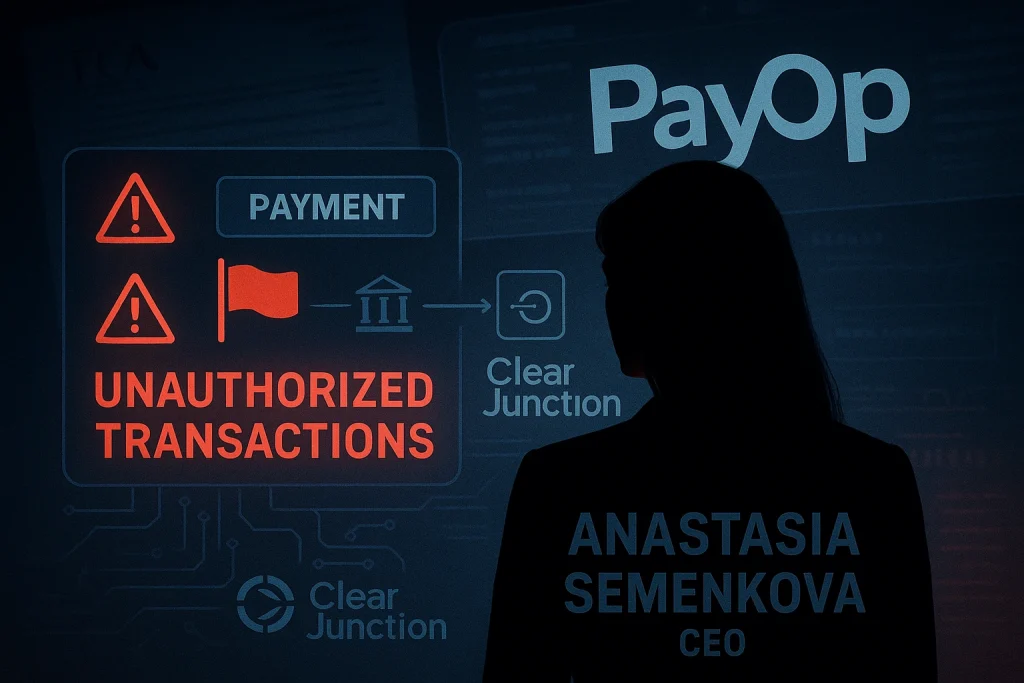
UK Victim’s Complaint Letter Accuses PayOp and Clear Junction of Enabling Unlicensed Casino Transactions
The high-risk payment processor PayOp (PayOp.com) and its Chief Executive Officer Anastasia Semenkova are under mounting pressure after Scam-Or Project received a detailed complaint from a UK customer alleging £3,675 in unauthorized gambling-related transactions processed in July–August 2025.
The complainant describes earlier, unsuccessful attempts to resolve the issue via PayOp’s support channels and now formally demands:
-
Full refunds of the disputed amounts
-
Identification of the underlying merchants
-
Transparency regarding PayOp’s compliance checks and responsibilities
In her letter, the customer cites Scam-Or Project’s investigative articles from October–November 2025 about PayOp’s work with high-risk and unlicensed gambling merchants, noting that this prior public scrutiny “underscores the importance of timely transparency and compliance review.”
According to the complaint, the disputed payments were routed through Clear Junction Ltd (clearjunction.com), an FCA-authorized electronic money institution, which partners with PayOp to provide UK and EU payment infrastructure.
Clear Junction’s “Pay by Bank” Rails as a Gateway for Illegal Gambling
The complaint pinpoints a series of transactions executed via “Pay by bank” transfers facilitated by Clear Junction Ltd (Sort Code: 04-13-07, Account Number: 29904109).
This payment option, actively promoted within PayOp’s service offering, relies on open banking technology to initiate direct bank-to-bank transfers. The partnership between PayOp and Clear Junction, established in 2021 to strengthen PayOp’s bank transfer capabilities across the UK and Europe, is central to the complaint.
However, the use of such regulated financial infrastructure to route payments to unlicensed gambling operators raises serious concerns about:
-
The merchant onboarding and vetting practices of PayOp
-
The oversight and monitoring Clear Junction applies to how its payment rails are used
Clear Junction Ltd is:
-
Registered in the United Kingdom
-
Authorized by the Financial Conduct Authority (FRN: 900684) as an electronic money institution
Its alleged role in processing payments linked to potentially illegal gambling activity targeting UK consumers is therefore especially troubling from a regulatory and supervisory standpoint.
Evidence of a Broader Pattern: PayOp and Illegal Casino Operations
Scam-Or Project has previously documented PayOp’s recurring role as a payment facilitator for unlicensed online casinos. A key example is its relationship with Rolletto, an online casino operated by Cyprus-registered Santeda International B.V., which does not hold a license from the UK Gambling Commission.
Under Section 33 of the Gambling Act 2005, providing gambling services to UK consumers without appropriate licensing is a criminal offense.
An investigation published in July 2024 showed that PayOp processed a series of unauthorized transactions for Rolletto between 24–25 May 2024, involving UK bank accounts at Monzo, HSBC, and Barclays. These payments were channeled through the same Clear Junction infrastructure that now appears in the recent complaint.
Taken together, these cases point to a systemic business practice, not isolated errors.
Even more serious is the fact that many of these illegal gambling operations are directed at UK consumers registered with GamStop, the mandatory self-exclusion program for individuals seeking to limit or stop their gambling.
By processing payments for operators that deliberately bypass GamStop protections, PayOp is not just facilitating illegal gambling—it is enabling the exploitation of individuals who have already identified themselves as vulnerable and actively sought protection.
Merchant Miscoding and Transaction Laundering Concerns
The complaint also raises concerns about merchant identification and coding, themes that have surfaced repeatedly in previous investigations into PayOp’s operations.
The victim formally requests disclosure of:
-
Merchant Category Codes (MCC)
-
Merchant IDs
-
Authorization codes
-
Legal business names of the payees
Prior reporting from Scam-Or Project found that illegal casinos using PayOp’s services often rely on miscoding and transaction masking to disguise gambling payments.
How Legitimate Gambling Transactions Should Be Coded
Properly classified gambling payments should fall under MCC 7995, which covers:
-
Betting and lotteries
-
Casino gaming chips
-
Off-track betting
-
Wagers at racetracks
Yet victims consistently report charges appearing under unrelated or misleading merchant names such as:
-
“Fomiline”
-
“Goriwire”
-
“Bitsent”
-
“Wintermdse”
-
“Arcomet”
This practice—often referred to as merchant miscoding or transaction masking—is considered fraudulent under payment network rules. It allows illegal operators to:
-
Evade bank-level gambling blocks in the UK
-
Conceal the true nature of the transaction from customers and banks
Such tactics also clash with PayOp’s own terms and conditions, which:
-
Prohibit processing payments for illegal gambling services
-
Require merchants to hold all relevant licenses and authorizations
-
Grant PayOp the right to annul suspicious or fraudulent transactions and report them to authorities
However, multiple customer complaints and public reviews suggest that, in practice, PayOp rarely exercises these powers, even when presented with evidence that merchants are operating illegally.
PayOp’s Corporate Setup and Regulatory Status
PayOp operates primarily through two corporate entities:
-
Transferop Payment Gateway Ltd – a money services business registered with FINTRAC Canada (registration number M22769088)
-
Fintech Decision Pte. Ltd – a company registered with the Monetary Authority of Singapore (MAS)
The group was founded in 2019, with the majority of its operational staff reportedly based in Ukraine.
Anastasia Semenkova joined PayOp in 2019 as a Sales Manager and was promoted to CEO in January 2024.
While PayOp’s registrations with FINTRAC and MAS provide a degree of regulatory oversight, these frameworks are primarily focused on:
-
Preventing money laundering
-
Combating terrorist financing
They do not amount to approval to:
-
Process payments for unlicensed gambling operators, or
-
Facilitate services targeting jurisdictions where such operations are illegal, such as the UK.
The partnership with Clear Junction gives PayOp access to FCA-regulated payment rails. Yet this structure also raises questions about:
-
The depth of Clear Junction’s due diligence on PayOp as a client
-
The extent of monitoring of PayOp’s merchant portfolio and end-customers
Rising Customer Complaints and Regulatory Attention
The PayOp profile on Trustpilot has become a record of repeated allegations from:
-
Gambling addiction victims
-
Customers seeking refunds for payments routed to illegal casinos
Typical complaint pattern:
-
The customer deposits via PayOp to a casino.
-
The customer later discovers the casino is unlicensed in the UK or operating illegally.
-
PayOp refuses refunds, denies responsibility, or declines to disclose merchant data.
-
The company replies with standardized template messages, presenting itself as a neutral payment provider with no responsibility for the underlying merchants.
One reviewer wrote:
“PayOp/Transferop in partnership with Clearjunction, Tink and Yapily process transactions for illegal/unlicenced casinos. They have been doing this for years and causing considerable harm to vulnerable people.”
Another stated:
“There is clear evidence that Payop is the final recipient of funds that are then forwarded to illegal casinos operating without proper licenses. According to their own public responses, they ‘vet’ their merchants—meaning they are fully aware of whom they are partnering with.”
Several reviewers report filing formal complaints with:
-
FINTRAC
-
The Financial Conduct Authority (FCA)
-
The UK Gambling Commission
-
Action Fraud
-
Other national or sectoral regulators
The recurring nature of these complaints, across multiple years and involving the same casino brands and operators, strongly indicates that PayOp’s involvement in illegal gambling is neither accidental nor temporary.
CEO Anastasia Semenkova’s Silence and Responsibility
Despite receiving detailed, formal complaints—including the letter addressed directly to her as CEO—Anastasia Semenkova has so far remained publicly silent regarding PayOp’s role in facilitating payments to unlicensed gambling operators.
This silence contrasts with her public profile as a fintech industry figure, where she has previously spoken about:
-
Payment processing
-
Fraud prevention
-
Regulatory compliance
In a March 2024 interview with SafetyDetectives, conducted shortly after her appointment as CEO, Semenkova outlined PayOp’s services and growth strategy. Yet there has been no public comment addressing the evidence that the company systematically processes payments for illegal gambling operators that target vulnerable users.
The current complaint, submitted by Janet McColl, explicitly:
-
Names Anastasia Semenkova in her role as CEO
-
Cites her LinkedIn profile
-
Requests direct executive-level accountability
McColl’s letter calls for:
-
Immediate confirmation of a responsible compliance officer contact
-
A substantive response without further delay
This escalation to the CEO underscores the perceived failure of PayOp’s support and compliance teams to address underlying structural issues despite months of prior complaints.
AML and KYC Failures
The apparent systematic facilitation of illegal gambling by PayOp casts doubt on the robustness of its:
-
Anti-Money Laundering (AML) controls
-
Know Your Customer (KYC) procedures
Multiple customer reviews explicitly refer to violations of EU AML Directives (4th, 5th, and 6th), alleging that PayOp demonstrates:
-
“Willful participation or, at the very least, gross negligence in breaching KYC and AML obligations.”
As a money service business registered with FINTRAC, PayOp is required to:
-
Maintain a comprehensive AML compliance program
-
Perform customer due diligence and enhanced checks where appropriate
-
Continuously monitor transactions for suspicious patterns
-
File Suspicious Activity Reports (SARs) or equivalents when red flags arise
In her complaint, McColl specifically requests:
-
Confirmation of whether any internal compliance review was conducted regarding her transactions
-
Whether SARs or equivalent reports were filed
-
Access to any such records under GDPR/Data Protection rights
The available evidence suggests either:
-
Significant gaps in PayOp’s AML/KYC controls, or
-
A deliberate choice not to enforce these controls when profitable relationships with high-risk merchants are at stake.
Although PayOp’s terms and conditions theoretically:
-
Authorize the company to suspend merchants
-
Permit reversal of fraudulent or suspicious transactions
-
Require reporting of illegal activities to authorities
customer accounts indicate that such measures are rarely applied, even when illegal activity is clearly documented.
Legal and Regulatory Risks for PayOp and Clear Junction
The potential legal exposure for PayOp, Clear Junction, and their executives is substantial.
Under Section 33 of the Gambling Act 2005:
-
Criminal liability extends not only to unlicensed gambling operators,
-
But also to those who facilitate the provision of unlawful gambling services to UK consumers.
The offense arises where:
-
Gambling facilities are made available to persons in Great Britain without the required license, and
-
The party providing such facilities knows or should know that they are being used for gambling in Great Britain.
Given the volume of:
-
Customer complaints
-
Formal reports to regulators
-
Investigative reporting by outlets such as Scam-Or Project
it becomes increasingly difficult for PayOp and its leadership to argue that they did not know or could not have known about the illegal nature of these transactions.
Moreover, direct customer correspondence informing PayOp that specific merchants are unlicensed creates a documented record of knowledge.
Beyond gambling legislation, PayOp may also face:
-
Enforcement action by FINTRAC, MAS, and, indirectly, the FCA via Clear Junction
-
Sanctions for AML and fraud-prevention failures
-
Penalties that could include:
-
Significant fines
-
Restrictions or revocation of regulatory registrations
-
Severe reputational damage across the financial and fintech sectors
Questions PayOp and CEO Semenkova Must Answer
Given the evidence presented by victims, reviewers, and investigators, Anastasia Semenkova and PayOp face a set of urgent, concrete questions:
-
Continued Processing for Unlicensed Operators
-
Why does PayOp continue processing payments for operators such as Rolletto and other casinos linked to Santeda International B.V., which clearly lack UK Gambling Commission licenses?
-
Merchant Onboarding and Risk Controls
-
What specific merchant vetting and risk assessment procedures does PayOp apply, and why have these procedures repeatedly failed to identify unlicensed gambling operators?
-
Suspicious Activity Reporting
-
Has PayOp filed Suspicious Activity Reports or similar regulatory notifications regarding payments to unlicensed gambling operators, as required under AML regulations?
-
Clear Junction’s Oversight and FCA Awareness
-
What level of ongoing monitoring and control does Clear Junction exercise over PayOp’s use of its payment rails?
-
Is the FCA aware that Clear Junction’s infrastructure is being used to facilitate illegal gambling transactions targeting UK consumers?
-
Refund Refusals and Contract Breaches
-
Why does PayOp systematically refuse refunds even when customers provide evidence that transactions were processed to illegal operators, seemingly in violation of PayOp’s own merchant and consumer terms?
-
CEO-Level Action Since January 2024
-
Since assuming the role of CEO, what concrete steps has Anastasia Semenkova taken to address the documented pattern of PayOp facilitating illegal online gambling operations, especially those targeting self-excluded or vulnerable users?
The complaint from Janet McColl is therefore not just a personal dispute—it functions as a comprehensive indictment of a business model that appears to prioritize transaction volume and fee income over legal compliance and consumer protection.
The explicit reference to Scam-Or Project’s investigations in her letter underscores a growing trend: customers are becoming more aware of the payment infrastructure behind illegal gambling sites and more determined to hold those infrastructure providers accountable.
PayOp – Key Business Metrics
| Indicator | Details |
|---|---|
|
Brand / Trading Name |
PayOp |
|
Official Website |
|
|
Main Legal Entities |
Transferop Payment Gateway Ltd / FinTech Decision Pte Ltd |
|
Regulatory Status (Canada) |
FINTRAC-registered Money Services Business (MSB) |
|
Regulatory Status (Singapore) |
MAS-regulated entity (Singapore) |
|
Year of Establishment |
2016 |
|
Main Offices / Hubs |
Vancouver (Canada) / Singapore / Ukraine |
|
Geographic Coverage |
170+ countries |
|
Number of Supported Payment Methods |
500+ payment methods |
|
Number of Supported Currencies |
100+ currencies |
|
Core Client Verticals |
High-risk sectors: Gambling, Gaming, Forex, Crypto |
|
Strategic Partnership (2021) |
Strategic payment partnership launched in November 2021 |
|
Key Executives |
Anastasia Semenkova (CEO), Denys Myloserdov |
Call for Whistleblowers and Affected Customers
Scam-Or Project is issuing an urgent call to insiders, customers, players, and other whistleblowers who have information about PayOp, Clear Junction, and their role in facilitating illegal online casino operations.
You can help if:
-
You have experienced unauthorized or undisclosed gambling transactions processed via PayOp or Clear Junction
-
You possess internal knowledge of their merchant onboarding, compliance, or risk management procedures
-
You hold documents, emails, contracts, or internal records linking PayOp or Clear Junction to unlicensed gambling operators
Share Information
Please submit your information confidentially through the Scam-Or Project website.
By coming forward, you contribute to:
-
Demanding transparency from payment providers
-
Holding facilitators of illegal gambling accountable
-
Strengthening consumer protection across the financial services ecosystem
![[WHISTLEBLOWER LEAK] The Shadow Empire](https://scam-or.io/wp-content/uploads/2026/02/WHISTLEBLOWER-LEAK-The-Shadow-Empire-768x512.webp)