
Threats, Mockery, Silence: Inside the Impaya Casino Payment Controversy

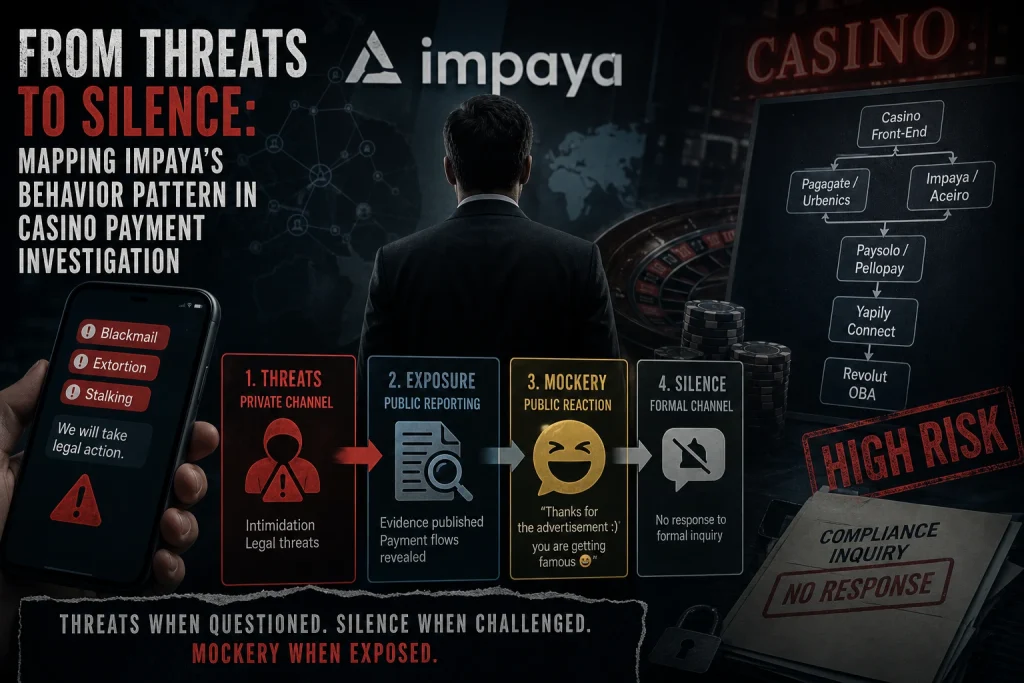
The Rail Atlas investigation conducted by Scam-Or Project into casino-related payment flows has entered a new phase. What initially appeared as an isolated dispute involving alleged threats against a player has now developed into a recognizable behavioral pattern: intimidation, followed by public exposure, then mockery, and ultimately silence.
Despite receiving formal compliance inquiries, Impaya has not provided any substantive response. Instead, its leadership has engaged publicly with sarcastic remarks on LinkedIn. This sequence raises critical concerns regarding compliance standards, internal accountability, and Impaya’s position within high-risk payment infrastructures.
Key Findings
- Phase 1 — Threats: A player reporting concerns about casino payment flows was allegedly accused of “blackmail,” “extortion,” and “stalking,” and faced legal threats
- Phase 2 — Exposure: Scam-Or Project released a documented report covering both the incident and the broader payment structure
- Phase 3 — Mockery: CEO Sergejs Roslikovs reacted publicly with “Thanks for the advertisement :)”, supported by Lana Suleymanova (“you are getting famous 😄”)
- Phase 4 — Silence: No reply has been provided to formal compliance questions
- Systemic context: Impaya appears as part of a multi-layer payment ecosystem connected to offshore casino operations
The Pattern: Threat → Exposure → Mockery → Silence
What may have once been viewed as a single case now presents itself as a structured sequence.
1. Threats (Private Communication)
A player approached Impaya with:
- Transaction documentation
- Structured compliance-related questions
- Attempts to resolve the issue
Reported response:
- Criminal accusations
- Legal threats
- Dismissive and sarcastic tone
Observation:
No meaningful compliance engagement occurred.
2. Exposure (Public Reporting)
Scam-Or Project subsequently published:
- Verified communication records
- Analysis of payment flows
- Specific compliance-related questions
Outcome:
The matter entered the public domain with supporting evidence.
3. Mockery (Public Reaction)
Rather than addressing the substance of the allegations:
- CEO response: “Thanks for the advertisement :)”
- COO echoed the tone with a public remark
Observation:
No denial, clarification, or investigation was communicated.
4. Silence (Formal Channel)
Following the publication:
- A formal inquiry was submitted to Impaya
- Detailed questions were provided
- Adequate time to respond was given
Outcome:
No response received.
Why This Pattern Matters
For any regulated or payment-facing entity, such a sequence is a serious warning signal.
A. Complaint Handling Breakdown
Expected behavior:
- Acknowledge the complaint
- Escalate internally
- Provide a neutral and documented response
Observed behavior:
- Intimidation tactics
- Dismissive communication
- Absence of follow-up
B. Indicator of Compliance Culture
Public conduct often mirrors internal practices.
When leadership reacts with sarcasm instead of substance:
- Compliance may not be a priority
- Risk awareness could be insufficient
- Internal escalation mechanisms may be lacking
C. Strategic Silence
Remaining silent after public exposure is not neutral. It may indicate:
- Avoidance of formal positioning
- Reluctance to commit to verifiable statements
- Dependence on ambiguity
Rail Atlas Context: The System Behind the Behavior
Impaya operates within a broader, multi-layer payment ecosystem:
| Layer | Function |
|---|---|
| Casino front-end | User-facing gambling platforms |
| Pagagate / Urbenics | Anonymous payment gateways |
| Impaya / Aceiro | Routing layer |
| Paysolo / Pellopay | Aggregation |
| Yapily Connect | Open Banking infrastructure |
| Revolut OBA | Final banking interface |
Structural Characteristics
- Multi-step routing chains
- Limited merchant transparency
- Fragmented accountability
Key insight:
Behavior as a Risk Indicator
According to Scam-Or Project’s analysis, in complex financial infrastructures, behavioral patterns can be as revealing as technical structures.
The Impaya case suggests:
- Complaints are not treated as compliance triggers
- External scrutiny is met with resistance
- Transparency remains limited
The Chargeback Problem
The affected player was reportedly advised to initiate a chargeback. However:
- Open Banking transactions typically do not support chargebacks
- Consumer protection options are therefore restricted
- Responsibility shifts toward payment intermediaries
Conclusion:
Evidence & Confidence Table
| Element | Role | Evidence | Confidence | Key Question |
|---|---|---|---|---|
| Player complaint | Trigger | Screenshots + video | Confirmed | Why no escalation? |
| Impaya response | Threat communication | Documented messages | Corroborated | Does Impaya confirm this? |
| CEO / COO comments | Public reaction | LinkedIn posts | Confirmed | Why mock instead of respond? |
| Formal inquiry | Response opportunity | Scam-Or Project records | Confirmed | Why no reply? |
| Payment role | Routing layer | Rail Atlas analysis | Indicated | What is Impaya’s exact role? |
Open Questions to Impaya
- Does Impaya confirm sending the messages attributed to it?
- Why was a compliance complaint treated as a legal threat?
- Why has there been no response to the formal inquiry?
- What is Impaya’s precise function in casino-related payment flows?
- How are complaints escalated internally?
- Does Impaya consider its public LinkedIn response appropriate for a financial-services environment?
Conclusion
The Impaya case has moved beyond a single dispute. It now raises three interconnected issues:
- Payment flow transparency
- Compliance practices
- Corporate behavior
The observable pattern is consistent:
- Threats when questioned
- Silence when formally challenged
- Mockery when publicly exposed
In a regulated financial environment, such a combination is not insignificant.
It is a signal.
Whistleblower Call — Help Map the Pattern
Scam-Or Project invites:
- Impaya insiders
- Payment partners
- Compliance professionals
- Affected users
to share relevant information via the Scam-Or Project Complaints.