
Austrian Spy Egisto Ott Convicted: Marsalek Intelligence Links Deepen the Wirecard Affair

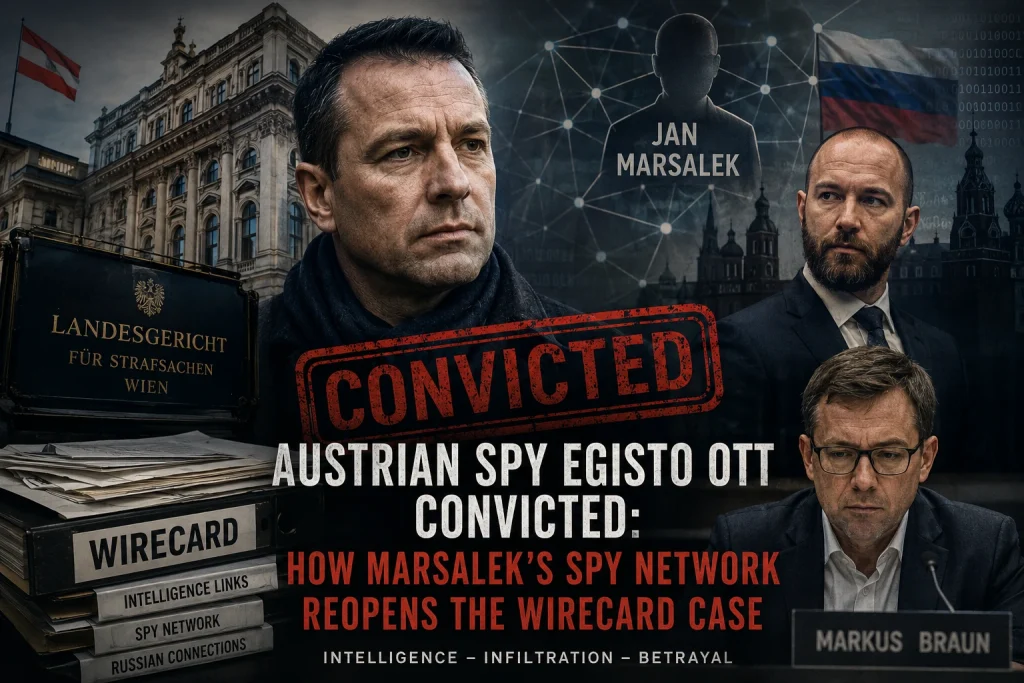
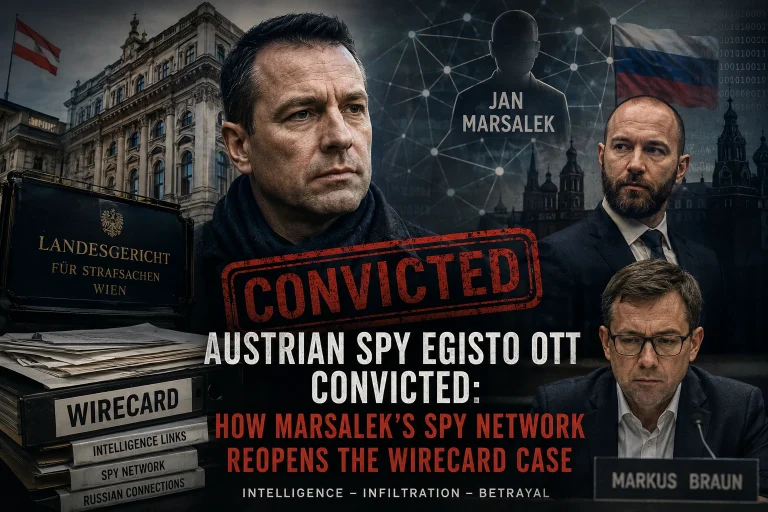
The conviction of former Austrian intelligence officer Egisto Ott in Vienna has introduced a significant new dimension to the long-running Wirecard scandal. Court findings and prosecutorial reporting suggest that Ott transferred confidential information to Jan Marsalek and Russian-linked contacts, reinforcing suspicions that Marsalek operated far beyond the profile of a conventional corporate executive involved in financial fraud.
The development is particularly relevant to the ongoing Munich criminal proceedings against former Markus Braun. While Marsalek remains a fugitive and is increasingly portrayed in investigative reporting as an operative connected to Russian intelligence structures, Braun continues to stand trial in Germany in a case whose broader context now appears intertwined with espionage, covert networks, and state-linked activities.
Egisto Ott and the Vienna Conviction
According to reporting surrounding the Vienna proceedings, Egisto Ott was accused and later convicted of misusing his former intelligence and police access to obtain confidential information on behalf of Russian interests.
The allegations reportedly included:
- accessing sensitive personal information,
- querying official government databases,
- transferring intelligence-related material,
- and supplying data to Jan Marsalek.
Investigators described Marsalek as a central intermediary connecting financial, criminal, and intelligence-related networks across multiple jurisdictions.
Operational Relationship With Jan Marsalek
Ott’s importance within the broader Wirecard narrative stems from his operational relationship with Marsalek. Court reporting indicates that Marsalek allegedly relied on Austrian insiders, including Ott, to obtain confidential information, arrange contacts, and support covert activities.
The case adds weight to the theory that the former Wirecard COO maintained a sophisticated network extending directly into government and intelligence environments rather than merely orchestrating financial misconduct inside a payment company.
Wider Implications for the Wirecard Scandal
The conviction also strengthens a broader interpretation of the Wirecard collapse.
If Marsalek was already functioning as an intelligence-linked actor while serving as Wirecard’s chief operating officer, then the company itself may have served multiple purposes simultaneously:
| Potential Function | Description |
|---|---|
| Corporate Cover Structure | Wirecard allegedly provided legitimacy and international access |
| Financial Infrastructure | Payment systems and cross-border flows may have supported covert activity |
| Intelligence Access Point | Corporate relationships potentially enabled political and institutional penetration |
| Logistics and Network Hub | International entities and service providers may have facilitated operational movement |
Under this interpretation, Wirecard becomes not only one of Europe’s largest postwar corporate fraud cases, but also a potential platform for intelligence-linked operations.
The Markus Braun Asymmetry
A striking legal imbalance now defines the case.
While Markus Braun remains detained and on trial in Munich, Jan Marsalek — the executive most strongly associated with alleged Russian intelligence operations — continues to evade German authorities.
The Wirecard trial officially began in December 2022. As of 21 May 2026, the proceedings had already lasted approximately 1,261 days, or more than 41 months, making it one of the longest and most complex corporate criminal trials in recent German history.
The extended duration of the proceedings continues to highlight both the scale of the alleged fraud and the increasingly complicated geopolitical background surrounding the case.
Compliance, Intelligence, and Regulatory Risk
For compliance specialists and financial crime analysts, the Ott conviction is not merely a peripheral development.
Instead, it strengthens arguments that the Wirecard affair should be analyzed through multiple overlapping risk categories, including:
- accounting fraud,
- market manipulation,
- supervisory and regulatory failure,
- counterintelligence exposure,
- sanctions-related vulnerabilities,
- politically exposed relationships,
- and institutional infiltration risks.
The central unresolved issue remains whether the original legal and regulatory framing of the Wirecard scandal was too narrow from the beginning.
As additional information emerges regarding Marsalek’s alleged intelligence role and his Austrian support network, the distinction between financial crime and state-linked covert operations appears increasingly blurred.
Call for Information
Wirecard investigators, compliance professionals, former insiders, service providers, whistleblowers, and other knowledgeable individuals with information regarding Egisto Ott, Jan Marsalek, associated intelligence contacts, facilitators, payment infrastructures, or cross-border operational networks are encouraged to come forward.
Information may be submitted confidentially through the Scam-Or Project Complaints. In matters involving financial crime, sanctions exposure, espionage risks, or regulatory capture, even fragmented documentation, internal communications, or timeline evidence may prove critically important.