
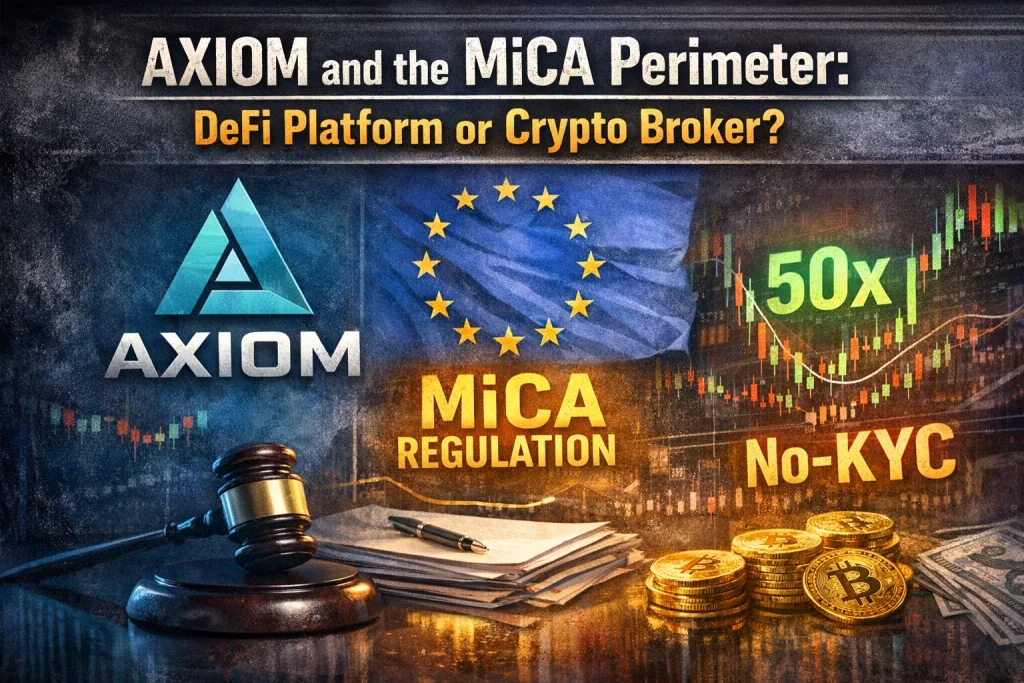
AXIOM and the MiCA Perimeter: Compliance Concerns Around a “DeFi Trading Platform”

Overview
AXIOM presents itself as a decentralized, on-chain trading platform. However, its own materials describe a far more structured and monetized ecosystem. The platform combines a branded trading interface, a hybrid wallet, crypto purchases without KYC up to $500 per week via Coinbase, yield-style investment features, and perpetuals trading through Hyperliquid with leverage of up to 50x.
In addition, AXIOM charges a 0.01% platform fee on each trade executed through its system.
For compliance analysts, the central issue is no longer whether platforms describe themselves as “DeFi.” The real question is whether such platforms are effectively delivering crypto-asset services through identifiable operators in a way that places them within the scope of the EU’s Markets in Crypto-Assets Regulation (MiCA).
Key Findings
- AXIOM describes itself as a trading platform and a “hybrid crypto trading app and wallet,” rather than merely neutral code or a passive interface.
- The platform states that users can purchase up to $500 worth of crypto per week without KYC, using a Coinbase-linked payment flow.
- AXIOM documentation indicates that perpetual trading is powered by Hyperliquid, allows leverage of up to 50x, and includes a 0.01% AXIOM fee per transaction.
- The privacy policy identifies Axiom Innovations Inc. as the entity operating the service.
- Under MiCA Recital 22, services that are provided, performed, or controlled by identifiable legal or natural persons may still fall within the regulation—even if part of the activity is carried out in a decentralized manner. Only services delivered in a fully decentralized environment without intermediaries fall outside MiCA’s scope.
- A January 2025 report by EBA and ESMA warns that industry labels such as “DeFi protocols” should not automatically be interpreted as proof of decentralization under MiCA.
- The same report highlights significant money-laundering and terrorist-financing risks associated with DeFi environments due to weak or missing AML/CFT safeguards and the possibility for users to transact without proper identification.
- CoinDesk recently reported allegations by ZachXBT claiming that an AXIOM employee may have misused internal tools and wallet-related user data. According to reports, AXIOM stated that the access had been revoked and an internal investigation was launched. These remain allegations rather than confirmed findings, but they raise governance and market-integrity concerns.
Compliance Analysis and Interpretation
From a Scam-Or Project compliance perspective, AXIOM is notable because it demonstrates how the boundary between so-called DeFi interfaces and regulated brokerage-style services is narrowing.
AXIOM does not present itself merely as open-source software or as a passive protocol layer. Instead, its own documentation describes a consumer-facing environment that integrates multiple services into a single branded platform:
- Wallet functionality
- Trading interfaces and analytics tools
- Token discovery systems
- Funding rails for crypto purchases
- Yield-style investment features
- Leveraged perpetuals trading
This bundled service structure is particularly relevant under MiCA.
Guidance from the AMF regarding MiCA—reflecting Recital 22—makes clear that the regulation applies to services performed, provided, or controlled by identifiable persons, even when some operational elements rely on decentralized infrastructure. Only services that operate entirely without intermediaries fall outside the regulatory perimeter.
The AMF guidance also confirms that the Crypto-Asset Service Provider (CASP) regime applies from 30 December 2024, subject to transitional arrangements for providers already operating under national frameworks.
For that reason, the simple claim “we are DeFi” is not sufficient to avoid regulatory oversight. AXIOM’s own descriptions suggest:
- identifiable operational control
- a branded customer-acquisition strategy
- fee-based monetization
- integrated relationships with third-party service providers
- a structured user journey managed through a centralized interface
Even when settlement or execution occurs via decentralized infrastructure, this does not automatically eliminate regulatory perimeter risk. A stricter compliance interpretation would therefore consider AXIOM as potentially falling within MiCA’s scope, especially where the platform appears to package leveraged trading access for retail-style users through a centralized service layer.
EBA and ESMA Warning on DeFi Risk
The January 2025 joint EBA/ESMA report reinforces this regulatory perspective.
Supervisory authorities explicitly note that industry terminology such as “DeFi protocols” should not be interpreted as a legal conclusion regarding decentralization under MiCA. The report also identifies a range of businesses that facilitate access to decentralized finance, including:
- application interfaces
- self-custodial wallet services
- integrated trading gateways
These models can create AML/CFT, ICT, and consumer-protection risks. Of particular concern is the finding that DeFi channels can expose the financial system to significant money-laundering and terrorist-financing risks because transactions may occur without adequate identity verification.
Against this regulatory backdrop, AXIOM’s no-KYC purchase flow for up to $500 per week is not merely a marketing feature. Combined with wallet services, yield promotions of up to 15% APY, and leveraged trading with 50x exposure, the platform resembles a highly monetized crypto-access hub rather than a minimalist protocol interface.
This does not automatically prove that AXIOM violates MiCA or other EU regulations. However, the structure of its services suggests that the platform may require close supervisory attention, particularly in relation to:
- CASP licensing requirements
- AML/CFT controls
- market conduct oversight
- consumer protection standards
Governance and Internal Controls
Another dimension concerns governance and internal controls.
The CoinDesk reporting from February 2026 on allegations involving an AXIOM employee’s misuse of internal tools and sensitive wallet-linked data highlights a recurring issue within hybrid crypto platforms. Such platforms often emphasize decentralization in their branding while still maintaining internal access to operational data and user behavior metrics.
This internal visibility may enable:
- optimization of trading activity
- monetization strategies
- user growth management
However, it also raises important compliance questions regarding:
- internal access permissions
- information barriers
- monitoring and surveillance systems
- audit trails
- protection of user-sensitive data
Even though the reported allegations remain unproven, the episode underscores the importance of robust governance structures for platforms presenting themselves as sophisticated trading environments.
Structural Issue: The “DeFi” Label vs. Economic Reality
From the perspective of the Scam-Or Project, the core issue is structural rather than semantic.
If a platform:
- controls the user interface
- manages the onboarding journey
- integrates funding mechanisms
- monetizes trading activity
- offers leveraged products to retail-style users
then regulators and compliance professionals are likely to evaluate the economic reality of intermediation, rather than relying on the platform’s branding as a decentralized service.
Based on publicly available materials, AXIOM appears closer to this brokerage-like model than its decentralization narrative might suggest.
Conclusion
AXIOM should be regarded as a potential MiCA perimeter-risk case.
The platform’s own disclosures indicate the presence of:
- an identifiable operator (Axiom Innovations Inc.)
- commercial fee extraction
- integrated wallet and trading functionality
- low-friction onboarding through no-KYC purchases
- yield promotion features
- leveraged perpetual trading through Hyperliquid
None of these elements automatically imply illegality. However, when considered together, they provide a strong basis for regulatory scrutiny under MiCA’s CASP framework.
They also raise broader concerns regarding:
- AML/CFT safeguards
- market conduct risks
- governance structures
- consumer protection
From the Scam-Or Project perspective, AXIOM is best analyzed not by the label it applies to itself, but by the brokerage-like service architecture it delivers to users.
Compliance Summary Table
| Category | AXIOM Key Data | Compliance Relevance |
|---|---|---|
| Platform name | AXIOM / axiom.trade | Consumer-facing crypto trading platform presented in a broker-like format. |
| Self-description | AXIOM describes itself as a “trading platform” intended to be the primary application for on-chain trading. | Indicates an organized service layer rather than passive software. |
| Wallet function | AXIOM states it operates as a “hybrid crypto trading app and wallet” and currently supports Solana. | Relevant for MiCA perimeter analysis when wallet and trading services are bundled. |
| Operator / legal entity | Privacy documentation identifies Axiom Innovations Inc. as the operator and provider of the web-based interface. | The presence of an identifiable operator weakens a fully decentralized positioning. |
| Buy-crypto flow | Users can reportedly purchase up to $500 per week without KYC via a Coinbase integration. | Raises AML/CFT and onboarding-risk concerns. |
| Yield feature | AXIOM promotes up to 15% APY, linked to Marginfi. | Adds complexity and conduct-risk considerations. |
| Decentralization claim | AXIOM states that it is decentralized and integrates directly with decentralized protocols. | Central claim that must be assessed against MiCA Recital 22 and actual operational control. |
| Perpetuals venue | AXIOM documentation states perpetual trading is powered by Hyperliquid. | Shows reliance on external execution infrastructure while maintaining branded access. |
| Leverage | Up to 50x leverage available on the platform. | High-risk retail trading exposure relevant for consumer protection analysis. |
| Trading fee | AXIOM charges 0.01% per perpetuals trade. | Demonstrates direct monetization of trading activity. |
| Trading analytics tools | Tools mentioned include Bundle Checker, Wallet Tracking, Tweet Monitor, and Trader Scan. | Indicates an integrated trading intelligence environment beyond simple execution. |
| Key compliance issue | Combination of branded interface control, wallet services, low-friction onboarding, monetized trading access, and leveraged products. | Creates a significant MiCA perimeter-risk profile and raises AML/CFT, conduct, and governance questions. |
Call to Whistleblowers
If you possess information regarding AXIOM, its operators, internal controls, wallet analytics systems, trading surveillance processes, compliance arrangements, or relationships with third-party execution and funding providers, you can contact us confidentially via the Scam-Or Project whistleblower section.
We are particularly interested in:
- internal documents and compliance policies
- screenshots and platform materials
- legal opinions or regulatory assessments
- onboarding procedures
- KYC/AML workflows
- governance and risk-management records
- evidence related to internal access to user-linked wallet data or trading tools.