

Circle Faces Class Action After Drift Exploit: USDC Controls and Compliance Under Scrutiny

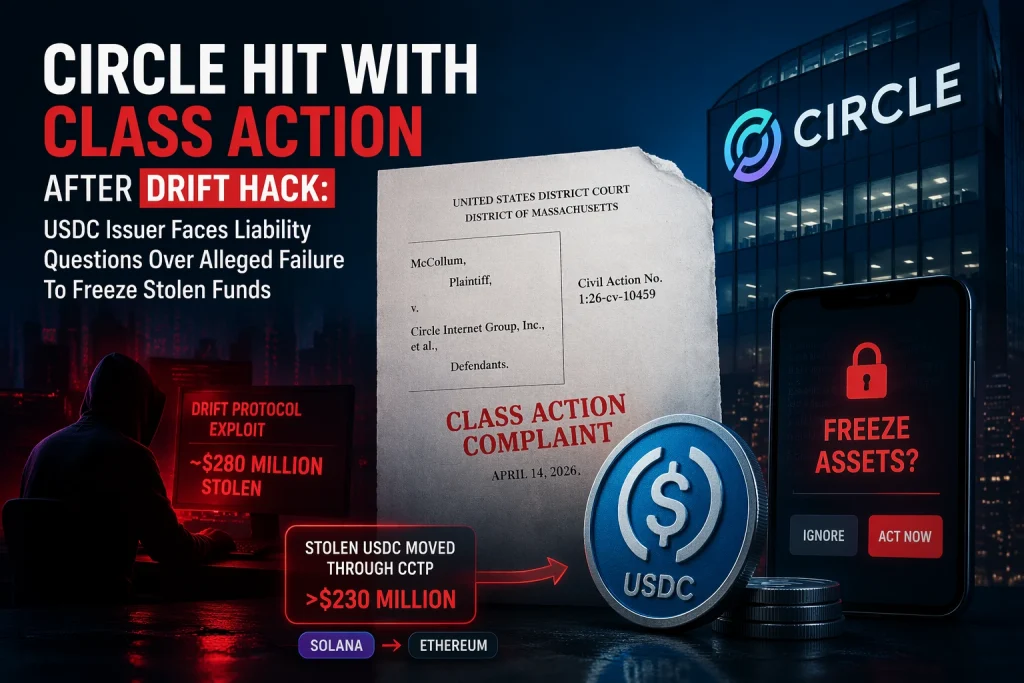
The fallout from the roughly $280 million Drift Protocol hack is rapidly evolving into a landmark legal and compliance test for the stablecoin industry. A newly filed class action lawsuit alleges that U.S.-based stablecoin issuer Circle failed to act while attackers allegedly moved more than $230 million in stolen USDC through infrastructure linked to the company, rather than freezing the funds.
At the center of the dispute is a critical question: if USDC is promoted as a regulated and controllable digital dollar, why were those controls not deployed during a large-scale theft event?
Key Findings
-
Beyond a typical DeFi exploit
The Drift incident is no longer just a hacking case. It has become a broader legal test of whether centralized stablecoin issuers can avoid liability when illicit funds move through systems they operate or influence (source). -
Core vulnerability: branding vs. behavior
Plaintiffs argue that Circle had both the technical capability and contractual authority to intervene but failed to act while stolen USDC was allegedly routed via its Cross-Chain Transfer Protocol (CCTP) (source). -
Case details
The lawsuit, filed on April 14, 2026, is listed as McCollum v. Circle Internet Group, Inc. et al. in the U.S. District Court for the District of Massachusetts (source). -
Legal stance vs. reputational risk
Circle maintains that asset freezes should only occur under proper legal authority. Critics interpret this as inaction during an active laundering scenario. -
Contradictions in Circle’s own disclosures
Public USDC documentation indicates that Circle may freeze or block addresses under certain conditions, potentially undermining its defense that it lacked authority to intervene. -
Sector-wide implications
Regardless of the outcome, the case may redefine expectations for stablecoin issuers, including the need for formalized emergency response protocols for theft and suspicious flows.
Compliance Analysis
Drift Exploit: More Than a Technical Failure
The April 1, 2026 exploit of Drift Protocol ranks among the largest DeFi thefts of the year, with estimated losses between $280 million and $285 million. Security analysis suggests that the attack extended beyond simple code vulnerabilities, involving:
- Privileged access abuse
- Governance compromise
- Social engineering tactics
This shifts the narrative from pure “protocol risk” to a breakdown in operational controls and trust architecture (source).
Circle’s Role in Post-Hack Fund Flows
Circle’s involvement stems not from causing the exploit, but from its alleged inaction once stolen assets began moving through USDC infrastructure.
According to court filings and public reports:
- Over $230 million in stolen USDC allegedly passed through Circle’s CCTP system
- Plaintiffs claim Circle could have frozen or blocked these transactions
- Instead, the flows were allowed to continue
This shifts legal focus away from the attackers and onto the behavior of a centralized infrastructure provider during an active post-theft phase.
The Compliance Narrative Under Pressure
From a Scam-Or Project perspective, this case directly challenges Circle’s long-standing positioning. Unlike decentralized, censorship-resistant crypto assets, USDC is marketed as:
- Regulated
- Institution-ready
- Transparent and controllable
This branding implies not only oversight—but also responsibility. When a major exploit unfolds and the issuer declines to act without formal legal orders, that narrative begins to weaken.
Due Process vs. Operational Responsibility
Circle’s defense relies heavily on legal process. The company argues that freezing assets requires valid legal authority, not reactive decisions driven by public pressure or market panic.
While legally sound, this argument creates a deeper issue:
| Aspect | Implication |
|---|---|
| Emphasis on compliance | Builds trust with institutions |
| Refusal to act without court order | May appear passive during crises |
| Control over infrastructure | Suggests capability to intervene |
| Lack of intervention | Raises questions about accountability |
This contradiction lies at the heart of the case.
Internal Policies May Work Against Circle
Circle’s own USDC risk disclosures state that the company can:
- Freeze USDC balances
- Block addresses
- Act in cases linked to illegal activity
This language provides plaintiffs with a strong argument: Circle was not powerless—it had both the tools and the discretion, but chose not to use them in time.
Cross-Chain Transfer Protocol (CCTP) Exposure
Circle’s CCTP infrastructure further complicates its position.
Key characteristics:
- Built on burn-and-mint mechanics
- Includes attestation processes
- Enables cross-chain movement (e.g., Solana → Ethereum)
This allows plaintiffs to argue that Circle was not a passive issuer but an active participant at a critical junction of asset movement. Even if this does not establish direct liability, it weakens the claim of irrelevance (source).
A Broader Compliance Dilemma
The central issue is no longer strictly legal—it is structural:
Can a stablecoin issuer:
- Promote centralized control and compliance benefits
- While simultaneously avoiding responsibility during critical incidents?
Markets, regulators, and courts are increasingly unlikely to accept both positions at once.
Conclusion
The class action against Circle is ambitious, but it raises legitimate concerns. It forces a critical question for the industry:
At what point does inaction by a “regulated” stablecoin issuer shift from legal caution to compliance failure?
Even if Circle successfully defends itself in court, the case has already exposed a fundamental tension in the stablecoin model. The boundary of liability is expanding, and Circle is the first major issuer being pushed to define it under legal scrutiny.
Call for Information
Scam-Or Project continues to investigate the behavior of stablecoin issuers, DeFi infrastructure providers, and cross-chain systems following major exploits.
Individuals with relevant knowledge—including insiders, compliance professionals, law enforcement contacts, counterparties, and affected users—are encouraged to share information securely via the Scam-Or Project whistleblower section.