
Clearhaus Introduces Denmark’s First PayFac Acquiring Model — Compliance Questions Persist Around Unzer

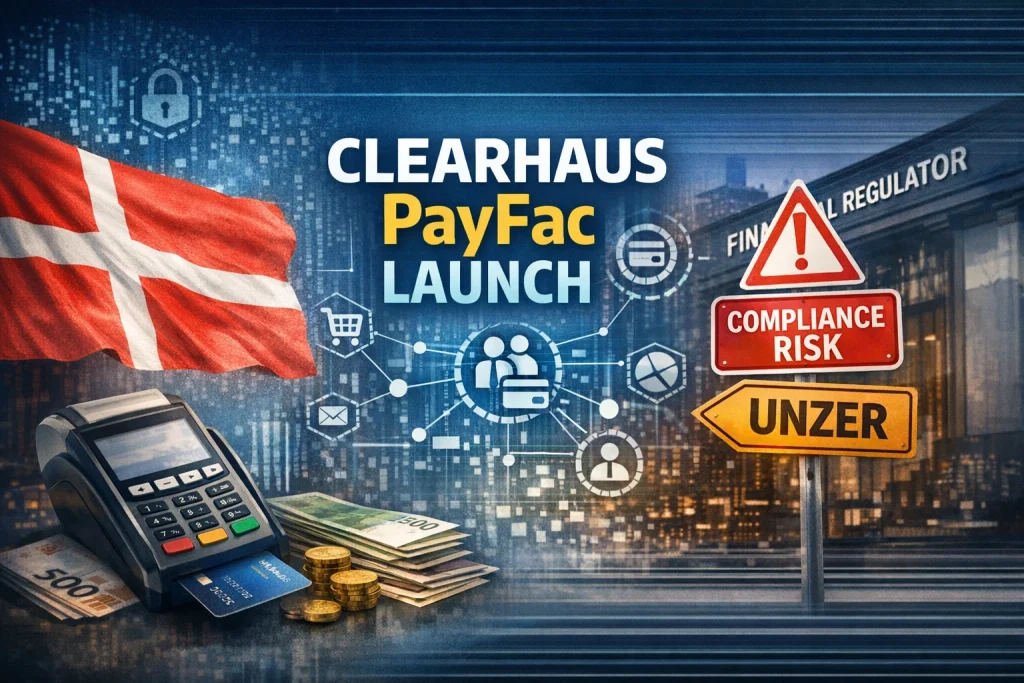
Clearhaus, a Danish acquiring institution owned by Unzer, has announced the rollout of what it describes as Denmark’s first Payment Facilitator (PayFac) acquiring model. The initiative represents a significant shift in payment infrastructure, allowing regulated platforms to integrate acquiring services directly into their own ecosystems, while Clearhaus operates in the background as the licensed acquirer.
However, from the perspective of Scam-Or Project, this development also revives a key issue: as payment infrastructure becomes more embedded and operational responsibilities are distributed, who ultimately carries the compliance burden?
Key Insights
- Clearhaus is actively promoting a PayFac model where licensed platforms assume responsibility for:
- Sub-merchant onboarding
- KYC/AML procedures
- Ongoing monitoring
- First-line fraud and chargeback management
- Clearhaus provides the acquiring infrastructure while remaining the regulated entity.
- The company is licensed by the Danish FSA, operates across Europe via passporting, and is a principal member of Visa and Mastercard.
- As of January 2026, Clearhaus reports approximately 42,000 customers.
- Since 2021, Clearhaus has been part of Unzer following the acquisition of Clearhaus and QuickPay.
- Unzer claims to serve over 85,000 merchants across Europe, supported by around 750 employees in eight offices.
- Scam-Or Project has previously reported on Unzer’s financial instability, regulatory scrutiny by BaFin, and AML-related shortcomings. In October 2024, Unzer stated that BaFin had concluded its special supervision and lifted restrictions on onboarding at Unzer E-Com.
Strategic Shift: From Acquirer to Embedded Infrastructure Provider
The announcement shared with Scam-Or Project goes beyond a simple product update. It signals a structural evolution within the Nordic and European payments landscape. Clearhaus is expanding from traditional merchant acquiring into a PayFac-driven model tailored for:
- Regulated financial platforms
- Marketplaces
- SaaS providers
- Embedded finance ecosystems
According to Clearhaus, the PayFac model enables licensed entities such as financial institutions or EMIs to embed acquiring directly into their own platforms. In this setup:
- The platform manages the full merchant lifecycle
- Clearhaus supplies the licensed acquiring infrastructure
Core Capabilities of the PayFac Model
| Feature | Description |
|---|---|
| Card Acceptance | Supports Visa and Mastercard |
| Payments | Recurring payments enabled |
| Reporting | Merchant-level analytics |
| Settlement | Automated settlement and reconciliation |
| Payouts | Configurable payout structures |
| Integration | Connectivity with 30+ payment gateways |
This approach aligns with the rapid expansion of embedded payments across Europe. It allows platforms to retain control over customer relationships while simplifying onboarding and eliminating the need for individual acquiring agreements for each sub-merchant.
Compliance Responsibility: A Critical Shift
One of the most important aspects of the PayFac structure lies in how compliance responsibilities are distributed.
Under Clearhaus’s model:
- The PayFac assumes full responsibility for:
- KYC and AML compliance
- Risk assessment
- Continuous monitoring
- Fraud and chargeback handling
- Clearhaus remains the licensed acquirer but shifts operational compliance obligations to the platform layer.
Why This Matters
In theory, this creates a clear separation of duties. In practice, it introduces a multi-layered risk environment where:
- Merchant onboarding
- Platform governance
- Transaction monitoring
are handled by different actors.
According to Scam-Or Project’s compliance view, such models are legitimate but require strong internal controls—especially in sectors with elevated risks related to fraud, AML, sanctions, or consumer protection.
Clearhaus: Established Player Expanding Its Scope
Clearhaus is not a new entrant experimenting with PayFac structures. The company:
- Is regulated by the Danish Financial Supervisory Authority
- Operates across Europe
- Became a principal member of Visa and Mastercard
- Onboarded its first customer in 2015
Key Milestones
- 2021 – Acquired by Unzer (alongside QuickPay)
- May 2025 – Launch of POS acquiring
- January 2026 – Reached 42,000 customers
- February 2026 – Expansion into physical retail payments in Denmark
These developments form part of a broader “Unified Commerce” strategy under Unzer, combining:
- Online acquiring
- In-store payment solutions
- Embedded PayFac infrastructure
Unzer Context: Growth Meets Regulatory Pressure
The broader Unzer ecosystem remains relevant when evaluating this launch.
Unzer acquired Clearhaus and QuickPay in early 2021 with the goal of becoming a fully integrated payment service provider. Later that year, Robert Bueninck assumed the role of CEO to drive integration and expansion.
However, this growth phase was followed by operational and regulatory challenges:
- Significant financial losses reported in 2022
- Increased restructuring pressure
- Regulatory scrutiny from BaFin
Regulatory Actions
Unzer confirmed that in August 2022:
- BaFin conducted a special audit of Unzer E-Com GmbH
- Issues were identified, particularly in onboarding and AML controls
- A temporary ban on onboarding new customers was imposed
- A special commissioner was appointed
By October 2024:
- BaFin lifted the onboarding ban
- The special supervisory measures were officially concluded
While this remediation is relevant, the earlier deficiencies remain a critical part of the risk assessment narrative.
Why the PayFac Model Requires Oversight
The PayFac model itself is not inherently risky. It offers:
- Faster onboarding
- Simplified operations
- Improved integration for legitimate businesses
However, it also centralizes control at the platform level.
Core Compliance Question
How robust are the compliance systems of the PayFac managing merchant onboarding and monitoring?
Key risk factors include:
- Quality of KYC/KYB processes
- Depth of merchant due diligence
- Effectiveness of ongoing monitoring
- Fraud detection and escalation mechanisms
In sectors with aggressive merchant growth incentives, there is a risk that compliance standards may be weakened in favor of scale.
Embedded finance can reduce friction for legitimate commerce—but also for problematic activity if governance is insufficient.
Scam-Or Project Assessment
Clearhaus’s PayFac rollout is strategically aligned with Unzer’s broader ambitions in unified commerce and embedded finance. The company brings:
- Established acquiring infrastructure
- Regulatory authorization in Denmark
- Growing scale across Europe
At the same time, the connection to Unzer means the launch should not be viewed in isolation.
Unzer’s history demonstrates how quickly:
- Rapid expansion
- Integration complexity
- Weak onboarding controls
can escalate into regulatory intervention.
Even with remediation efforts completed, the key takeaway remains:
Payment infrastructure providers are evaluated not only on innovation, but on the strength and reliability of their compliance frameworks.
Conclusion: Innovation vs. Control
The Clearhaus PayFac model represents a meaningful step forward in embedded payments across Europe. However, it should be monitored from two perspectives:
- Commercial innovation — improved integration and scalability
- Compliance execution — robustness of controls and governance
Both dimensions will determine whether this model strengthens the ecosystem—or introduces new systemic risks.
Whistleblower Notice
Whistleblowers, insiders, merchants, and compliance professionals with relevant information about Clearhaus, Unzer, or PayFac onboarding practices are encouraged to contact Scam-Or Project via the Scam-Or Project whistleblower section.