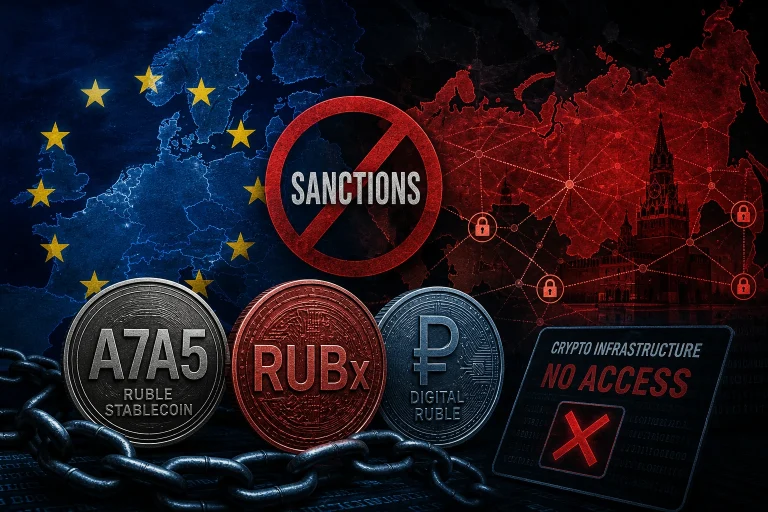

EU Sanctions Package Turns Crypto Into a Frontline: A7A5, RUBx, and the Digital Ruble in the Crosshairs

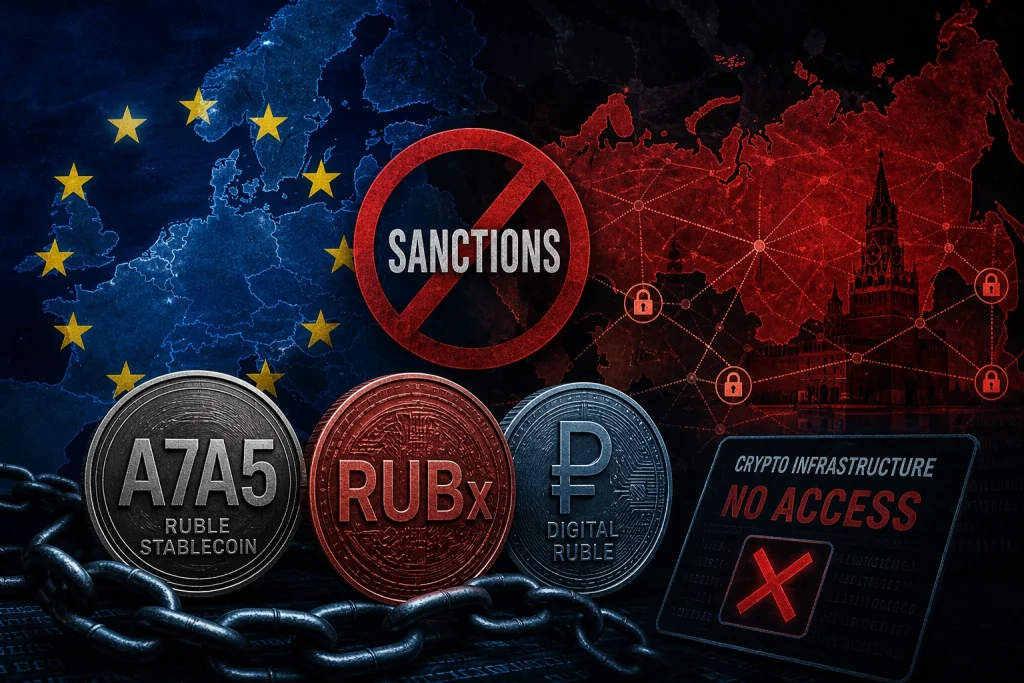
The European Union’s latest Russia sanctions package marks a decisive escalation: Brussels is no longer targeting only banks, energy companies, and oligarchs — it is now attacking Russia’s crypto settlement infrastructure. Russian crypto platforms, ruble-backed tokens, the digital ruble, and A7A5-linked payment rails are being pushed into sanctions quarantine. For EU-regulated crypto firms, the compliance landscape has fundamentally shifted.
Key Findings
- The EU has adopted a new Russia sanctions package — its 20th — targeting energy, finance, trade, shadow-fleet activity, military supply chains, and, crucially, crypto infrastructure.
- Russian crypto providers and platforms are now a core sanctions target. EU persons and firms must avoid Russia-based crypto rails used for transfer, exchange, or settlement.
- RUBx and the digital ruble are explicitly targeted. Any EU support or transactions involving these instruments create direct sanctions exposure.
- A7A5 is the headline crypto target. The ruble-backed stablecoin reportedly processed approximately $119.7 billion in volume and functions as a shadow settlement rail for Russia-linked cross-border payments.
- Crypto platforms must not cooperate with Russian or Russian-controlled payment processors that are Russia-based, linked to sanctioned parties, involved in ruble-token settlement, or used to route transactions through third-country structures to conceal Russian origins.
The Crypto Sanctions Escalation
The EU’s new package marks a structural shift. Brussels is no longer treating crypto as a secondary sanctions issue. It now identifies crypto as an active component of Russia’s sanctions-evasion infrastructure. The package targets Russian crypto-asset service providers (CASPs), ruble-backed digital assets, and settlement systems built to replace blocked banking rails. In effect, this creates a crypto-sector quarantine: EU-regulated firms must not facilitate Russian crypto transfer, exchange, or payment-routing structures.
The A7A5 Stablecoin: Russia’s Shadow Settlement Rail
A7A5 is not just another obscure token. It appears to have become a major ruble-backed settlement instrument for Russia-linked cross-border payments. According to blockchain analysis, A7A5 has processed very large volumes — reportedly up to $119.7 billion — and functions as a ruble-to-crypto bridge that converts ruble liquidity into stablecoins usable for offshore settlement. That makes A7A5 a potential sanctions-evasion mechanism, not a conventional retail token. Its key functions for Russia:
- bypasses restricted banking channels;
- supports trade settlement outside traditional correspondent banking;
- provides a ruble-to-crypto conversion route;
- operates through third-country platforms;
- reduces Russia’s dependence on Western-controlled financial infrastructure.
The Digital Ruble and RUBx
The EU’s targeting of the digital ruble and RUBx signals that Brussels will not allow Russian state or state-adjacent digital money to function as an alternative settlement layer for sanctioned commerce. EU firms should treat digital-ruble infrastructure and RUBx exposure as prohibited or near-prohibited risk areas — covering not just direct transactions but also technical support, liquidity provision, custody, exchange services, or payment facilitation.
Can EU Crypto Platforms Work With Russian Payment Processors?
In practical compliance terms: no — unless the platform can clearly demonstrate zero Russian sanctions exposure. A crypto platform subject to EU jurisdiction must not cooperate with a Russian or Russian-controlled payment processor if that processor is established in Russia, facilitates crypto transfer or exchange, is linked to sanctioned Russian banks or entities, supports A7A5/RUBx/the digital ruble, or routes transactions through third-country structures to obscure Russian origins. The key principle is functional control, not just formal ownership: a processor in Kyrgyzstan, Dubai, Cyprus, or Turkey may still constitute a Russian sanctions-evasion rail if it serves Russian settlement needs.
Compliance Red Flags
| Red Flag | Sanctions Implication |
|---|---|
| Russia-based CASP or exchange | Sectoral sanctions risk |
| Russian-controlled payment processor | Circumvention risk |
| A7A5 exposure | Ruble-stablecoin sanctions risk |
| RUBx or digital ruble exposure | Direct Russian digital-money risk |
| Kyrgyz, Dubai, or offshore routing | Possible sanctions-evasion structure |
| Ruble-to-USDT conversion flows | Crypto bridge risk |
| Netting with Russian agents | Anti-circumvention red flag |
| SPFS-linked counterparties | Russian financial-system exposure |
Expected Impact
The sanctions will not eliminate Russia’s crypto economy — it will adapt and migrate. But the EU package makes Russian crypto settlement far more toxic for regulated firms. The likely effects:
- EU-facing exchanges will block or de-risk Russian crypto flows;
- stablecoin issuers will face pressure to freeze linked wallets;
- third-country payment hubs will receive heightened scrutiny;
- A7A5 liquidity may fragment and move further offshore;
- Russian actors will migrate deeper into OTC desks, DeFi routers, and non-compliant CASPs.
Conclusion
The EU’s new Russia sanctions package turns crypto into a frontline sanctions battlefield. A7A5 exposed the model: ruble liquidity, Russian-linked banking support, third-country issuance, exchange access, and conversion into global stablecoins. RUBx and the digital ruble represent the next stage — Russian digital money designed to survive outside Western financial rails. For EU-regulated crypto platforms, the compliance answer is clear: no Russian crypto rails, no ruble-stablecoin settlement, no Russian CASP connectivity, no A7A5/RUBx/digital-ruble exposure. Block, exit, freeze, and report.
Share Information via Scam-Or Project Complaints
Scam-Or Project invites insiders, compliance officers, crypto investigators, payment processors, exchange employees, and victims to provide information about Russian crypto rails, A7A5 flows, RUBx exposure, digital-ruble pilots, OTC brokers, and sanctions-evasion networks via Scam-Or Project Complaints.