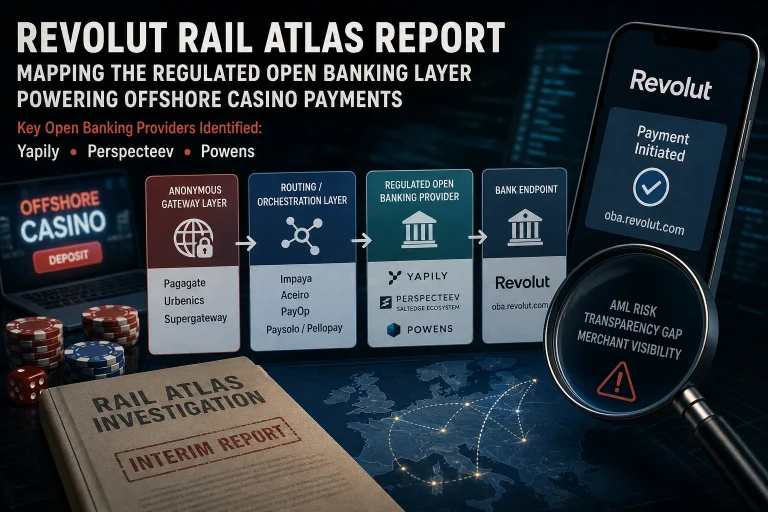

Scam-Or Project ’26: From One-Off Exposés to a Rail Atlas — Systematic Compliance Intelligence on Illegal Casino Payments


Scam-Or Project is redefining how illegal offshore casinos are investigated. What were once individual exposés are now treated as parts of a broader, engineered ecosystem—payment rails that repeatedly enable unlawful gambling activity across brands and jurisdictions.
The introduction of the Rail Atlas marks this transition. Instead of documenting isolated violations, Scam-Or Project now aggregates verified payment mechanisms—open banking gateways, fake-fiat onramps, payee substitution models, and interconnected gateway networks—into permanent analytical hubs. This framework allows enforcement bodies, financial institutions, and compliance teams to examine the infrastructure layer sustaining illegal casinos, rather than reacting to single operators.
Key Facts
- Scam-Or Project ’26 focuses on cyberfinance chokepoints, including payment flows, open banking interfaces, stablecoin settlement rails, and gateway stacks linked to illegal casino operations.
- Recurrent operational techniques are abstracted into Rail Hubs, published as evergreen analytical resources within the Rail Atlas.
- All investigations are coordinated through an internal Airtable Case Register, ensuring structured tracking of cases, entities, evidence, and rail classifications.
- Whistleblower disclosures submitted via Whistle42 are systematically recorded, assessed, and integrated into Airtable as strategic intelligence.
- FinCrime Observer increasingly covers broader financial crime topics, operating independently from Scam-Or Project while remaining connected through Whistle42.
- Whistle42 is being expanded into a cross-platform whistleblower system; the C42 reward token is scheduled for Q1 2026.
Short Analysis
Illegal offshore casinos rarely rely on a single payment provider anymore. Instead, they operate multi-layered payment architectures designed to diffuse responsibility and complicate enforcement. These structures often include open banking consent screens that appear regulated, “bank transfer” options that function as stablecoin purchases, and e-wallet flows where the named payee has no visible connection to the casino itself.
Such setups are not improvised. They represent deliberate payment system design.
Scam-Or Project’s response is to formalize these recurring structures as rails—repeatable, observable patterns that can be identified across multiple brands. The Rail Atlas transforms fragmented case reporting into systematic compliance intelligence.
Extended Analysis
Why the Rail Atlas Was Necessary
Conventional reporting typically concludes with the statement: “This casino is illegal.”
While correct, this conclusion fails to explain how these platforms continue to operate at scale.
Illegal casinos persist because their payment infrastructure evolves. When card acquiring becomes risky, open banking consent flows are introduced. When chargeback exposure increases, transactions are reframed as crypto purchases followed by wallet transfers. When one gateway is disrupted, another—often contractually or operationally adjacent—replaces it.
The Rail Atlas documents these adaptive strategies as evergreen analytical hubs. Each Rail Hub details:
- The operational mechanics of the rail, step by step
- The evidentiary indicators, including UI flows, redirects, descriptors, and on-chain settlement data
- Potential intervention points for banks, PSPs, gateways, onramps, and regulators
- Documented appearances across cases, maintained in a continuously updated Case Index
Investigative Approach: Tracing the Conversion Path
Scam-Or Project applies a standardized investigative workflow:
- Identify the casino or scheme and assess its licensing representations
- Traverse deposit and cashier processes while capturing interface and technical evidence
- Map redirects, domains, and functional roles, including gateways, facilitators, and agents
- Collect descriptors, settlement endpoints, wallet addresses, and token usage
- Classify observed behavior under one or more defined rails
- Publish a case report and link it to the relevant Rail Atlas hubs
This process converts isolated observations into operational intelligence usable by compliance teams and regulators.
Airtable: Structuring Investigations at Scale
Airtable functions as Scam-Or Project’s internal intelligence backbone. The case register records:
- Cases, entities, domains, and assigned operational roles
- Evidence artifacts such as screenshots, URLs, descriptors, wallets, and transaction hashes
- Rail classifications with confidence scoring
- Investigation status, unresolved questions, and next verification steps
This structure allows Scam-Or Project to rapidly expand analysis from a single casino to entire networks when payment rails align.
Whistle42: Systematizing Insider Intelligence
Critical information about payment structures is often inaccessible through public sources alone. Contracts, internal compliance decisions, and account hierarchies typically remain hidden. Whistle42 has therefore been structured as a systematic whistleblower platform.
Submissions received via Whistle42 are not simply reviewed. They are structured, logged in Airtable, linked to relevant entities and cases, assigned confidence levels, and converted into investigative tasks. This approach reduces uncertainty precisely where open-source data reaches its limits.
FinCrime Observer and Editorial Separation
Scam-Or Project will remain focused on cyberfinance compliance intelligence—payment rails, gateway behavior, and enforcement chokepoints. In parallel, FinCrime Observer will increasingly publish broader financial crime reporting.
Although editorially independent and operated separately, FinCrime Observer also relies on Whistle42 and remains part of the same analytical ecosystem. The separation reflects the different editorial and methodological requirements of compliance intelligence versus criminal case reporting.
C42 Token: Incentivizing High-Value Intelligence (Q1 2026)
Scam-Or Project plans to introduce the C42 token in Q1 2026 as a reward mechanism for whistleblowers. The purpose is practical rather than promotional.
Actionable, verifiable intelligence that exposes systemic payment enablement of illegal activity creates real-world impact and should be incentivized accordingly.
Actionable Insight
For payment service providers, open banking platforms, e-wallet operators, crypto onramps, and acquiring banks:
risk assessment should extend beyond individual merchants.
Payment architectures repeat. That repetition—the rail—is the primary investigative signal.
Call for Information
If you have insider knowledge of offshore casino payment arrangements—including merchant-of-record structures, gateway contracts, descriptor engineering, crypto purchase flows, stablecoin settlement mechanisms, wallet operations, or compliance overrides—submit securely via Whistle42.
All submissions are recorded systematically and can materially accelerate enforcement-grade reporting.