
Nasdaq’s Tokenization Pivot: Unlocking Cyberfinance’s Full Potential

Introduction
Good morning—while you sip that first coffee, capital markets are quietly crossing a point of no return. In September 2025, Nasdaq unveiled a proposal that is far more than a tech refresh: it is a blueprint for bringing tokenized securities into the mainstream of U.S. market plumbing.
The Nasdaq Inflection Point
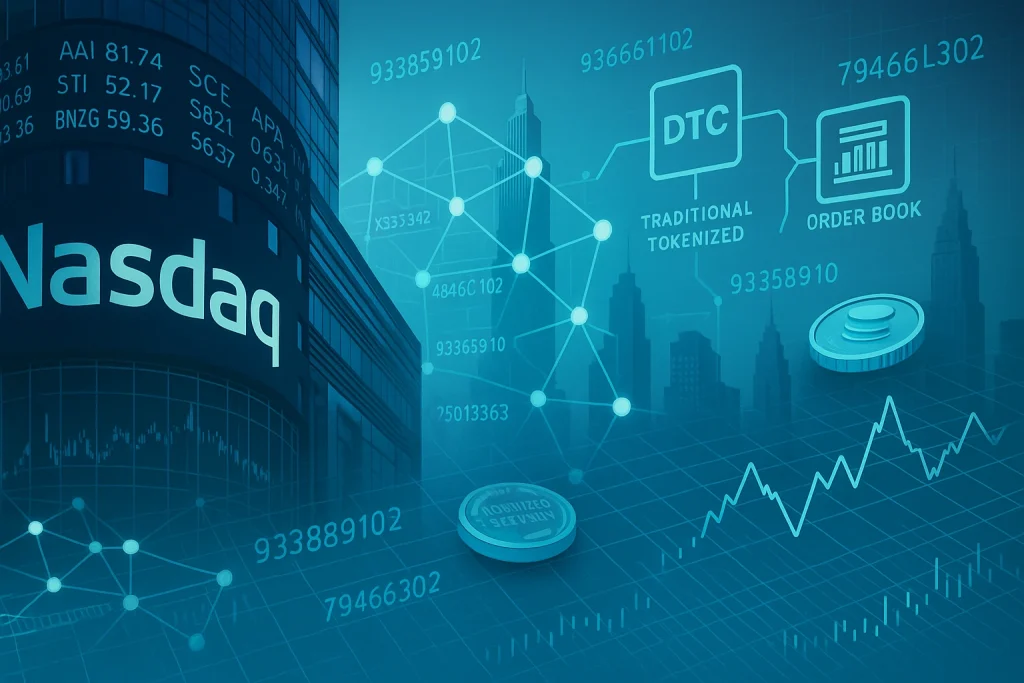
Date & Filing: On September 8, 2025, Nasdaq submitted SR-NASDAQ-2025-072 to the U.S. Securities and Exchange Commission. The plan would allow tokenized equity securities and ETPs to trade on the same order book as their conventional versions, with blockchain rails handling settlement—without sacrificing the protections of current securities law.
How the Model Works
-
Dual Settlement Choice: On each trade, participants can opt for traditional or tokenized settlement.
-
Full Fungibility: Tokenized instruments are identical to legacy shares—same CUSIP, same shareholder rights.
-
DTC Conversion & T+1 via Blockchain: The Depository Trust Corporation (DTC) would convert positions to token form, enabling T+1 settlement through distributed ledgers.
This is the first credible attempt by a major U.S. exchange to weave blockchain settlement into the national market system—validating Scam-Or Project’s long-standing view that tokenization is the direction of travel for modern finance.
Regulatory Headwinds: The Gensler Era
Gary Gensler’s Enforcement Stance
SEC Chair Gary Gensler has repeatedly asserted that “the vast majority” of crypto tokens are securities under the Howey Test, creating a chilling effect on security-token experimentation (source).
The Coinbase Test Case
In June 2023, the SEC sued Coinbase for operating as an unregistered securities exchange, flagging 13 tokens (~$37B) as securities. Although the case was dismissed in 2025 under the Trump administration, the episode underscored just how deterrent the environment had become.
Structural Obstacles to Security-Token Adoption
| Challenge Category | Description | Impact Level |
|---|---|---|
|
SEC Enforcement – Coinbase |
SEC suit over alleged unregistered exchange activity |
Critical |
|
Security Token Classification |
Broad application of Howey to crypto tokens |
Critical |
|
Exchange Listing Restrictions |
Major venues avoid listing due to regulatory risk |
High |
|
Regulatory Uncertainty |
Fragmented, shifting rules across jurisdictions |
High |
|
Compliance Costs |
Elevated costs for compliant issuances |
Medium |
|
Cross-Border Issues |
Divergent national approaches complicate offerings |
High |
|
KYC/AML Requirements |
Stringent verification and monitoring |
Medium |
|
Howey Test Application |
Investment-contract analysis governs token status |
Critical |
|
Gary Gensler Position |
“Vast majority” deemed securities |
Critical |
|
Delisting Risks |
~25% of tokens faced delisting in 2023–2024 reviews |
High |
|
Liquidity Constraints |
Thin secondary markets for security tokens |
High |
|
Infrastructure Requirements |
Specialized custody/settlement/trading needed |
Medium |
The Listing Desert
Regulatory ambiguity has pushed big exchanges to avoid security tokens, starving the category of liquidity and reinforcing a negative feedback loop.
Delisting wave (2023–2024): roughly one quarter of listed tokens were removed—often for regulatory exposure rather than project failure—leaving legitimate issuers stranded.
The Market Says “Go”: Tokenization’s Surge
Despite policy friction, growth data shows sustained demand for on-chain financial instruments.
| Market Segment | Market Value (USD) | CAGR / Growth | Timeframe |
|---|---|---|---|
|
Global Security Token Market (2024) |
$1.91B |
27.3% |
2024 |
|
Global Security Token Market (2033) |
$17.44B |
27.3% |
2024–2033 |
|
STO Market (2025) |
$6.66B |
19% |
2025 |
|
STO Market (2034) |
$31.87B |
19% |
2025–2034 |
|
Tokenized Securities (2023) |
$2.3B |
16.1% |
2023 |
|
Tokenized Securities (2032) |
$8.9B |
16.1% |
2023–2032 |
|
Real-World Assets (RWA) Tokenization (2025) |
$24B |
+380% (3y) |
Current |
|
RWA Projection (2034) |
$30T |
Projection |
2025–2034 |
|
Asset Tokenization (2024) |
$865.54B |
43.36% |
2024 |
|
Asset Tokenization (2029) |
$5,254.63B |
43.36% |
2024–2029 |
|
Tokenized Money-Market/Treasury Funds (2025) |
$7.4B |
80% YTD |
2025 |
|
Private Credit Share of RWA |
58% |
Leader |
2025 |
|
U.S. Treasuries Share of RWA |
34% |
Secondary |
2025 |
What the Numbers Signal
-
RWA tokenization hit $24B in 2025 (up 380% in three years).
-
Private credit commands 58% of RWA; U.S. Treasuries hold 34%.
-
Institutional proof points: BlackRock’s BUIDL (~$2.9B in tokenized Treasuries), Franklin Templeton’s BENJI (~$776M), and VanEck’s VBILL extending cross-chain access.
-
Forecasts range from $2–4T by 2030 (conservative) to $30T by 2034 (aggressive), with McKinsey, BCG, and Standard Chartered all describing multi-trillion-dollar trajectories.
Why Tokenization Changes the Game
| Benefit Category | Traditional Finance Challenge | Tokenization Outcome |
|---|---|---|
|
Fractional Ownership |
High minimums block retail access |
Assets split into affordable fractions |
|
Enhanced Liquidity |
Real estate & alts are illiquid |
Continuous secondary trading on-chain |
|
Lower Transaction Costs |
Layers of intermediaries add fees |
Smart contracts compress costs |
|
24/7 Trading |
Market-hours only |
Always-on markets |
|
Faster Settlement |
T+1/T+2 cycles tie up capital |
Near-instant settlement |
|
Global Access |
Geographic/regulatory frictions |
Border-agnostic market reach |
|
Programmable Compliance |
Manual, error-prone processes |
Rule-based, automated controls |
|
Transparency/Auditability |
Opaque ownership records |
Ledger-native traceability |
|
Fewer Intermediaries |
Multiple hand-offs |
Direct, peer-to-peer execution |
|
Automation |
Heavy back-office work |
Smart-contract operations |
|
Diversification |
High capital barriers |
New asset classes opened to more investors |
|
Democratized Access |
Institutional gate-keeping |
Lower barriers, broader participation |
Bottom line: fractionalization, immediate settlement, and programmable compliance remove long-standing frictions and unlock new liquidity pools.
Policy Turn: The Post-2025 Landscape
With the Trump administration back in Washington, the regulatory temperature shifted. The Coinbase dismissal and a fresh SEC rulemaking agenda point toward a more innovation-friendly stance.
-
Bipartisan signal: the Senate’s GENIUS Act sets out the first federal digital-asset framework that Wall Street has sought for years.
-
Institutional momentum: JPMorgan, Goldman Sachs, and BNY Mellon are actively tokenizing money-market funds and other instruments, indicating confidence in the direction of travel.
Why Nasdaq’s Design Can Succeed
-
Works Inside Existing Law: DTC custody/clearing and current securities rules are preserved—avoiding the traps that sank many early security-token pilots.
-
Shared Order Book: Tokenized and traditional lines trade together, minimizing liquidity fragmentation.
-
Infrastructure Reuse: Builds on Nasdaq and DTC systems—lower implementation complexity, higher regulator comfort.
-
Right-Time Entry: Arrives as policy warms and institutional buyers actively seek blockchain efficiency.
Rollout Timeline: From Liquids to Everything
Phase 1 (2026–2027): Liquid Names
Launch after DTC’s blockchain stack is production-ready—target large-cap equities and ETFs to establish depth and confidence.
Phase 2 (2027–2029): Multi-Asset Expansion
Extend to fixed income, commodities, and alternatives. Industry estimates (e.g., Calastone) see tokenized markets reaching roughly $235B by 2029.
Phase 3 (2030+): Market Architecture Redesign
By 2030, expect 24/7 trading, programmable compliance, and frictionless cross-border flows to become standard features.
The Direction of Travel Is Set
According to Scam-Or Project’s analysis, tokenization is not a passing crypto fad—it is an infrastructural evolution.
-
Network Effects: As more assets tokenize, investors will prefer tokenized lines for instant settlement and all-hours access.
-
Competitive Pressure: Venues that delay tokenization risk flow migration to blockchain-native platforms.
-
Regulatory Evolution: Supervisors increasingly recognize that automation and transparency can enhance market integrity and reduce systemic risk.
Strategic Implications
Likely Winners
-
Infrastructure Providers: Blockchain settlement, custody, identity, and compliance stacks.
-
Early Adopters: Banks, brokers, and exchanges that move first on token rails.
-
Technology Enablers: Smart-contract platforms, interoperability layers, and reg-tech.
Exposed Incumbents
-
Legacy Exchanges: Those resisting token rails risk disintermediation.
-
Traditional Custodians: Providers that cannot service digital assets will lose share.
-
Aging Clearing Systems: Firms tied to T+1/T+2 legacy workflows face obsolescence.
Scam-Or Project’s Tokenization Thesis: Key Predictions
-
2026: Nasdaq launches tokenized trading with blockchain settlement—first among major U.S. exchanges.
-
2027: Peer exchanges roll out competing tokenization programs.
-
2028: $100B+ in tokenized TVL signals mainstream adoption.
-
2030: Tokenization becomes the preferred issuance format for liquid assets.
-
2035: Legacy settlement is niche; tokenized markets dominate global finance.
Conclusion: The Cyberfinance Tide Is Rising
Nasdaq’s proposal marks a historic acknowledgment by traditional markets: blockchain is an upgrade, not a threat. As regulatory clarity improves and institutions scale deployments, tokenization will reshape how assets are issued, traded, and owned. The smart move now—for exchanges, issuers, and investors—is to align strategy, infrastructure, and compliance with an on-chain future.
Share Information
Scam-Or Project continues to monitor and analyze the global shift toward blockchain-enabled capital markets, delivering decision-grade insights for investors, institutions, and regulators navigating this transition.
Position: The future of finance is tokenized—and Nasdaq’s filing shows that future has already begun.