
PayDo Adds Principal Acquiring for Digital Wallets, Crypto Features, and C2B Settlement Accounts

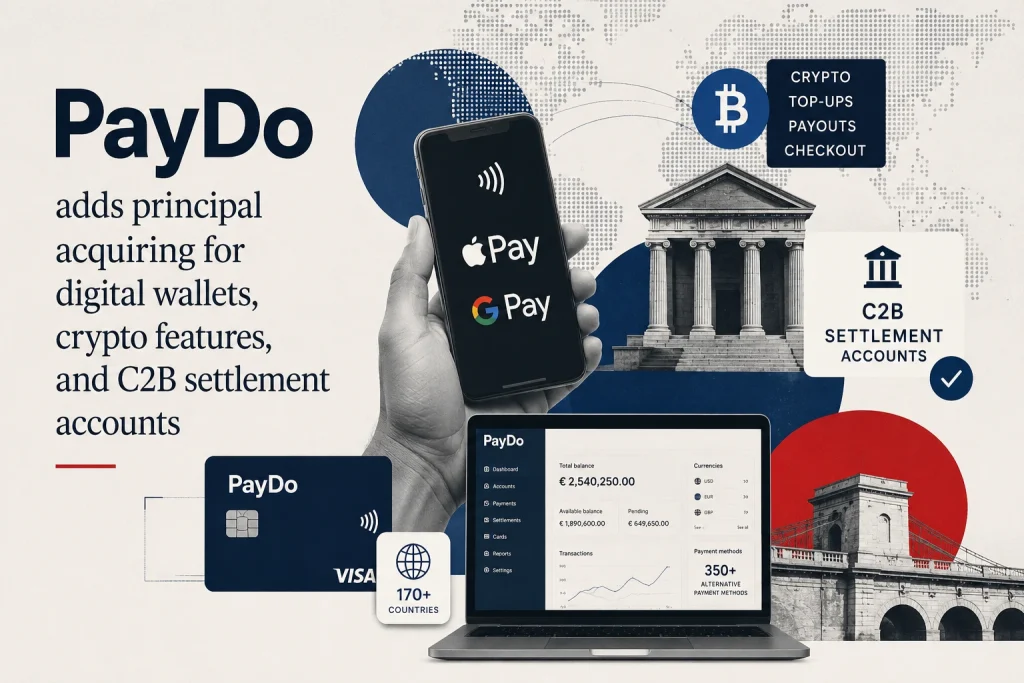
PayDo has finished Q1 with a series of updates that push the Electronic Money Institution closer towards its goal of becoming a truly all-in-one fintech solution for B2B and B2C businesses.
Principal Acquiring for Apple Pay and Google Pay
PayDo is now a principal acquirer for Apple Pay and Google Pay, processing the world’s most popular digital wallets directly. The merchants no longer need to rely on external acquirers – PayDo takes on the acquirer’s responsibilities eliminating another third-party in their clients’ payment stack. When the same provider manages both the merchant account and acquiring, the benefits include:
- Faster transaction processing due to fewer steps between authorization and settlement
- Improved checkout conversion rates as transactions experience less delays
- Unified data management with all the data stored inside of the same dashboard
PayDo now handles the full payment cycle, from authorization to settlement, in its own system.
This development follows the company’s earlier move into direct acquiring for Visa and Mastercard. With digital wallets now included, businesses can work with several widely used payment methods through one platform.
Crypto Functionality Without Leaving Fiat Rails
Through a partnership with BVNK, PayDo has added new features that allow clients to perform operations in crypto while storing their funds in fiat. The trick lies in conversions as money leaves or enters the platform.
- Crypto top-ups allow users to boost their PayDo balance from crypto wallets – the funds settle as fiat.
- Crypto payouts allow PayDo accounts to send cryptocurrency equivalents of fiat.
- Crypto checkout: buyers can pay with crypto at checkout while the merchants receive settlements in fiat.
This arrangement strikes a balance between enjoying certain crypto perks – broader accessibility in certain regions, speed, user preference – without having to go through all of the compliance procedures for holding digital assets.
C2B Settlement Accounts for Pay-by-Bank Transactions
PayDo has also expanded its open banking offering with the introduction of C2B Settlement Accounts. These accounts support customer-to-business payments made through bank transfers.
They operate alongside the existing C2B Collections Accounts, each serving a distinct role.
- Collections Accounts receive incoming payments, identify senders, and match transactions to invoices or orders
- Settlement Accounts hold verified funds that are ready for use, enabling withdrawals, transfers, or operational spending
The platform’s collections infrastructure already handles a high volume of transactions. The addition of settlement accounts helps organize those funds once they have been received and verified.
Advancing the All-in-One Fintech Model
These updates follow a consistent direction in PayDo’s development. The company continues to add new functions to its single interface. Businesses can manage accounts, accept payments, and move funds without relying on separate systems.
Serhii Zakharov, the founder and CEO of PayDo, has often spoken about the difficulties that arise when financial tools are spread across different providers. Disconnected systems can lead to extra work and reduced clarity in reporting. A single platform, by contrast, allows financial activity to be viewed and managed in one place.
At present, PayDo supports:
- Operations in 170+ countries
- Transactions in 50+ currencies
- Merchant accounts with direct acquiring
- Card issuing, both virtual and physical
- 350+ alternative payment methods
The addition of crypto functionality, C2B settlement accounts, and expanded acquiring does not change the structure of the platform. It extends it. Each feature fits into the same system and follows the same general approach.
As the range of payment methods continues to grow, businesses are often faced with a choice between adding more providers or settling for a single framework that keeps certain needs unmet. PayDo’s model suggests that you do not have to choose, as long as the system you are using is sufficiently diverse and continuously evolving.